
VII.19
If four numbers be proportional, the number produced from the first and fourth will be equal to the number produced from the second and third; and, if the number produced from the first and fourth be equal to that produced from the second and third, the four numbers will be proportional.
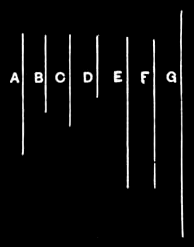
Let A, B, C, D be four numbers in proportion, so that,
as A is to B, so is C to D;
and let A by multiplying D make E, and let B by multiplying C make F; I say that E is equal to F.
For let A by multiplying C make G.
Since, then, A by multiplying C has made G, and by multiplying D has made E, the number A by multiplying the two numbers C, D has made G, E.
Therefore, as C is to D, so is G to E. [VII.17]
But, as C is to D, so is A to B; therefore also, as A is to B, so is G to E.
Again, since A by multiplying C has made G, but, further, B has also by multiplying C made F, the two numbers A, B by multiplying a certain number C have made G, F.
Therefore, as A is to B, so is G to F. [VII.18]
But further, as A is to B, so is G to E also; therefore also, as G is to E, so is G to F.
Therefore G has to each of the numbers E, F the same ratio;
therefore E is equal to F. [cf. V.9]
Again, let E be equal to F; I say that, as A is to B, so is C to D.
For, with the same construction, since E is equal to F, therefore, as G is to E, so is G to F. [cf. V.7]
But, as G is to E, so is C to D, [VII.17]
and, as G is to F, so is A to B. [VII.18]
Therefore also, as A is to B, so is C to D. Q. E. D.