X50
X74 -CEVA CONJUGATE OF X184
5, 6, 7
3, 4, 5
Kepler
Kimberling
< A B C >: Reference Triangle △ABC
[ A B ]: Sideline AB (Base c = 1) [ B C ]: Sideline BC (Side a) [ C A ]: Sideline CA (Side b) { 3, 6 }: Brocard Axis { 67, 248 }: Central Line L(67, 248) { 115, 231 }: Central Line L(115, 231) { 112, 477 }: Central Line L(112, 477) { 338, 401 }: Central Line L(338, 401) { 230, 858 }: Central Line L(230, 858)
A = Vertex A (0.0000, 0.0000) B = Vertex B (1.0000, 0.0000) C = Vertex C (0.6122, 0.5999) X_74 = ISOGONAL CONJUGATE OF EULER INFINITY POINT (0.7484, -0.3437) X_184 = INVERSE OF X(125) IN THE BROCARD CIRCLE (0.5788, 0.1496) X_3 = CIRCUMCENTER (0.5000, 0.1021) X_6 = SYMMEDIAN POINT (LEMOINE POINT, GREBE POINT) (0.6000, 0.2672) X_67 = ISOGONAL CONJUGATE OF X(23) (0.7606, -0.2152) X_248 = -LINE CONJUGATE OF X(132) (0.8229, -0.0790) X_115 = CENTER OF KIEPERT HYPERBOLA (0.7507, 0.0838) X_231 = -CEVA CONJUGATE OF X(128) (1.0375, 0.6458) X_112 = Ψ(ORTHOCENTER, SYMMEDIAN POINT) (0.5162, 0.6121) X_477 = TIXIER ANTIPODE (0.0176, -0.0644) X_338 = CEVAPOINT OF X(115) AND X(125) (0.6941, 0.0587) X_401 = BAILEY POINT (-0.0758, -1.4044) X_230 = -CEVA CONJUGATE OF X(114) (0.9746, 0.6698) X_858 = COMPLEMENT OF X(23) (0.1126, -0.9116) X_50 = -CEVA CONJUGATE OF X(184) (2.1559, 2.8368)
A
B
C
X74
X184
X3
X6
X67
X248
X115
X231
X112
X477
X338
X401
X230
X858
X50
(a, b, c) = (5, 6, 7) | AB = 1
< A B C >: Reference Triangle △ABC
[ A B ]: Sideline AB (Base c = 1) [ B C ]: Sideline BC (Side a) [ C A ]: Sideline CA (Side b) { 3, 6 }: Brocard Axis { 67, 248 }: Central Line L(67, 248) { 115, 231 }: Central Line L(115, 231) { 112, 477 }: Central Line L(112, 477) { 338, 401 }: Central Line L(338, 401) { 230, 858 }: Central Line L(230, 858)
A = Vertex A (0.0000, 0.0000) B = Vertex B (1.0000, 0.0000) C = Vertex C (0.6400, 0.4800) X_74 = ISOGONAL CONJUGATE OF EULER INFINITY POINT (0.6400, -0.4800) X_184 = INVERSE OF X(125) IN THE BROCARD CIRCLE (0.6400, 0.0000) X_3 = CIRCUMCENTER (0.5000, 0.0000) X_6 = SYMMEDIAN POINT (LEMOINE POINT, GREBE POINT) (0.6400, 0.2400) X_67 = ISOGONAL CONJUGATE OF X(23) (0.6400, -0.2400) X_248 = -LINE CONJUGATE OF X(132) (0.7596, 0.0000) X_115 = CENTER OF KIEPERT HYPERBOLA (0.7445, 0.0609) X_231 = -CEVA CONJUGATE OF X(128) (0.9181, 0.3989) X_112 = Ψ(ORTHOCENTER, SYMMEDIAN POINT) (0.6400, 0.4800) X_477 = TIXIER ANTIPODE (0.1239, -0.3295) X_338 = CEVAPOINT OF X(115) AND X(125) (0.6400, 0.0349) X_401 = BAILEY POINT (0.3600, -0.4800) X_230 = -CEVA CONJUGATE OF X(114) (0.8489, 0.4191) X_858 = COMPLEMENT OF X(23) (0.3600, -0.4800) X_50 = -CEVA CONJUGATE OF X(184) (2.2857, 3.0612)
A
B
C
X74
X184
X3
X6
X67
X248
X115
X231
X112
X477
X338
X401
X230
X858
X50
(a, b, c) = (3, 4, 5) | AB = 1
< A B C >: Reference Triangle △ABC
[ A B ]: Sideline AB (Base c = 1) [ B C ]: Sideline BC (Side a) [ C A ]: Sideline CA (Side b) { 3, 6 }: Brocard Axis { 67, 248 }: Central Line L(67, 248) { 115, 231 }: Central Line L(115, 231) { 112, 477 }: Central Line L(112, 477) { 338, 401 }: Central Line L(338, 401) { 230, 858 }: Central Line L(230, 858)
A = Vertex A (0.0000, 0.0000) B = Vertex B (1.0000, 0.0000) C = Vertex C (0.6180, 0.4859) X_74 = ISOGONAL CONJUGATE OF EULER INFINITY POINT (0.6180, -0.4859) X_184 = INVERSE OF X(125) IN THE BROCARD CIRCLE (0.6180, 0.0000) X_3 = CIRCUMCENTER (0.5000, 0.0000) X_6 = SYMMEDIAN POINT (LEMOINE POINT, GREBE POINT) (0.6180, 0.2429) X_67 = ISOGONAL CONJUGATE OF X(23) (0.6180, -0.2429) X_248 = -LINE CONJUGATE OF X(132) (0.7236, 0.0000) X_115 = CENTER OF KIEPERT HYPERBOLA (0.7135, 0.0464) X_231 = -CEVA CONJUGATE OF X(128) (0.8795, 0.4223) X_112 = Ψ(ORTHOCENTER, SYMMEDIAN POINT) (0.6180, 0.4859) X_477 = TIXIER ANTIPODE (0.1722, -0.3776) X_338 = CEVAPOINT OF X(115) AND X(125) (0.6180, 0.0256) X_401 = BAILEY POINT (0.3820, -0.4859) X_230 = -CEVA CONJUGATE OF X(114) (0.8090, 0.4395) X_858 = COMPLEMENT OF X(23) (0.3820, -0.4859) X_50 = -CEVA CONJUGATE OF X(184) (2.6180, 4.3593)
A
B
C
X74
X184
X3
X6
X67
X248
X115
X231
X112
X477
X338
X401
X230
X858
X50
Kepler (1, √φ, φ) | AB = 1
< A B C >: Reference Triangle △ABC
[ A B ]: Sideline AB (Base c = 1) [ B C ]: Sideline BC (Side a) [ C A ]: Sideline CA (Side b) { 3, 6 }: Brocard Axis { 67, 248 }: Central Line L(67, 248) { 115, 231 }: Central Line L(115, 231) { 112, 477 }: Central Line L(112, 477) { 338, 401 }: Central Line L(338, 401) { 230, 858 }: Central Line L(230, 858)
A = Vertex A (0.0000, 0.0000) B = Vertex B (1.0000, 0.0000) C = Vertex C (0.6331, 0.2801) X_74 = ISOGONAL CONJUGATE OF EULER INFINITY POINT (0.5025, -0.8451) X_184 = INVERSE OF X(125) IN THE BROCARD CIRCLE (0.3215, 1.0549) X_3 = CIRCUMCENTER (0.5000, -0.2747) X_6 = SYMMEDIAN POINT (LEMOINE POINT, GREBE POINT) (0.6573, 0.1655) X_67 = ISOGONAL CONJUGATE OF X(23) (0.4783, -0.1812) X_248 = -LINE CONJUGATE OF X(132) (0.6841, 0.1154) X_115 = CENTER OF KIEPERT HYPERBOLA (0.6909, 0.0207) X_231 = -CEVA CONJUGATE OF X(128) (1.0516, 0.1599) X_112 = Ψ(ORTHOCENTER, SYMMEDIAN POINT) (0.6732, 0.2689) X_477 = TIXIER ANTIPODE (0.3619, -0.8282) X_338 = CEVAPOINT OF X(115) AND X(125) (0.5073, 0.0075) X_401 = BAILEY POINT (0.5331, -0.0001) X_230 = -CEVA CONJUGATE OF X(114) (0.7126, 0.2008) X_858 = COMPLEMENT OF X(23) (0.5140, -0.1585) X_50 = -CEVA CONJUGATE OF X(184) (0.5919, -0.0176)
A
B
C
X74
X184
X3
X6
X67
X248
X115
X231
X112
X477
X338
X401
X230
X858
X50
Kimberling (6, 9, 13) | AB = 1
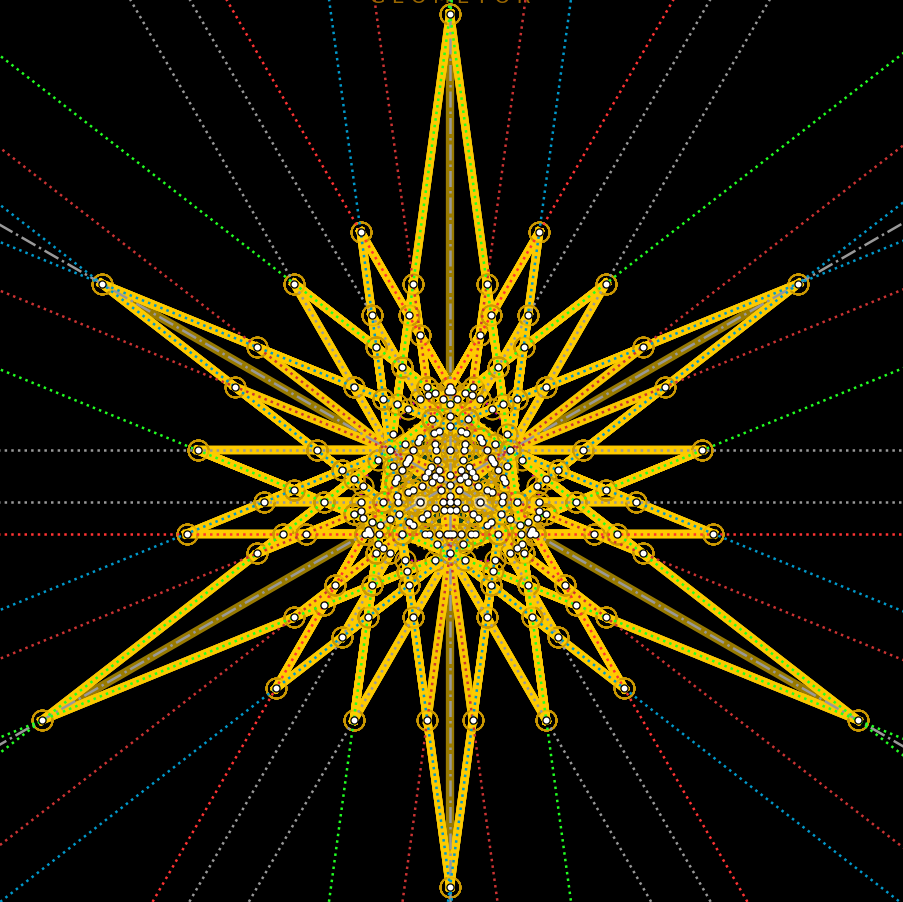
X50 (X74 -CEVA CONJUGATE OF X184 ) constructed on acute reference triangle \((a, b, c) = (5, 6, 7)\) with unit baseline AB = \(1\) .
Trilinears: \(\sin 3A : :\)
Barycentrics: \(\sin A \sin 3A : \sin B \sin 3B : \sin C \sin 3C\)
Tripolars: \((pending)\)
Search Value (6, 9, 13): \(3.400616763711\)
▸ Alternate Coordinates5 forms
Trilinears: \(\cos A \sin 2A + \sin A \cos 2A : :\)
Trilinears: \(\sin A + \cos A \cot D/2 : :\) , where cot \(D/2 = (4 \operatorname{area})/(6R^{2} - a^{2} - b^{2} - c^{2})\) , where R = abc/(4*area) (Peter Moses , 12/19/2011; cf. X568
Trilinears: \(a(1 - 4 \cos^{2} A) : b(1 - 4 \cos^{2} B) : c(1 - 4 \cos^{2} C)\)
Trilinears: \(a(1 + 2 \cos 2A) : b(1 + 2 \cos 2B) : c(1 + 2 \cos 2C)\)
Barycentrics: \(a^{4} ((a^{2} - b^{2} - c^{2})^{2} - b^{2} c^{2}) : :\)
▸ Linear Combinations1 combination
▸ Incident Central Lines7 lines
{3 6 67 248 112 477 115 231 230 858 338 401 647 654
▸ Functional Relations18 relations
X50 isogonal conjugate of X94
X50 isotomic conjugate of X20573
X50 anticomplement of X34827
X50 complement of isogonal conjugate of X34448
X50 32761
X50 X566
X50 i -Ceva conjugate of Xj for these (i,j): (1 215 74 184 94 49
X50 crosspoint of Xi and Xj for these (i,j): (93 94 186 323
X50 X49 X50
X50 crossdifference of every pair of points on line X5 X523
X50 X15 X16
X50 i -isoconjugate of Xj for these (i,j): (92 265 1577 476
X50 X568
X50 X110
X50 X2 11597
X50 ABC and unary cofactor triangle of Ehrmann vertex-triangle
X50 X35 X36
X50
Notes
Let DEF be any equilateral triangle inscribed in the circumcircle of ABC . Let D' be the barycentric product E*F , and define E' , F' cyclically. Then D' ,E' ,F' all line on a line passing through X50 DEF is the circumtangential triangle, the points D' ,E' ,F' lie on the Brocard axis, and in case DEF is the circumnormal triangle, the points D' ,E'F' lie on the line X50 X647 6149 . (Randy Hutson , January 29, 2015)
Let A'B'C' and A″B″C″ be the (equilateral) circumcevian triangles of X15 X16 A* be the barycentric product A' *A″ , and define B* and C* cyclically. The lines AA* , BB* , CC* concur in X50 6149 . (Randy Hutson, January 29, 2015)
Let AA1 A2 , BB1 B2 , CC1 C2 be the circumcircle-inscribed equilateral triangles used in the construction of the Trinh triangle. Let A' be the barycentric product A1 *A2 , and define B' and C' cyclically. The lines AA' , BB' , CC' concur in X50 6149 . (Randy Hutson, October 13, 2015)
Let A1 B1 C1 and A2 B2 C2 be the 1st and 2nd Ehrmann circumscribing triangles. Let A' be the crossdifference of A1 and A2 , and define B' and C' cyclically. The lines AA' , BB' , CC' concur in X50