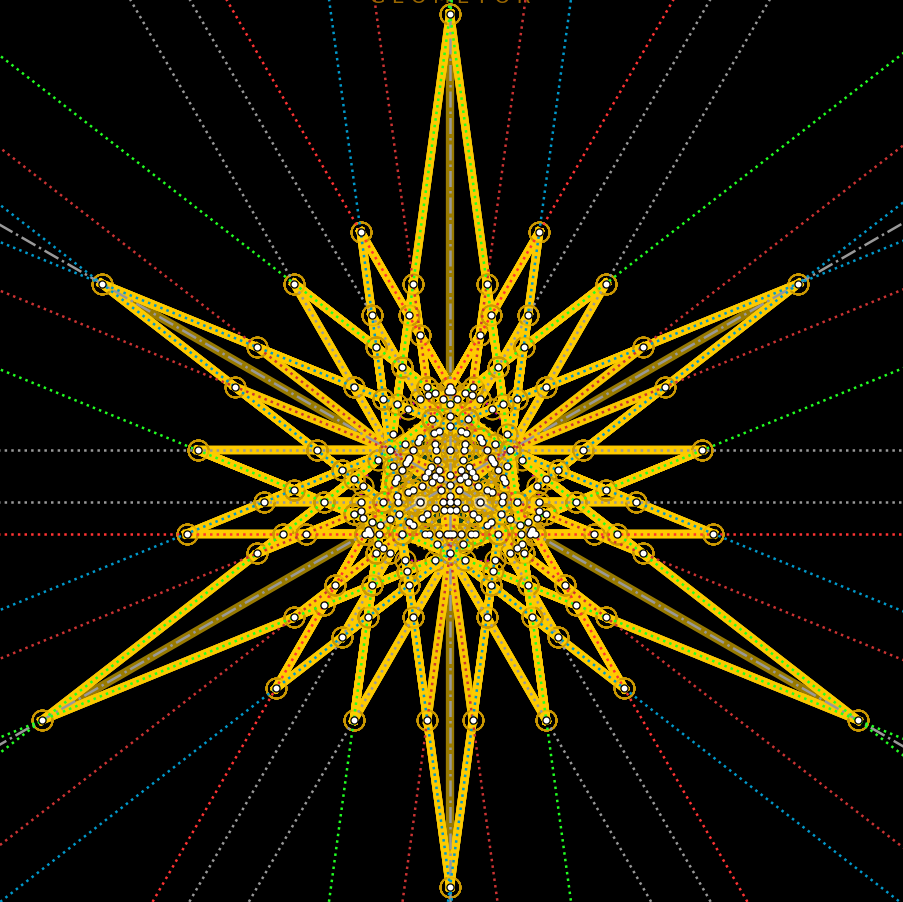
X402
ZEEMAN-GOSSARD PERSPECTOR
X402 (ZEEMAN-GOSSARD PERSPECTOR) constructed on acute reference triangle \((a, b, c) = (5, 6, 7)\) with unit baseline AB = \(1\).
Constructed Elements
Central Lines: {2, 3} (Euler line)
Related Centers: X2 (CENTROID), X3 (CIRCUMCENTER), X4 (ORTHOCENTER)
Linear Combinations1 combination
X402 = X1 - \(3\) X11831, X1 + \(3\) X11852, \(5\) X2 + X3081, \(3\) X2 + X4240, \(5\) X2 - X11050, \(3\) X2 - \(5\) X15183, \(2\) X2 + X34582, X3 + \(3\) X11911, X3 - \(3\) X26451, \(3\) X3 - X35241, X4 + \(3\) X11845, X4 - \(3\) X11897, \(2\) X5 + X15774, X8 - \(3\) X16210, X8 + \(3\) X16212, X20 - \(3\) X16190, X145 - \(3\) X16211, \(3\) X381 - X18507, \(3\) X381 + X18508, X1650 + \(3\) X1651, \(5\) X1650 + \(3\) X3081, \(2\) X1650 - \(3\) X11049, \(5\) X1650 - \(3\) X11050, X1650 - \(5\) X15183, \(2\) X1650 + \(3\) X34582, \(5\) X1651 - X3081, \(3\) X1651 - X4240, \(2\) X1651 + X11049, \(5\) X1651 + X11050, \(3\) X1651 + \(5\) X15183, \(3\) X1651 + \(2\) X15184, \(3\) X3081 - \(5\) X4240, \(2\) X3081 + \(5\) X11049, \(3\) X3081 + \(25\) X15183, \(3\) X3081 + \(10\) X15184, \(2\) X3081 - \(5\) X34582, \(2\) X4240 + \(3\) X11049, \(5\) X4240 + \(3\) X11050, X4240 + \(5\) X15183, X4240 + \(2\) X15184, \(2\) X4240 - \(3\) X34582, \(3\) X5055 + X20128, \(5\) X11049 - \(2\) X11050, \(3\) X11049 - \(10\) X15183, \(3\) X11049 - \(4\) X15184, \(3\) X11050 - \(25\) X15183, \(3\) X11050 - \(10\) X15184, \(2\) X11050 + \(5\) X34582, X11251 - \(3\) X11911, X11251 + \(3\) X26451, \(3\) X11251 + X35241, \(3\) X11831 + X12438, \(3\) X11845 - X12113, \(3\) X11852 - X12438, \(3\) X11897 + X12113, \(9\) X11911 + X35241, X12626 + \(3\) X16210, X12626 - \(3\) X16212, \(5\) X15183 - \(2\) X15184, \(10\) X15183 + \(3\) X34582, \(4\) X15184 + \(3\) X34582, \(9\) X26451 - X35241 (Peter Moses, November 26,2020)
Incident Central Lines62 lines
{1, 11831}, {2, 3}, {6, 11901}, {8, 12626}, {10, 11900}, {11, 11903}, {12, 11904}, {13, 12793}, {14, 12792}, {17, 22897}, {18, 22852}, {32, 11839}, {40, 12696}, {54, 12797}, {55, 11848}, {56, 18958}, {64, 12791}, {67, 32279}, {68, 12418}, {74, 12369}, {76, 12794}, {79, 16129}, {80, 12729}, {83, 12795}, {84, 12668}, {98, 12181}, {99, 13179}, {100, 13268}, {104, 12752}, {110, 13212}, {112, 13281}, {113, 38605}, {145, 16211}, {190, 24830}, {262, 22698}, {265, 12790}, {371, 35791}, {372, 35790}, {485, 12800}, {486, 12799}, {493, 11907}, {494, 11908}, {671, 12347}, {1297, 12796}, {1327, 13689}, {1328, 13809}, {3068, 13894}, {3069, 13948}, {5597, 11863}, {5598, 11864}, {5877, 26958}, {5972, 6130}, {6145, 32372}, {6776, 39886}, {7160, 12789}, {7740, 18279}, {10266, 12798}, {11657, 16186}, {13494, 13495}, {22466, 22943}, {25641, 38625}, {34297, 38794}
Functional Relations13 relations
X402 = midpoint of Xi and Xj for these {i,j}: {1, 12438}, {2, 1651}, {3, 11251}, {4, 12113}, {5, 32162}, {6, 12583}, {8, 12626}, {13, 12793}, {14, 12792}, {17, 22897}, {18, 22852}, {40, 12696}, {54, 12797}, {64, 12791}, {67, 32279}, {68, 12418}, {74, 12369}, {76, 12794}, {79, 16129}, {80, 12729}, {83, 12795}, {84, 12668}, {98, 12181}, {99, 13179}, {100, 13268}, {104, 12752}, {110, 13212}, {112, 13281}, {190, 24830}, {262, 22698}, {265, 12790}, {402, 402}, {485, 12800}, {486, 12799}, {671, 12347}, {1297, 12796}, {1327, 13689}, {1328, 13809}, {1650, 4240}, {3081, 11050}, {6145, 32372}, {6776, 39886}, {7160, 12789}, {7740, 18279}, {10266, 12798}, {11049, 34582}, {11831, 11852}, {11832, 11853}, {11839, 11885}, {11845, 11897}, {11848, 11909}, {11863, 26383}, {11864, 26407}, {11901, 19017}, {11902, 19018}, {11903, 11906}, {11904, 11905}, {11907, 26447}, {11908, 26448}, {11911, 26451}, {11912, 26452}, {11913, 26453}, {11914, 11915}, {13494, 13495}, {13894, 26449}, {13948, 26450}, {16210, 16212}, {18507, 18508}, {18958, 22755}, {22466, 22943}
X402 = reflection of Xi in Xj for these {i,j}: {11049, 2}, {34582, 1651}, {1650, 15184}, {15774, 32162}
X402 = complement of X1650
X402 = anticomplement of X15184
X402 = isotomic conjugate of the anticomplement of X32750
X402 = Xi-complementary conjugate of Xj for these (i,j): {162, 16177}, {1304, 34846}, {15459, 21253}, {24000, 113}, {32640, 16595}, {32676, 39008}, {32695, 8287}, {32715, 16573}, {36034, 122}, {36117, 37985}, {36131, 15526}
X402 = Xi-Ceva conjugate of Xj for these (i,j): {5972, 31945}, {9033, 30}, {13494, 523}
X402 = X32750-cross conjugate of X2
X402 = Xi-isoconjugate of Xj for these (i,j): {74, 9390}, {1304, 9392}, {2159, 15351}
X402 = Xi-reciprocal conjugate of Xj for these (i,j): {30, 15351}, {1494, 39352}, {2173, 9390}, {2349, 2629}, {2631, 9392}, {15184, 32750}, {16077, 39062}, {34767, 38240}
X402 = barycentric product Xi*Xj for these {i,j}: {30, 39352}, {2629, 14206}, {4240, 38240}, {9033, 39062}
X402 = barycentric quotient Xi/Xj for these {i,j}: {30, 15351}, {2173, 9390}, {2629, 2349}, {2631, 9392}, {32750, 15184}, {38240, 34767}, {39062, 16077}, {39352, 1494}
X402 = {Xi,Xj}-harmonic conjugate of Xk for these (i,j,k): {1, 11852, 12438}, {1, 26452, 11915}, {1, 26453, 11914}, {2, 1650, 15184}, {2, 4240, 1650}, {3, 11911, 11251}, {4, 11845, 12113}, {8, 16212, 12626}, {381, 18508, 18507}, {1650, 1651, 4240}, {1650, 15183, 2}, {1650, 15184, 11049}, {1651, 15183, 1650}, {4240, 15183, 15184}, {11251, 26451, 3}, {11831, 12438, 1}, {11897, 12113, 4}, {11901, 11902, 12583}, {11912, 11913, 1}, {11912, 12438, 11914}, {11913, 12438, 11915}, {12626, 16210, 8}, {19017, 19018, 6}, {26452, 26453, 12438}
Notes
As a point on the Euler line, X402 has Shinagawa coefficients \((5EF - 13F^{2} - S^{2}, 3EF + 3F^{2} - S^{2})\).
Actually, X402 dates back to an article by Christopher Zeeman in Wiskundige Opgaven 8 (1899-1902) 305. For details, see Paul Yiu’s Hyacinthos message #7536 and others with Gossard in the subject line. (In ETC, the change of name from Gossard Perspector to Zeeman-Gossard Perspector was made on Oct. 15, 2003.) Further details are given by Wilson Stothers in Hyacinthos #8383, Oct. 21, 2003.
(From Angel Montesdeoca, November 25, 2020) Let P be a variable point on the Euler line and Q its isotomic conjugate. Let TP and TQ be the cevian triangles of P and Q, respectively. Let F be the finite fixed point of the affine transformation that carries TP onto TQ. The envelope of the line PF is a hyperbola (H) with center X402, an asymptote of the Euler line. A barycentric equation for (H) follows:
cyclic sum [(-b^4+c^4+a^2 (b^2-c^2))^4 (-2 a^4+(b^2-c^2)^2+a^2 (b^2+c^2))^2x^2-2 (a^2-b^2)^2 (a^2-c^2)^2 (a^4-(b^2-c^2)^2)^2 (a^8-a^6 (b^2+c^2)+5 a^2 (b^2-c^2)^2 (b^2+c^2)+a^4 (-3 b^4+7 b^2 c^2-3 c^4)-(b^2-c^2)^2 (2 b^4+5 b^2 c^2+2 c^4))y z ] = 0.