X14
2nd ISOGONIC CENTER
X14 (2nd ISOGONIC CENTER) constructed on acute reference triangle \((a, b, c) = (5, 6, 7)\) with unit baseline AB = \(1\).
Constructed Elements
Equilateral Side Triangles: △BCA', △CAB', △ABC' erected on sidelines with apexes A', B', C'
Concurrence Lines: A–A', B–B', C–C' concurring at X14
Alternate Coordinates2 forms
Trilinears: \(\sec(A + \pi /6) : \sec(B + \pi /6) : \sec(C + \pi /6)\)
Barycentrics: \((S_{A} - \sqrt{3} S) (S_{B} + S_{C}) + 4 S_{B} S_{C} : :\)
X14 lies on the Neuberg cubic.
Related Collection 1 Topic Guides
T_13: The Isogonic & Napoleon Central Lines • T_18: The Apollonian Circles • T_24: Equilateral, Isogonic & Napoleon Triangles
Incident Central Lines21 lines
Functional Relations32 relations
X14 = \(3^{1/2}(r^{2} + 2rR + s^{2})\)*X1 - 6\(r(3^{1/2}\)R + 2s)*X2 - 2\(r(3^{1/2}\)r - 3s)*X3 (Peter Moses, April 2, 2013)
X14 = reflection of Xi in Xj for these (i,j): (13, 115), (16, 395), (99, 618), (299, 624), (617, 619)
X14 = isogonal conjugate of X16
X14 = isotomic conjugate of X299
X14 = complement of X617
X14 = anticomplement of X619
X14 = circumcircle-inverse of X6105
X14 = Xi-cross conjugate of Xj for these (i,j): (16, 17), (30, 13), (395, 2)
X14 = trilinear pole of line X396X523 (polar of X471 wrt polar circle)
X14 = pole wrt polar circle of trilinear polar of X471
X14 = X48-isoconjugate (polar conjugate) of X471
X14 = antigonal image of X13
X14 = homothetic center of inner Napoleon triangle and antipedal triangle of X14
X14 = outer-Napoleon-to-inner-Napoleon similarity image of X16
X14 = inner-Napoleon-to-outer-Napoleon similarity image of X13
X14 = homothetic center of (equilateral) antipedal triangle of X14 and triangle formed by circumcenters of BCX14, CAX14, ABX14
X14 = homothetic center of triangle formed by circumcenters of BCX13, CAX13, ABX13 and triangle formed by nine-point centers of BCX14, CAX14, ABX14
X14 = Thomson-isogonal conjugate of X34318
Notes
Let NaNbNc, Na'Nb'Nc' be the outer and inner Napoleon triangles, resp. Let A' be the isogonal conjugate of Na, wrt Na'Nb'Nc', and define B' and C' cyclically. The lines Na'A', Nb'B', Nc'C' concur in X14. (Randy Hutson, January 29, 2015)
Let NapaNapbNapc be the outer Napoleon triangle and Nap'aNap'bNap'c the inner Napoleon triangle. Let A* be the isogonal conjugate, wrt Nap'aNap'bNap'c, of Napa, and define B* and C* cyclically. The lines Nap'aA*, Nap'bB*, Nap'cC* concur in X14. (Randy Hutson, December 2, 2017)
The line X14X16 is parallel to the Euler line, and the distance between the two lines is \((S_{B} - S_{C})(S_{C} - S_{A})(S_{A} - S_{B})/|(\cot(\omega ) - 3^{1/2})|((E - 8F)S^{2})^{1/2}\). (Kiminari Shinagawa, February 20, 2018)
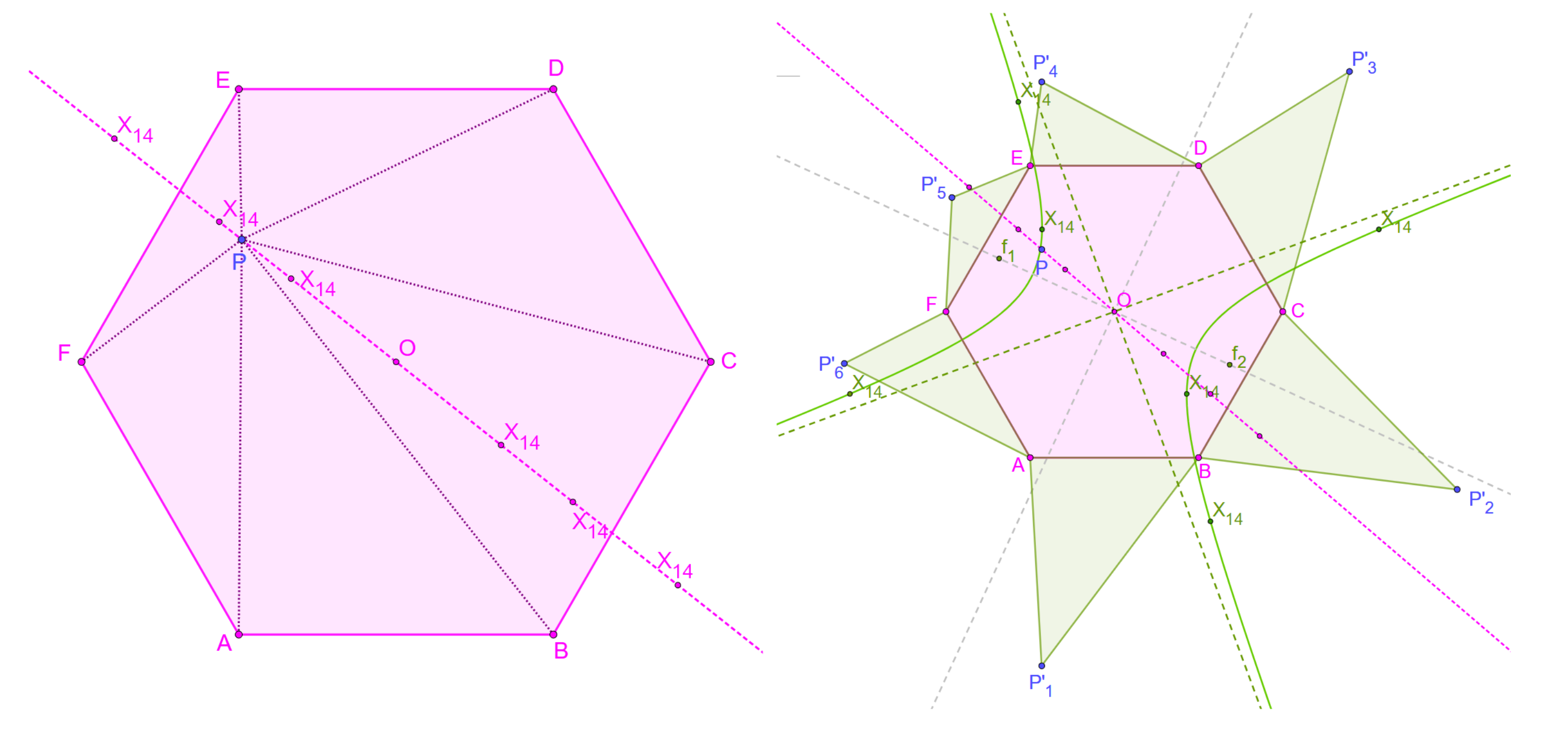
Let O be a point (not necessarily X3), let H=ABCDEF be a regular hexagon with center O, and let P be a point. Define 6 triangles T1=ABP, T2=BCP, … , T6=FAP.
Claim 1: The points X14-of-Ti lie on OP, i=1…6.
Next, define 6 reflection triangles T1' = reflection of T1 in AB, T2' = reflection of T2 in BC, …, T6' = reflection of T6 in FA.
Claim 2: If P is interior to H, the points X14-of-Ti’ lie on a rectangular hyperbola centered at O: Figure. (Dan Reznik, December 10, 2021)