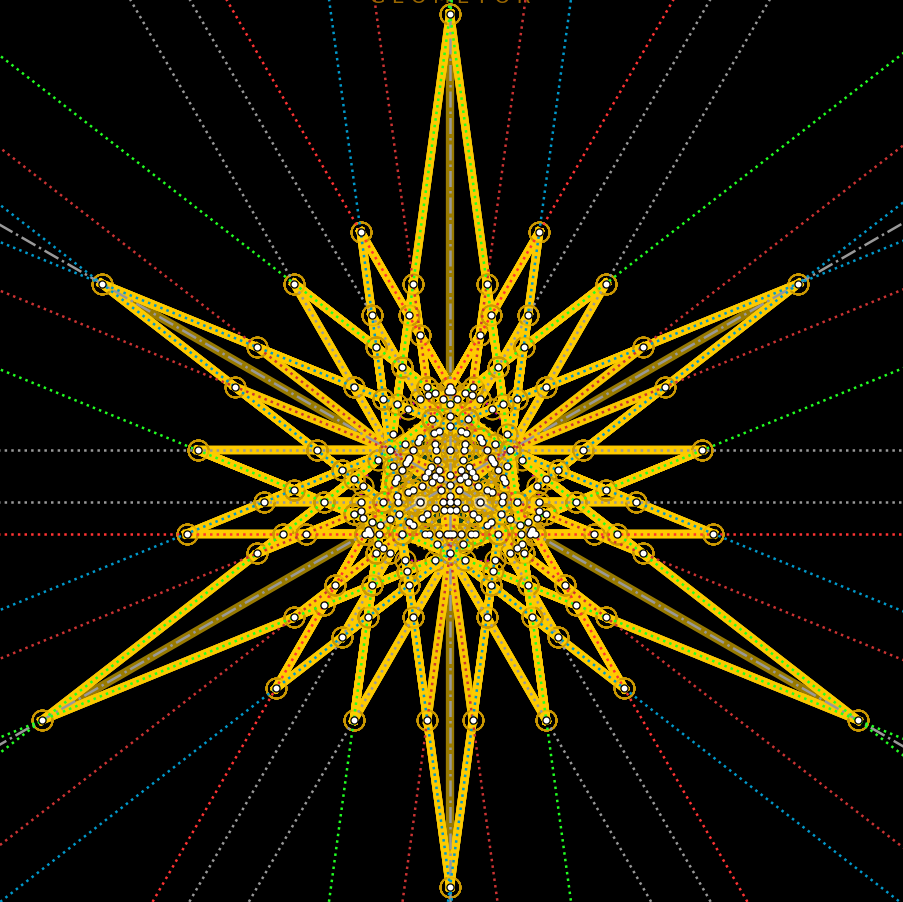
X238
X1-LINE CONJUGATE OF X37
X238 (X1-LINE CONJUGATE OF X37) constructed on acute reference triangle \((a, b, c) = (5, 6, 7)\) with unit baseline AB = \(1\).
Constructed Elements
Central Lines: {1, 1279}
Related Centers: X1 (INCENTER), X1279 (MIDPOINT OF X1 AND X238)
Incident Central Lines49 lines
{1, 6}, {2, 31}, {3, 978}, {4, 602}, {7, 1471}, {8, 983}, {10, 82}, {21, 256}, {36, 513}, {40, 1722}, {42, 1621}, {43, 55}, {47, 499}, {56, 87}, {57, 1707}, {58, 86}, {63, 614}, {71, 1244}, {100, 899}, {105, 291}, {106, 898}, {162, 415}, {190, 726}, {212, 497}, {239, 740}, {241, 1456}, {242, 419}, {244, 896}, {390, 1253}, {459, 1395}, {484, 1739}, {516, 673}, {517, 1052}, {519, 765}, {580, 946}, {601, 631}, {651, 1458}, {662, 1326}, {942, 1046}, {987, 1472}, {992, 1009}, {993, 995}, {1006, 1064}, {1040, 1711}, {1054, 1155}, {1284, 1428}, {1465, 1758}, {1479, 1714}, {1699, 1754}
Functional Relations21 relations
X238 = isogonal conjugate of X291
X238 = isotomic conjugate of X334
X238 = anticomplement of X3836
X238 = Xi-Ceva conjugate of Xj for these (i,j): (105, 1), (292, 171)
X238 = X659-cross conjugate of X3573
X238 = crosssum of Xi and Xj for these (i,j): (10, 726), (42, 672), (239, 894)
X238 = crossdifference of every pair of points on line X37X513
X238 = Xi-Hirst inverse of Xj for these (i,j): (1, 6), (43, 55)
X238 = X105-aleph conjugate of X238
X238 = Xi-beth conjugate of Xj for these (i,j): (21, 238), (643, 902), (644, 238), (932, 238)
X238 = intersection of trilinear polars of PU(8)
X238 = crossdifference of PU(i) for these i: 6, 52, 53
X238 = trilinear product of PU(134)
X238 = X6530-of-excentral-triangle
X238 = trilinear pole of line X659X4435 (the perspectrix of ABC and Gemini triangle 33)
X238 = perspector of Gemini triangle 34 and cross-triangle of ABC and Gemini triangle 34
Notes
X238 is the perspector of triangle ABC and the tangential triangle of the conic that passes through A, B, C, and the pair P(8) and U(8) of bicentric points (see the notes just before X1908. (Randy Hutson, 9/23/2011)