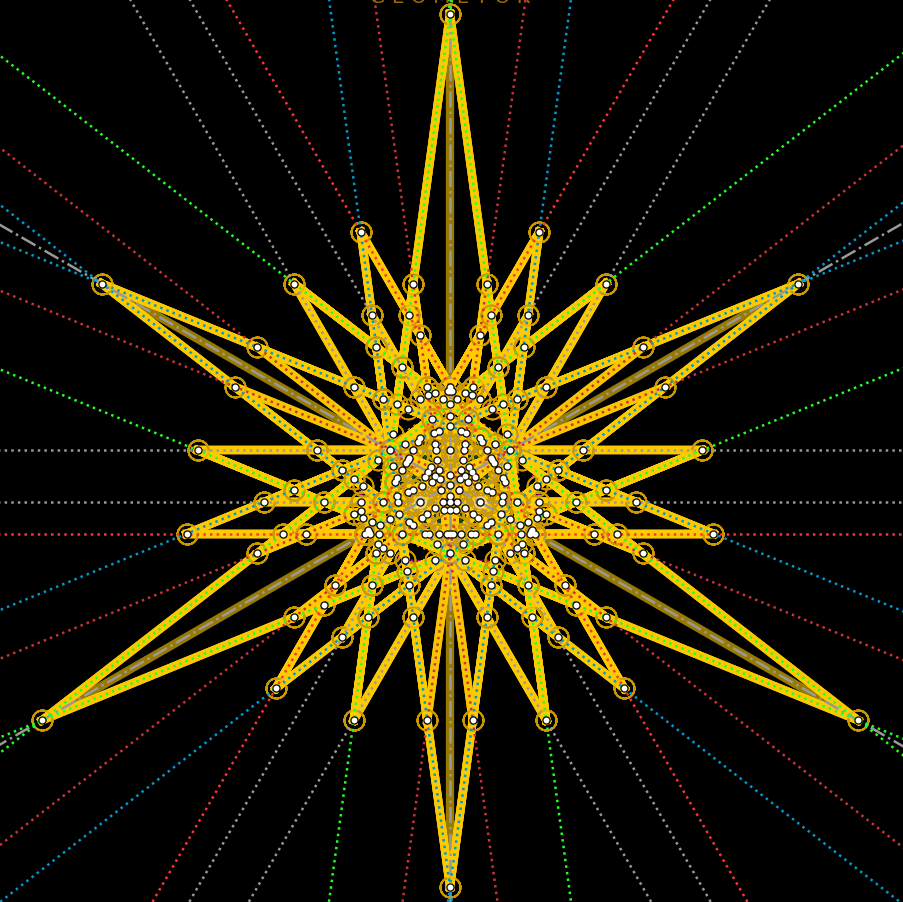
De Geometricis Transmutationibus — Isoperimetric Extrema and the Sesquiquartal Radius — Critical Commentary & Notes
Exact Symbolic Reconstruction, Latin Philology & Canon Reception · DGT (1445)
I. Exact Algebraic Audit of De Geometricis Transmutationibus (1445)
In the unit circle \(R = 1\) centered at A at \((0, 0)\), the inscribed equilateral triangle B–C–D has side \(|BC| = \sqrt{3}\) and perimeter \(P_3 = 3\sqrt{3}\). Dividing \(BC\) into four equal segments at E, F, G, the midpoint F satisfies \(Q(A, F) = \frac{1}{4}\) and the quarter-point E satisfies:
Extending \(AE\) in sesquiquartal ratio \(5:4\) gives Cusa’s isoperimetric radius \(|AH| = \frac{5\sqrt{7}}{16}\) (\(Q(A, H) = \frac{175}{256}\)), implying:
which exceeds true \(\pi \approx 3.14159265\) by only \(+7.45 \times 10^{-4}\) (lying strictly inside Archimedes' 96-gon bounds \(3\frac{10}{71} < \pi < 3\frac{1}{7}\), though Regiomontanus later showed via tighter bounds that \(\frac{24\sqrt{21}}{35} > \pi\); regiomontanus:quadratura:1533).
IV. Executable Symbolic Verification
In accordance with GEOMETOR’s strict content/code separation for historical editions, executable geometor.model SymPy constructions, Rational Trigonometry proofs, and series-error audits for De Geometricis Transmutationibus — Isoperimetric Extrema and the Sesquiquartal Radius live in src/geometor/cusa/ and the companion walkthrough Demos.