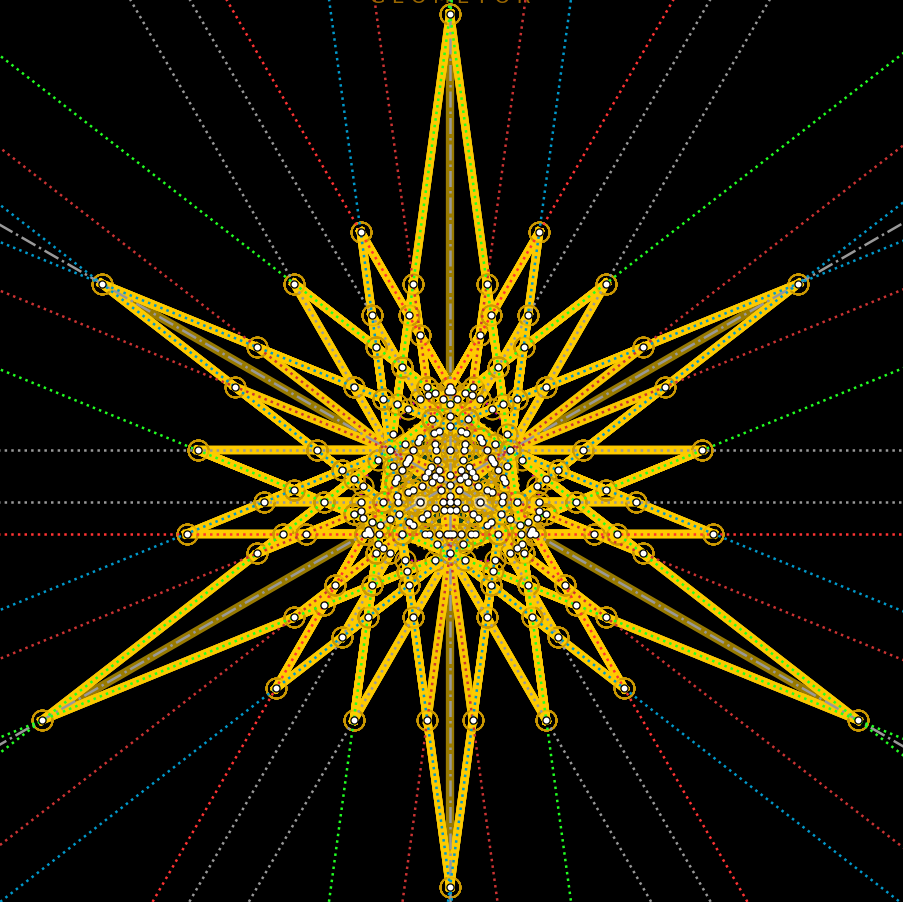
Contributions to the Geometry of Position¶
Beiträge zur Geometrie der Lage (Zweites Heft, 1857) — Karl Georg Christian von Staudt
“Four elements of a uniform fundamental form in a definite sequence are called a throw… Through the calculus of throws, the geometry of position becomes completely independent of all metrics.”
—Karl Georg Christian von Staudt, Beiträge zur Geometrie der Lage (1857), Heft 2, § 19
§ 19. The Concept and Addition of Throws (arts. 256–267)
Art. 256 (Concept of a Throw). Four elements $A, B, C, D$ of any uniform fundamental form, taken in a definite order, determine what we call a throw (einen Wurf), written $(ABCD)$. Two throws $(ABCD)$ and $(A'B'C'D')$ situated in the same or in distinct uniform fundamental forms are equal ($(ABCD) = (A'B'C'D')$) when and only when the two forms can be projectively related so that $A, B, C, D$ correspond in order to $A', B', C', D'$.
§ 20. Pure Straightedge Multiplication of Throws (arts. 268–269)
Art. 268 (*Produkte aus Würfen*). Retaining the same three gauge points $(P_0, P_1, P_\infty)$ on $\ell$, let $X$ and $Y$ be any elements of $\ell \setminus \{P_0, P_\infty\}$. To construct their product $P = X \cdot Y$ using only an unmarked straightedge:
§ 29. The Harmonic Scale & Projective Abscissae (arts. 403–404)
Art. 403. Repeated addition of the unit element $P_1$ produces on $\ell$ the harmonic scale $P_1, P_2, P_3, \dots, P_n, \dots$, where each consecutive triad $(P_{n-1}, P_n, P_{n+1})$ forms with $P_\infty$ a harmonic tetrad $(P_{n-1}, P_{n+1}; P_n, P_\infty) = -1$. Taking additive inverses yields $P_{-1}, P_{-2}, \dots$, and straightedge division ($P_p \cdot P_q^{-1}$) assigns a unique point $P_{p/q}$ on $\ell$ to every positive and negative rational number $p/q \in \mathbb{Q}$.