Content of type 'section'

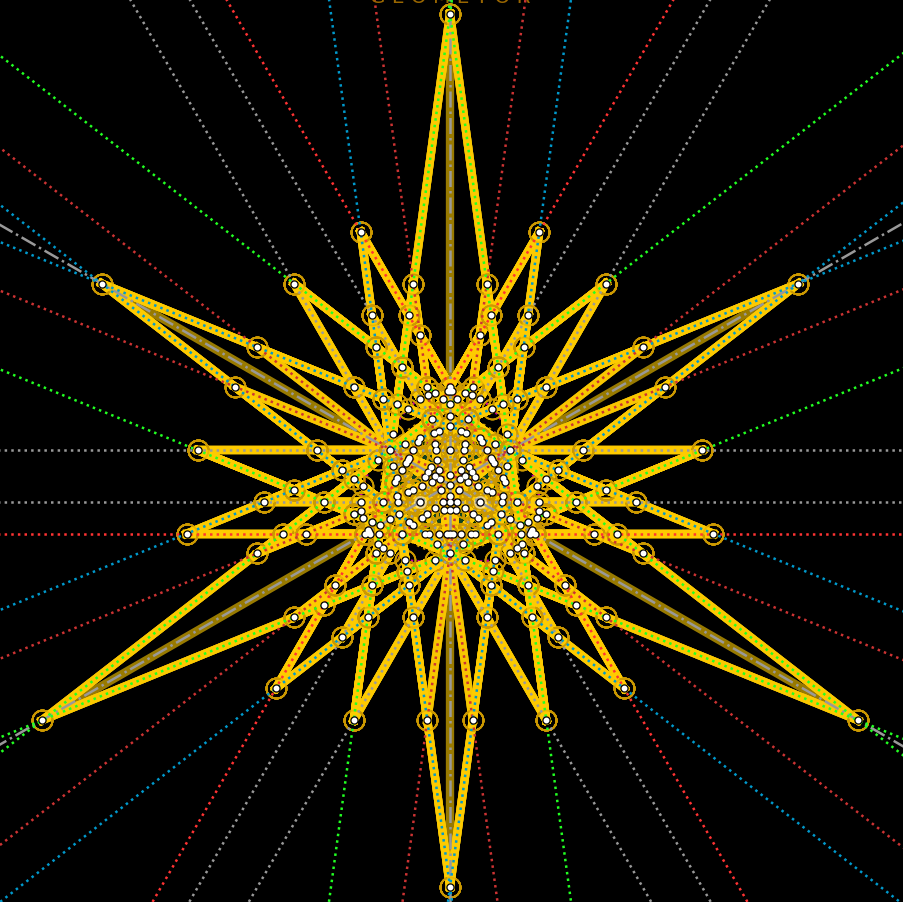
Pascal's Hexagrammum Mysticum (1640) on the Unit Circle ( O P0 ): x**2 + y**2 - 1 = 0 [ P0 P2 ]: -x - y + 1 = 0 [ P2 P4 ]: 9*x/5 - 3*y/5 + 3/5 = 0 [ P4 P1 ]: -7*x/5 + 7*y/5 + 7/25 = 0 [ P1 P3 ]: y - 3/5 = 0 [ P3 P5 ]: 7*x/5 + 7*y/5 + 7/25 = 0 [ P5 P0 ]: -4*x/5 + 2*y/5 + 4/5 = 0 [ M03 M14 ]: x/2 - 7*y/10 + 11/50 = 0 O = (0, 0) P0 = (1, 0) P1 = (4/5, 3/5) P2 = (0, 1) P3 = (-4/5, 3/5) P4 = (-3/5, -4/5) P5 = (3/5, -4/5) M03 = (2/5, 3/5) M14 = (-3/10, 1/10) M25 = (9/5, 8/5) O P0 P1 P2 P3 P4 P5 M03 M14 M25

Essay on Conics (English Translation)

When several straight lines meet at the same point, or are parallel to each other, all these lines are said to be of the same order or of the same ordonnance, and the totality of these lines is termed an order of lines, or an ordonnance of lines.

Pascal's Hexagrammum Mysticum (1640) on the Unit Circle ( O P0 ): x**2 + y**2 - 1 = 0 [ P0 P2 ]: -x - y + 1 = 0 [ P2 P4 ]: 9*x/5 - 3*y/5 + 3/5 = 0 [ P4 P1 ]: -7*x/5 + 7*y/5 + 7/25 = 0 [ P1 P3 ]: y - 3/5 = 0 [ P3 P5 ]: 7*x/5 + 7*y/5 + 7/25 = 0 [ P5 P0 ]: -4*x/5 + 2*y/5 + 4/5 = 0 [ M03 M14 ]: x/2 - 7*y/10 + 11/50 = 0 O = (0, 0) P0 = (1, 0) P1 = (4/5, 3/5) P2 = (0, 1) P3 = (-4/5, 3/5) P4 = (-3/5, -4/5) P5 = (3/5, -4/5) M03 = (2/5, 3/5) M14 = (-3/10, 1/10) M25 = (9/5, 8/5) O P0 P1 P2 P3 P4 P5 M03 M14 M25

Essay pour les Coniques (Texte Original)

Quand plusieurs lignes droites se rencontrent en un même point, ou sont entr’elles parallèles, toutes ces lignes sont dites de mesme ordre, ou de mesme ordonnance, & la totalité de ces lignes est appellée un ordre de lignes, ou une ordonnance de lignes.

Pascal's Hexagrammum Mysticum (1640) on the Unit Circle ( O P0 ): x**2 + y**2 - 1 = 0 [ P0 P2 ]: -x - y + 1 = 0 [ P2 P4 ]: 9*x/5 - 3*y/5 + 3/5 = 0 [ P4 P1 ]: -7*x/5 + 7*y/5 + 7/25 = 0 [ P1 P3 ]: y - 3/5 = 0 [ P3 P5 ]: 7*x/5 + 7*y/5 + 7/25 = 0 [ P5 P0 ]: -4*x/5 + 2*y/5 + 4/5 = 0 [ M03 M14 ]: x/2 - 7*y/10 + 11/50 = 0 O = (0, 0) P0 = (1, 0) P1 = (4/5, 3/5) P2 = (0, 1) P3 = (-4/5, 3/5) P4 = (-3/5, -4/5) P5 = (3/5, -4/5) M03 = (2/5, 3/5) M14 = (-3/10, 1/10) M25 = (9/5, 8/5) O P0 P1 P2 P3 P4 P5 M03 M14 M25

Mathematical Summary & Symbolic Architecture

Thirteen centuries after Pappus of Alexandria proved his Hexagon Lemma (Synagoge VII.139) for six points distributed along two straight lines $a$ and $b$, sixteen-year-old Blaise Pascal published a single printed broadsheet in February 1640—Essai pour les coniques—announcing a breathtaking generalization: the two lines can be replaced by any conic section.

Pascal's Hexagrammum Mysticum (1640) on the Unit Circle ( O P0 ): x**2 + y**2 - 1 = 0 [ P0 P2 ]: -x - y + 1 = 0 [ P2 P4 ]: 9*x/5 - 3*y/5 + 3/5 = 0 [ P4 P1 ]: -7*x/5 + 7*y/5 + 7/25 = 0 [ P1 P3 ]: y - 3/5 = 0 [ P3 P5 ]: 7*x/5 + 7*y/5 + 7/25 = 0 [ P5 P0 ]: -4*x/5 + 2*y/5 + 4/5 = 0 [ M03 M14 ]: x/2 - 7*y/10 + 11/50 = 0 O = (0, 0) P0 = (1, 0) P1 = (4/5, 3/5) P2 = (0, 1) P3 = (-4/5, 3/5) P4 = (-3/5, -4/5) P5 = (3/5, -4/5) M03 = (2/5, 3/5) M14 = (-3/10, 1/10) M25 = (9/5, 8/5) O P0 P1 P2 P3 P4 P5 M03 M14 M25

Scholarly Notes & Historical Context

In February 1640, sixteen-year-old Blaise Pascal printed approximately fifty copies of a single large folio sheet titled ESSAY POUR LES CONIQUES. Par B. P. in Paris. Only two original exemplars are known to survive today: one preserved in the Bibliothèque nationale de France in Paris, and one in the Gottfried Wilhelm Leibniz collection in Hannover.