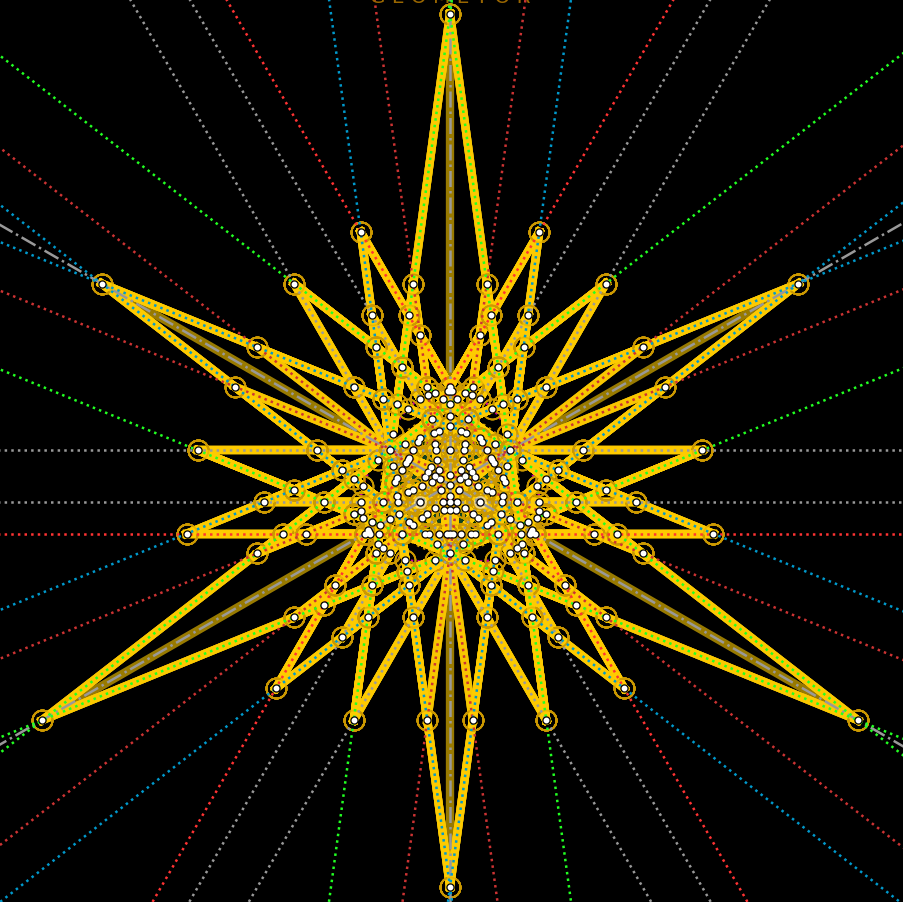
Mathematical Summary & Symbolic Architecture
Exact Symbolic Projective Geometry, Veronese Invariants & 60-Line Web
From Two Straight Lines to Any Conic Section
Thirteen centuries after Pappus of Alexandria proved his Hexagon Lemma (Synagoge VII.139) for six points distributed along two straight lines $a$ and $b$, sixteen-year-old Blaise Pascal published a single printed broadsheet in February 1640—Essai pour les coniques—announcing a breathtaking generalization: the two lines can be replaced by any conic section.
Algebraically, Pappus’s theorem and Pascal’s theorem are two faces of one projective law. Six points $P_k = (x_k, y_k)$ lie on a planar curve of degree two—whether a smooth conic $\mathcal{C}: A x^2 + B x y + C y^2 + D x + E y + F = 0$ (circle, ellipse, parabola, or hyperbola) or a degenerate conic $L_a(x, y) \cdot L_b(x, y) = 0$ (Pappus’s pair of lines)—if and only if their $6 \times 6$ Veronese matrix drops rank ($\det V_6 = 0$):
In geometor.pascal.projective.are_coconic, this exact SymPy rank test unifies smooth circles and ellipses with degenerate configurations under a single algebraic predicate, while Colin Maclaurin (1720) and William Braikenridge (1733) proved the converse: if the three opposite-side intersections of a hexagon are collinear, its six vertices necessarily lie on a conic.
Theorem (Pascal’s Hexagrammum Mysticum, 1640)
Let $P_0, P_1, P_2, P_3, P_4, P_5$ be any six distinct points on an irreducible conic $\mathcal{C}$ in $\mathbb{P}^2$, ordered in a cyclic hexagon $\langle P_{c_0}, P_{c_1}, P_{c_2}, P_{c_3}, P_{c_4}, P_{c_5} \rangle$. Then the three intersections of opposite sides,
are collinear along a single line $p$—the Pascal line of the inscribed hexagram.
The Mystic Star Hexagram on the Pythagorean Circle
To explore Pascal’s theorem in 100% exact rational arithmetic ($\mathbb{Q}^2$) without floating-point approximations, geometor.pascal.projective.circle_stereographic_point maps any rational parameter $t \in \mathbb{Q}$ onto the unit circle $x^2 + y^2 = 1$ via Weierstrass stereographic projection:
Seeding preset="hexagrammum" with $t = \left(0,\, \frac{1}{3},\, 1,\, 3,\, -2,\, -\frac{1}{2}\right)$ places six cardinal and $3\text{-}4\text{-}5$ Pythagorean vertices around all four quadrants of $x^2 + y^2 = 1$:
Tracing the non-convex mystic star cycle $\langle P_0, P_2, P_4, P_1, P_3, P_5 \rangle$ produces two interior meets and one compact exterior meet, all strictly rational:
aligned along the exact Pascal line $25x - 35y + 11 = 0$:
Universal Symbolic Proof & Conic Invariance
Why did Pascal need only prove his lemma for the circle in order to establish it for every ellipse, parabola, and hyperbola? Because any non-degenerate conic is the central projection of a circle from the apex of Apollonius’s cone, and incidence ($P \in \ell$) is preserved under every projective collineation $T \in \mathrm{PGL}_3(\mathbb{R})$.
Universal 6-Parameter Proof:
verify_pascal_symbolic()parameterizes six generic points $P_k = [1 - t_k^2 : 2 t_k : 1 + t_k^2]$ over the polynomial ring $\mathbb{Z}[t_0, t_1, t_2, t_3, t_4, t_5]$, computes $M_{03}, M_{14}, M_{25}$ via homogeneous 3D cross products, and expands $\det[M_{03}, M_{14}, M_{25}]$—which cancels identically to zero.General Ellipse Verification: Applying the affine transformation $(x, y) \mapsto (2x, y)$ in
preset="ellipse"maps the Pythagorean hexagram onto the non-circular ellipse $\mathcal{E}: \frac{x^2}{4} + y^2 = 1$ ($x^2 + 4y^2 - 4 = 0$), stretching the three Pascal intersections to $M'_{03} = \left(\frac{4}{5}, \frac{3}{5}\right)$, $M'_{14} = \left(-\frac{3}{5}, \frac{1}{10}\right)$, and $M'_{25} = \left(\frac{18}{5}, \frac{8}{5}\right)$ along $25x - 70y + 22 = 0$:
The Complete 60-Line Hexagrammum Mysticum Web
On two lines (Pappus), permuting the vertices yields $3! = 6$ hexagons and 6 Pappus lines concurring in 2 Steiner Star points. On a smooth conic, however, no three of the six vertices are collinear, so every cyclic ordering of $P_0, \dots, P_5$ up to dihedral rotation and reversal ($D_6$, order 12) inscribes a valid hexagon—producing:
In the nineteenth century, Jakob Steiner (1828), Julius Plücker (1830), Thomas Penyngton Kirkman (1850), Arthur Cayley, and George Salmon uncovered an astonishing, self-dual incidence architecture hidden inside these 60 lines. Running enumerate_hexagrammum_mysticum(preset="hexagrammum") constructs and verifies every element of this web in exact homogeneous coordinates with zero combinatorial degeneracies:
Geometric Stratum |
Count |
Incidence Law & Discoverer |
|---|---|---|
Conic Chords $[P_i P_j]$ |
15 |
$\binom{6}{2} = 15$ secant lines joining pairs of the 6 conic vertices |
Pascal Diagonal Points |
45 |
$\frac{1}{2}\binom{6}{2}\binom{4}{2} = 45$ intersections $[P_i P_j] \cap [P_k P_l]$; 4 Pascal lines pass through each |
Pascal Lines $p_H$ |
60 |
$6! / 12 = 60$ lines, each carrying 3 of the 45 diagonal points (Pascal, 1640) |
Steiner Points $G$ |
20 |
60 Pascal lines concur 3-by-3 at 20 Steiner points—2 per complementary triangle pair (Steiner, 1828) |
Kirkman Points $K$ |
60 |
60 Pascal lines also concur 3-by-3 in a second way at 60 Kirkman points—3 on each Pascal line (Kirkman, 1850) |
Plücker Lines $\ell_{\mathrm{Pl}}$ |
15 |
20 Steiner points lie 4-by-4 along 15 Plücker lines—3 through each Steiner point (Plücker, 1830) |
Bi-Triangle $S_3$ Concurrency: How Pappus’s Two Star Points Generalize
How do Steiner’s 20 points on a smooth conic relate to the 2 Star points $(S_+, S_-)$ of the Pappus–Steiner theorem? Partition the six conic vertices into two complementary inscribed triangles—say $\triangle_A = (P_0, P_2, P_4)$ and $\triangle_B = (P_1, P_3, P_5)$. There are $\frac{1}{2}\binom{6}{3} = 10$ such complementary triangle pairs.
Fixing $\triangle_A$ and permuting $\triangle_B$ by $\sigma \in S_3$ generates 6 alternating hexagons $\langle P_0, B_{\sigma_0}, P_2, B_{\sigma_1}, P_4, B_{\sigma_2} \rangle$—the exact smooth-conic counterpart of the six $S_3$ Pappus hexagons! Just as on two lines:
The 3 even ($\sigma \in A_3$) Pascal lines concur at the even Steiner point $G_+ = \left(\frac{78}{25},\; \frac{1}{25}\right)$.
The 3 odd ($\sigma \in S_3 \setminus A_3$) Pascal lines concur at the odd Steiner point $G_- = \left(\frac{498}{1565},\; \frac{281}{1565}\right)$.
Across all $10$ triangle partitions, $10 \times 2 = \mathbf{20}$ Steiner points arise; when the conic degenerates into two straight lines $a \cup b$, only the single partition separating $a$ from $b$ survives without collapsing onto the carrier lines, leaving Pappus’s two Star points $(S_+, S_-)$!
Golden Hexagrammum Mysticum in $\mathbb{Q}(\phi)$
By Michel Chasles’s Theorem (1865), four points $P_0, P_1, P_2, P_3$ on an irreducible conic $\mathcal{C}$ possess an intrinsic conic cross-ratio $(P_0, P_1; P_2, P_3)_{\mathcal{C}}$: for any fifth observer point $V \in \mathcal{C}$, the pencil of four rays $[V P_0], [V P_1], [V P_2], [V P_3]$ has the exact same cross-ratio, independent of $V$.
Because Weierstrass stereographic projection is a birational isomorphism $\mathbb{P}^1 \to \mathcal{C}$, seeding preset="golden_conic" with the golden stereographic chain $t = (0,\, 1,\, \phi,\, \phi + 1,\, -1,\, -\phi)$ inscribes six exact $\mathbb{Q}(\sqrt{5})$ points on $x^2 + y^2 = 1$:
Chasles Golden Conic Cross-Ratio: Calling
conic_cross_ratio(P_0, P_1, P_2, P_3, V)from either $V = P_4$ or $V = P_5$ simplifies identically to the Golden Ratio $\phi = \frac{1 + \sqrt{5}}{2}$!Emergent Golden Section on the Mystic Hexagram: Constructing the inscribed hexagram on cycle $\langle P_0, P_2, P_5, P_1, P_3, P_4 \rangle$ yields exact opposite-side intersections:
\[M_{03} = \left(\frac{5 - 4\sqrt{5}}{11},\; \frac{7 + \sqrt{5}}{11}\right), \qquad M_{14} = \left(-\frac{\sqrt{5}}{5},\; 0\right), \qquad M_{25} = \left(-\phi^{-1},\; -\phi\right) = \left(\frac{1 - \sqrt{5}}{2},\; -\frac{1 + \sqrt{5}}{2}\right).\]Running
geometor.divine(find_golden_sections) on this model automatically discovers an emergent golden section: the Pascal intersection $M_{25} = (-\phi^{-1}, -\phi)$ extends the conic chord $[P_4 P_0]$ ($y = x - 1$) in the exact Divine Proportion! Because $x(P_0) - x(P_4) = 1 - 0 = 1$ and $x(P_4) - x(M_{25}) = 0 - (-\phi^{-1}) = \phi^{-1}$ along the $45^\circ$ chord, $|P_0 P_4| / |P_4 M_{25}| = |M_{25} P_0| / |P_0 P_4| = \phi$ identically:
geometor.divine golden section M25 P4 P0 along chord P4 P0: $|P_0 P_4| = \sqrt{2}$ and $|P_4 M_{25}| = \phi^{-1}\sqrt{2}$, dividing the extended conic chord in the exact Golden Ratio $\phi = \frac{1 + \sqrt{5}}{2}$.