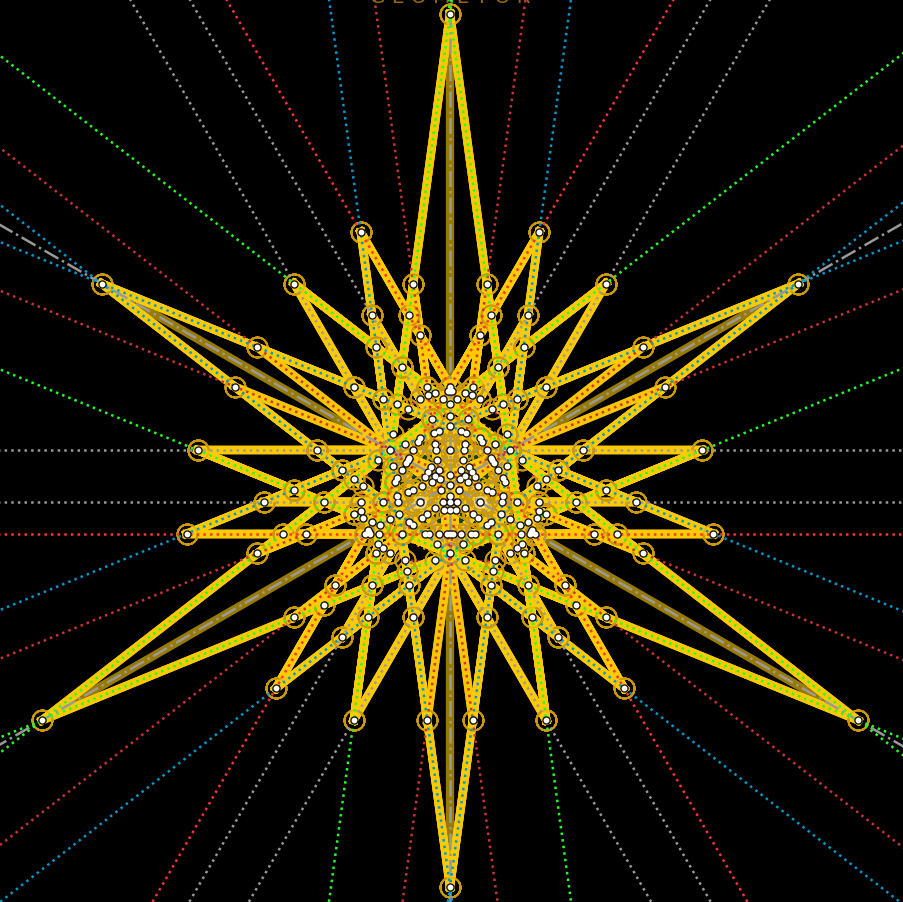
Cross-Ratios, Harmonic Conjugates & Golden Projectivity
Why does a purely straightedge construction preserve quantitative algebraic ratios when distances themselves are distorted by perspective projection? The answer already appears in Proposition 129 of Book VII of Pappus’s Synagoge: while lengths and simple ratios change under central projection from an apex $O$, the compound ratio of ratios—today called the projective cross-ratio—is an exact projective invariant.
The Projective Cross-Ratio & Its Anharmonic Orbit
For four distinct collinear points $A, B, C, D$ parameterized along their carrier line by affine coordinates $t_A, t_B, t_C, t_D$ (including $t = \infty$ for an ideal point), the cross-ratio is
In geometor.pappus.projective.cross_ratio, $A, B, C, D$ are verified strictly collinear and
projected onto whichever coordinate axis ($x$ or $y$) varies, returning an exact simplified SymPy
expression with zero floating-point approximation.
Permuting four collinear points across all $4! = 24$ orderings preserves $(A, B; C, D)$ on the Klein four-group $V_4 = \{\mathrm{id}, (AB)(CD), (AC)(BD), (AD)(BC)\}$, leaving at most $24 / 4 = 6$ values—the anharmonic six-group orbit:
Straightedge Fourth Harmonic Conjugate (Complete Quadrilateral)
The most symmetrical cross-ratio occurs when this six-value orbit collapses to three values $\{-1,\, 2,\, \frac{1}{2}\}$:
Here $C$ and $D$ separate $A$ and $B$ internally and externally in the same magnitude ratio—a harmonic range (Synagoge VII.131). Remarkably, given three collinear points $A, B, C$, the fourth harmonic conjugate $D$ can be constructed using a straightedge alone via a complete quadrilateral, and $D$ is completely independent of the auxiliary points chosen!
Emergent Harmonic Tetrads in the Pappus–Steiner Web
Because every complete quadrilateral embedded in a projective configuration generates harmonic
divisions along its diagonals and sides, the Pappus–Steiner 9-line / 6-line web teems with
emergent harmonic ranges. Running find_harmonic_ranges on preset="harmonic"
($A = [(1,0), (2,0), (3,0)]$ on $y = 0$ and $B = [(0,1), (1, \frac{3}{2}), (4, 3)]$ on
$-x + 2y = 2$, meeting at $O = (-2, 0)$) uncovers 19 exact collinear harmonic tetrads among
the given, cross-join, and Steiner points alone—and 81 exact collinear harmonic tetrads when
pairwise line intersections are included!
Carrier Line |
Collinear Harmonic Tetrad |
Exact Coordinates & Verification |
|---|---|---|
Carrier $b$: $-x + 2y = 2$ |
$(O,\, B_1;\, B_0,\, B_2)$ |
$x = (-2, 1; 0, 4) \implies (O, B_0, B_1, B_2)$ has $(O, B_1; B_0, B_2) = -1$ |
Carrier $a$: $y = 0$ |
$(A_0,\, A_1;\, X_1,\, A_2)$ |
$x = (1, 2; \tfrac{5}{3}, 3) \implies \frac{(1 - 5/3)(2 - 3)}{(1 - 3)(2 - 5/3)} = -1$ |
Carrier $a$: $y = 0$ |
$(A_0,\, A_2;\, A_1,\, X_2)$ |
$x = (1, 3; 2, \tfrac{7}{3})$ cut by the Steiner line through $S_+ = (\tfrac{31}{18}, \tfrac{1}{2})$ |
Cross-Line $[A_0 B_0]$ |
$(B_0,\, A_0;\, M_{0021},\, M_{0022})$ |
Exact harmonic conjugate cross-join pair cut across $[A_0 B_0]$ |
Golden Projectivity in $\mathbb{Q}(\phi)$
At the heart of the GEOMETOR initiative lies the Golden Ratio
$\phi = \frac{1 + \sqrt{5}}{2}$ ($\phi^2 = \phi + 1$). Projective cross-ratios unite harmonic
division and the divine proportion in three exact algebraic laws verified symbolically in
geometor.pappus:
Canonical Golden Chain: Four consecutive Fibonacci-scaled points $(0, 1, \phi, \phi + 1)$ have exact cross-ratio
\[(0, 1;\, \phi, \phi + 1) = \frac{(0 - \phi)(1 - \phi - 1)}{(0 - \phi - 1)(1 - \phi)} = \frac{\phi^2}{\phi^2 \cdot \phi^{-1}} = \phi,\]whose six-value anharmonic orbit is purely powers of $\phi$: $\left\{\phi,\; \phi^{-1},\; -\phi^{-1},\; -\phi,\; \phi^{-2},\; \phi^2\right\}$.
Harmonic–Golden Bridge: The fourth harmonic conjugate of $1$ with respect to $(0, \phi)$ is precisely $\phi^3 = 2\phi + 1$:
\[(0, \phi;\, 1, \phi^3) = \frac{(0 - 1)(\phi - \phi^3)}{(0 - \phi^3)(\phi - 1)} = \frac{\phi(\phi^2 - 1)}{\phi^3 \phi^{-1}} = -\frac{\phi^2}{\phi^2} = -1.\]Emergent Golden Section in the Golden Pappus Hexagon: In
preset="golden", carrier $a$ places $(A_0, A_1, A_2) = \bigl((0, 0),\, (1, 0),\, (\phi, 0)\bigr)$ in golden section along $y = 0$, while carrier $b$ places $B_0 = (0, 1)$, $B_1 = \left(\phi, \frac{\phi}{2} + 1\right)$, $B_2 = \left(\phi + 1, \frac{\phi + 3}{2}\right)$ in golden section along $-(\phi + 1)x + (2\phi + 2)y = 2\phi + 2$, intersecting $a$ at $O = (-2, 0)$.Computing the exact cross-join meets in $\mathbb{Q}(\sqrt{5})$ yields
\[M_{01} = (-4 + 2\sqrt{5},\; 5 - 2\sqrt{5}), \quad M_{12} = \left(\frac{1 + \sqrt{5}}{2},\; 2 - \frac{\sqrt{5}}{2}\right), \quad M_{20} = \left(\frac{2}{3},\; \frac{4 - \sqrt{5}}{3}\right).\]Scanning this model with
geometor.divineuncovers an emergent third golden section: the cross-join intersection $M_{12}$ divides the oblique hexagon side $[A_1 B_2]$ in the exact Golden Ratio $\phi$!
geometor.divine golden section A1 M12 B2:
because $x(A_1) = 1$, $x(M_{12}) = \phi$, and $x(B_2) = \phi + 1$, we have
$x(B_2) - x(M_{12}) = 1$ and $x(M_{12}) - x(A_1) = \phi - 1 = \phi^{-1}$, so
$|M_{12} B_2| / |A_1 M_{12}| = \phi$ identically!