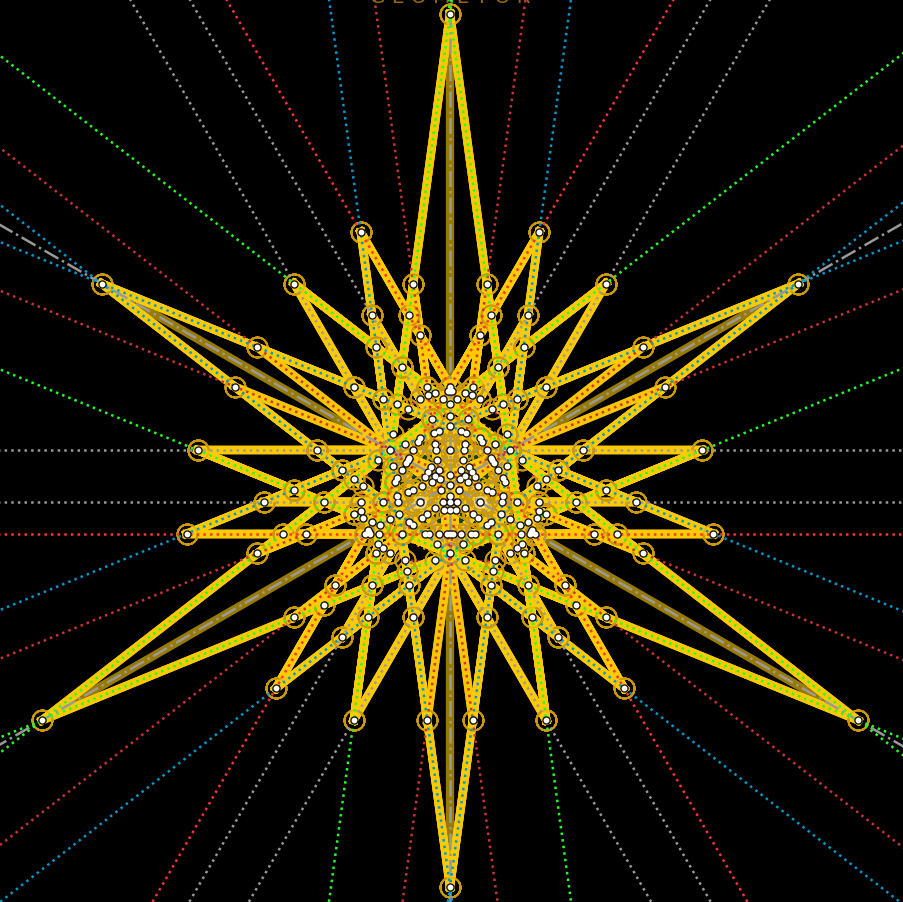
Notes: Proposition 139 · Intersecting Carriers
Philological & Foundational Commentary
1. Blaise Pascal and the Conic Generalization (1640)
In his sixteen-year-old broadside Essay pour les coniques (1640), Blaise Pascal observed that the two carrier lines $a$ and $b$ constitute a degenerate conic section (a pair of lines). Generalizing Pappus’s theorem to any smooth conic (ellipse, parabola, hyperbola, circle), Pascal discovered his famous Hexagrammum Mysticum: the opposite sides of any hexagon inscribed in a conic meet in three collinear points along a Pascal line.
2. David Hilbert and Field Commutativity (1899)
In Grundlagen der Geometrie (1899), David Hilbert revealed the profound algebraic meaning of Pappus’s Hexagon Theorem:
In a Desarguesian projective plane, Pappus’s Theorem is valid if and only if multiplication in the coordinate division ring is commutative ($a \cdot b = b \cdot a$).
While Desargues’s Theorem corresponds to associativity (allowing coordinate geometry over division rings/quaternions), Pappus’s Theorem demands commutativity (forcing the coordinate ring to be a field). Thus Pappus VII.139 is the pure geometric embodiment of the commutative law of multiplication.