Proposition 139: Pappus’s General Hexagon Collinearity Theorem
Synagoge Book VII, Proposition 139 (Hultsch II, pp. 886–889, Lemma XIII to Euclid’s Porisms) · Critical English Edition
Crowning the lemmas to Euclid’s Porisms is Proposition 139, the general theorem of collinearity for opposite sides of a hexagon whose vertices lie alternately on two intersecting carrier lines. Pappus establishes the result purely through compound ratios (cross-ratio invariance) without drawing a single circle.
Proposition 139 (Hultsch II, pp. 886–889): Let two straight lines a and b meet at O, carrying three points A0, A1, A2 on a and three points B0, B1, B2 on b. If opposite cross-joins A0B1 & A1B0 meet at M01, A2B0 & A0B2 meet at M20, and A1B2 & A2B1 meet at M12, then the three points M01, M20, and M12 lie on a single straight line p.
step Set carrier a with A0 $= (0, 0)$, A1 $= (2, 0)$, A2 $= (5, 0)$ and carrier b with B0 $= (0, 2)$, B1 $= (2, 3)$, B2 $= (6, 5)$, concurring at perspective apex O $= (-4, 0)$.
step
Form the three opposite cross-join intersections of hexagon A0B1A2B0A1B2:
\[M_{01} = \left(\frac{4}{5}, \frac{6}{5}\right), \qquad
M_{20} = \left(\frac{60}{37}, \frac{50}{37}\right), \qquad
M_{12} = \left(\frac{10}{3}, \frac{5}{3}\right).\]
step By Proposition 129, projecting from A0 and A2 onto cross-joins A1B0 and A1B2 equates their four-point cross-ratios; since the two ranges share their apex A1, the joins connecting corresponding points concur, forcing M01, M20, and M12 onto the single Pappus line p ($-7x + 38y = 40$).
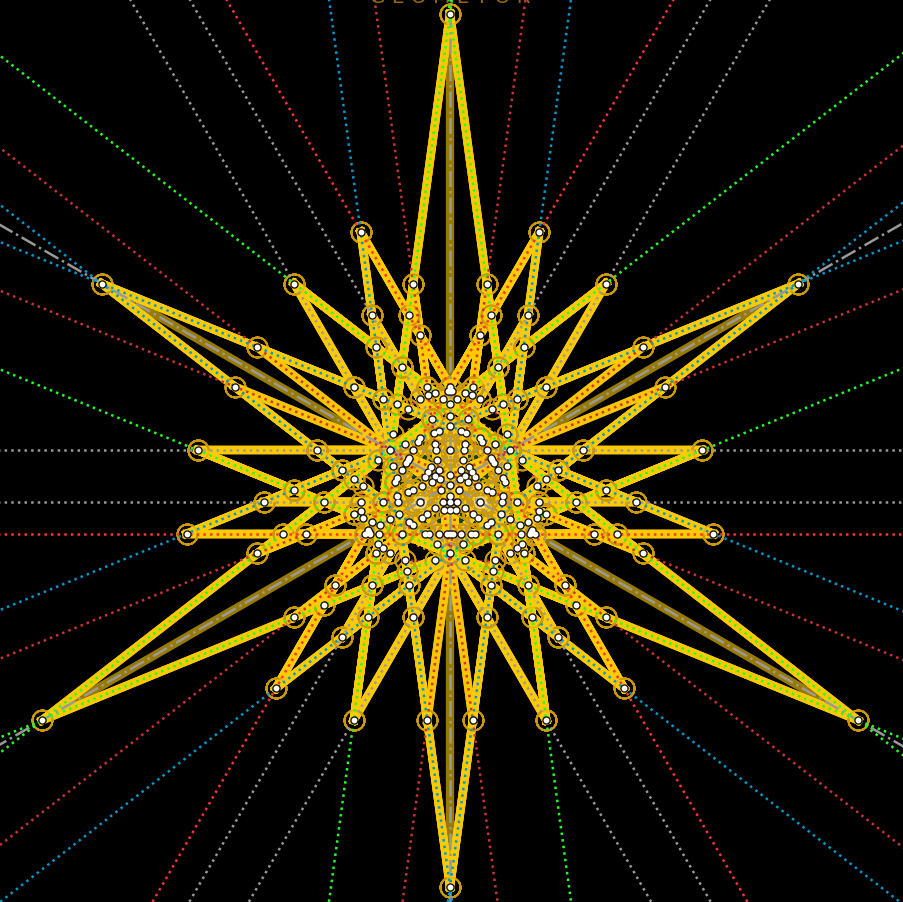
Permuting $(B_0, B_1, B_2)$ across all $3! = 6$ elements of $S_3$ (construct_pappus_configuration()) yields six Pappus lines that concur three-by-three by parity at Jakob Steiner's Star points S+ and S- along Steiner line: