
CHAPTER LXI
On Five-Sided (Pentagonal) Lateral Columns and How the Species of Lateral Columns Proceed to Infinity (Plates XLIX–L).

In the third place among lateral columns stand the five-sided or pentagonal columns (colonne laterate pentagone, Plates XLIX–L, and marginal diagram 0054.g6.png):
Properties of Pentagonal and General Polygonal Prisms ([XIII.7])
A pentagonal column is bounded laterally by 5 rectangular faces (ciascuna tetragona ouer quadrilatera) and closed at the top and bottom by 2 parallel pentagonal bases (rectilinear figures of 5 sides and 5 angles—for in every rectilinear plane figure, the number of angles equals the number of sides).
Like quadrilateral columns, pentagonal columns may be either equilateral and equiangular or inequilateral, depending on their pentagonal bases.
Geometric Caution on Pentagons (:just:`XIII.7`): Note well that a pentagon can have all five sides equal and even two angles equal without being equiangular! However, as we proved in Chapter XXI by the seventh of the thirteenth, every equilateral pentagon that has three angles equal (either consecutive or non-consecutive) is necessarily equiangular.
Infinite Progression of Lateral Columns: Just as plane polygons increase in number of sides to infinity (triangles, quadrangles, pentagons, hexagons, heptagons, octagons, and so forth), so the species of lateral columns increase to infinity (in infinito).
In every lateral column, the two bases (upper and lower) must be similar and equal polygons of the same number of sides (it could not have a triangle for one base and a quadrangle for the other!), while all the lateral faces are rectangles; and each column takes its name (denominatione) from its bases: triangula (3 lateral faces), quadrangola (4), pentagona (5), exagona (6), et sic de singulis.
All of these may be seen both in the material models suspended in public and in perspective drawing at their corresponding Roman numerals (Plates XLIX–L).
Marginal Woodcut Diagrams (Paganini 1509)
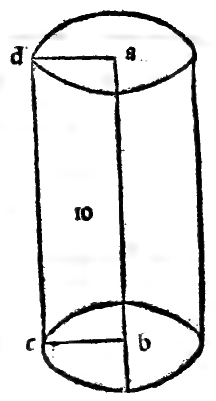
Folio 0053 Diagram 1