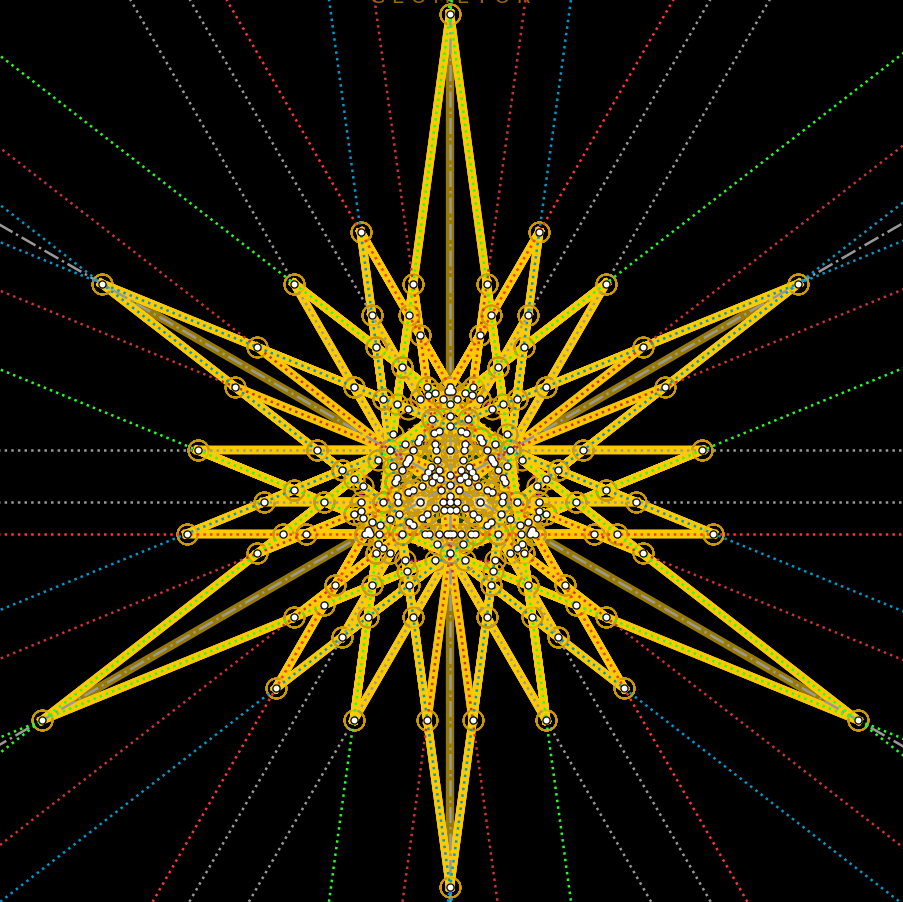
§ 3. Projective Geometry, Duality, and Imaginary Elements — Summary¶
Analytical Synopsis of Projective Invariance and Cayley’s Absolute
§ 3. Projective Geometry, Duality, and Imaginary Elements¶
Genesis of Projective Geometry: Projective geometry emerged when projection ceased to be merely a heuristic trick for transferring properties between individual figures and became the defining equivalence relation under the group of all projective collineations.
Two Internal Group Extensions: 1. Adjoining dualistic transformations (correlations exchanging points and planes in $3$-space, or points and lines in the plane), rendering dual figures identical in the group sense. 2. Adjoining complex/imaginary elements and transformations (von Staudt's Beiträge, 1856–1860), motivated not by projectivity per se (since real projectivities already form a group) but by closure under algebraic equations.
Recovery of Real Elementary Geometry: Elementary real Euclidean geometry is recovered inside complex projective geometry by simultaneously fixing the imaginary spherical circle at infinity and the real subspace $\mathbb{RP}^3$.