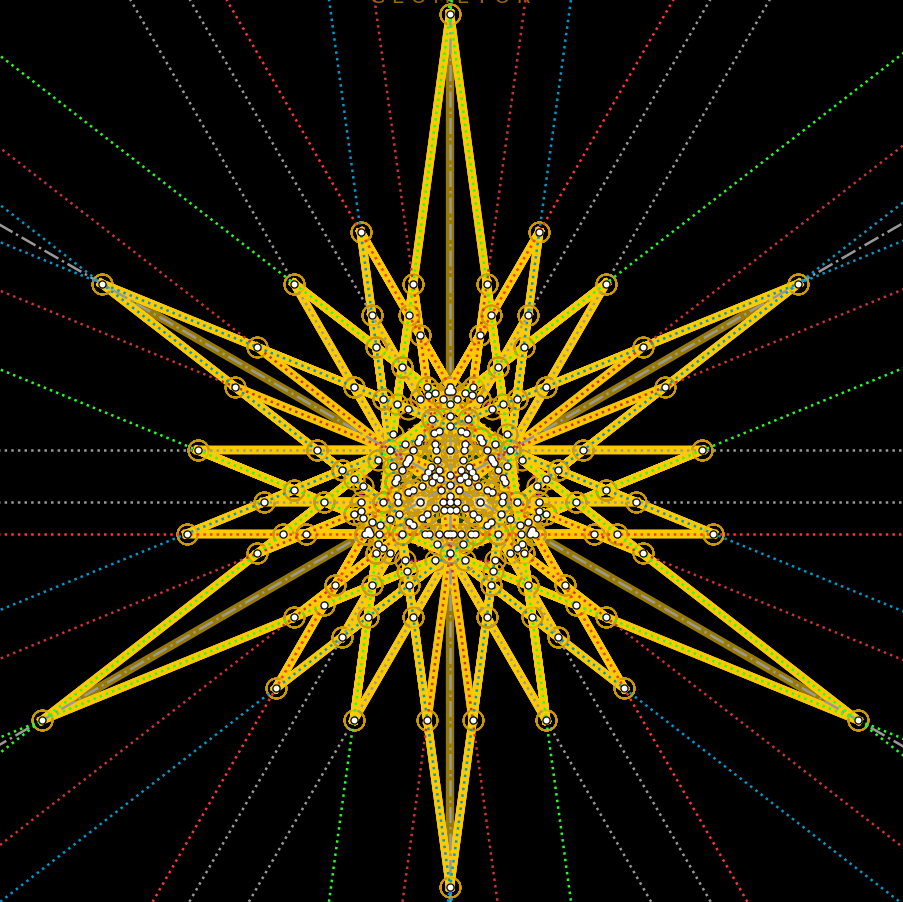
§ 1. Groups of Transformations, Principal Group & The General Problem — Summary¶
Analytical Synopsis of Klein’s Foundational Invariant Definition of Geometry
Axiomatic Group Closure (and Inverses): Klein defines a transformation group $G$ on space (or on an $n$-dimensional manifold $M$) as a family of transformations closed under composition—adding in his famous 1893 bracketed footnote that for infinite families one must explicitly stipulate closure under inverses ($g \in G \implies g^{-1} \in G$). While dualities (correlations) alone do not form a group because the product of two dualities is a collineation, the union of collineations and dualities forms an index-$2$ group extension.
The Principal Group (*Hauptgruppe*): Elementary Euclidean properties depend neither on absolute spatial position (translations and rotations), nor on absolute scale (homotheties), nor on chiral orientation (mirror reflections). Their composite group is the $7$-parameter spatial (or $4$-parameter planar) Principal Group of similarities. Elementary geometry is defined by invariance under the Principal Group.
The Erlangen Problem: Abstracting from physical space to any manifold $M$ equipped with an arbitrarily chosen transformation group $G$, Klein states the universal program of modern geometry:
\[\text{Geometry}(M, G) \;\equiv\; \text{Invariant Theory of } G \text{ acting on } M.\]