§§ 1–2: Principal Group & Transformation Hierarchy — Critical & Symbolic Notes¶
Exact Symbolic Verification of Invariant Shedding in geometor.klein.erlangen
Visualizing the Erlangen Subsumption Ladder¶
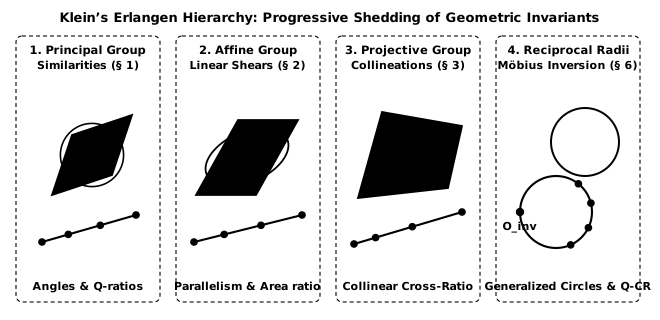
Klein’s Erlangen Hierarchy (§§ 1–3 & § 6). As the transformation group expands from the Principal Group (similarities) to Affine shears and Projective collineations, metric angles and quadrance ratios are progressively shed until only incidence and the $4$-point collinear cross-ratio survive; branching to Reciprocal Radii (Möbius circle inversion) merges lines and circles into generalized circles while preserving conformal angles and $4$-point quadrance cross-ratios.¶
Exact Symbolic Verification Over $\mathbb{Q}$ (geometor.klein.erlangen)¶
In geometor.klein.erlangen.verify_erlangen_invariants(), we instantiate rational test configurations inside geometor.model.Model (with zero floating-point approximations) and apply exact representatives of Klein’s four planar groups:
Principal Group (§ 1 — Rational Similarity): $(x, y) \mapsto (3x - 4y + 2,\; 4x + 3y - 1)$ (Pythagorean rotation-dilation scaling lengths by $5$ and quadrances by $25$).
Affine Group (§ 2 — Area-Scaling Shear): $(x, y) \mapsto (x + 2y + 1,\; 3y - 2)$ (fixes the line at infinity $w = 0$ without fixing the circular points $I, J$).
Projective Group (§ 3 — Full Homography): $(x, y) \mapsto \left(\frac{2x + y + 1}{x + y + 3},\; \frac{x + 3y + 2}{x + y + 3}\right)$ (moves the line at infinity to a finite horizon).
Reciprocal Radii (§ 6 — Möbius Circle Inversion): $(x, y) \mapsto \left(\frac{4x}{x^2 + y^2},\; \frac{4y}{x^2 + y^2}\right)$ (inverts across $x^2 + y^2 = 4$).
Using Rational Trigonometry invariants (Norman Wildberger, 2005; geometor.model.invariants), every invariant is tested by exact symbolic subtraction in SymPy:
Algebraic Invariant |
Principal (§ 1) |
Affine (§ 2) |
Projective (§ 3) |
Inversion (§ 6) |
|---|---|---|---|---|
Line Spread $s(\ell_{12}, \ell_{13})$ (Angle) |
Preserved ($\frac{9}{10}$) |
Broken ($\frac{81}{130}$) |
Broken ($\frac{25}{74}$) |
(Conformal) |
Quadrance Ratio $\frac{Q(T_1, T_2)}{Q(T_1, T_3)}$ |
Preserved ($\frac{4}{5}$) |
Broken ($\frac{1}{13}$) |
Broken ($\frac{185}{117}$) |
Broken ($\frac{65}{18}$) |
Parallelism ($\det(\ell, \ell') = 0$) |
Preserved |
Preserved |
Broken |
Broken |
Collinear Division Ratio $\frac{Q(A,B)}{Q(A,C)}$ |
Preserved ($\frac{1}{9}$) |
Preserved ($\frac{1}{9}$) |
Broken ($\frac{25}{147}$) |
Broken ($\frac{5}{27}$) |
Collinear Cross-Ratio $(A, B; C, D)$ |
Preserved ($\frac{4}{3}$) |
Preserved ($\frac{4}{3}$) |
Preserved ($\frac{4}{3}$) |
(On circle) |
4-Point Quadrance Cross-Ratio $\frac{Q_{AC} Q_{BD}}{Q_{AD} Q_{BC}}$ |
Preserved ($\frac{16}{9}$) |
Preserved ($\frac{16}{9}$) |
Preserved ($\frac{16}{9}$) |
Preserved ($\frac{16}{9}$) |
Philological Note on Footnote 8 (Group Inverses, 1893)¶
In 1872, following the finite permutation terminology of Galois, Serret, and Camille Jordan, Klein defined a group solely by closure under composition ($g_1, g_2 \in G \implies g_1 g_2 \in G$). For a finite set of bijections, closure automatically implies $g^{-1} = g^{k-1} \in G$; for infinite continuous families (such as contractions $x \mapsto \lambda x$ with $0 < \lambda < 1$), closure alone defines only a semigroup. Klein’s 1893 bracketed addition in Footnote 8 explicitly supplies the inverse axiom required by Sophus Lie's Theorie der Transformationsgruppen.