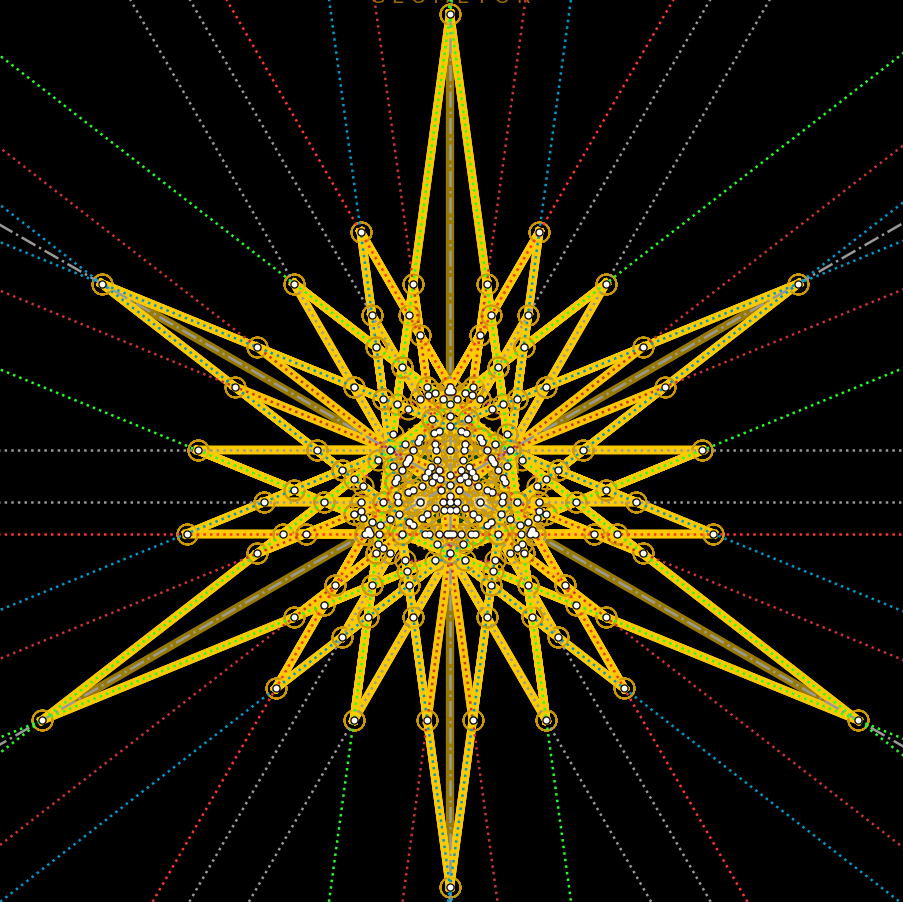
Section 3: Historical & Mathematical Commentary¶
Equivalence of Kepler’s Square-Pyramidal and Hexagonal Packings¶
A remarkable geometric subtlety appears in Strena §§11–12: Kepler describes two ways of stacking horizontal sphere layers so that each interior sphere touches twelve neighbors:
Start with a square grid in the horizontal $(x, y)$ plane and seat each sphere of the next layer into the fourfold hollow of four touching spheres below (cannonball pyramid).
Start with a triangular-hexagonal grid (fig03) and seat each sphere of the next layer into a threefold hollow ($A \to B \to C \to A\dots$ or $A \to B \to A\dots$).
In fact, the square-based cannonball pyramid is the face-centered cubic (FCC) lattice viewed along its [001] fourfold axis, whose [111] diagonal planes are hexagonal layers in ABCABC stacking! Both ABCABC (FCC, Voronoi cell = Rhombic Dodecahedron) and ABAB (HCP, Voronoi cell = Trapezo-Rhombic Dodecahedron) achieve the exact same packing fraction $\frac{\pi}{3\sqrt{2}}$. After standing open for 387 years, Kepler’s optimality claim was proved by Thomas C. Hales in 1998 (published 2005) and formally verified by machine in the Flyspeck theorem-proving project (2014).