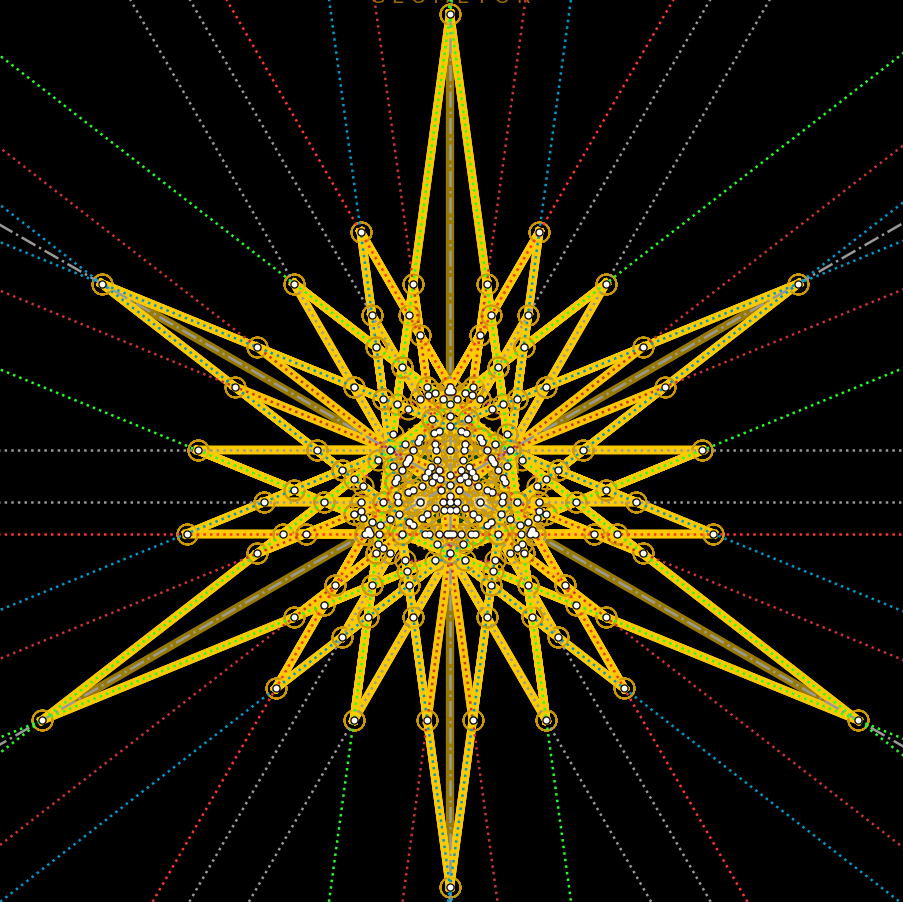
Caput III Prop. VIII: Historical & Mathematical Commentary
From Proportio Sesquialtera (1618) to Universal Gravitation (1687)
Kepler’s Third Law $(T_1 / T_2)^2 = (a_1 / a_2)^3$ (Book V, Ch. III, Prop. VIII) became the decisive quantitative touchstone from which Isaac Newton deduced in Principia (1687, Book I, Props. IV & XI) that a centripetal force holding planets in focal ellipses with $T^2 = \frac{4\pi^2}{GM} a^3$ must vary inversely as the square of the distance ($F \propto 1/r^2$). Two years after Harmonices Mundi, Kepler brought his lifework full circle by issuing the annotated second edition of Mysterium Cosmographicum (Frankfurt 1621), leaving his youthful 1596 text intact while supplying candid Notae Authoris explaining where pure polyhedral geometry required completion by elliptical dynamics and celestial harmony.