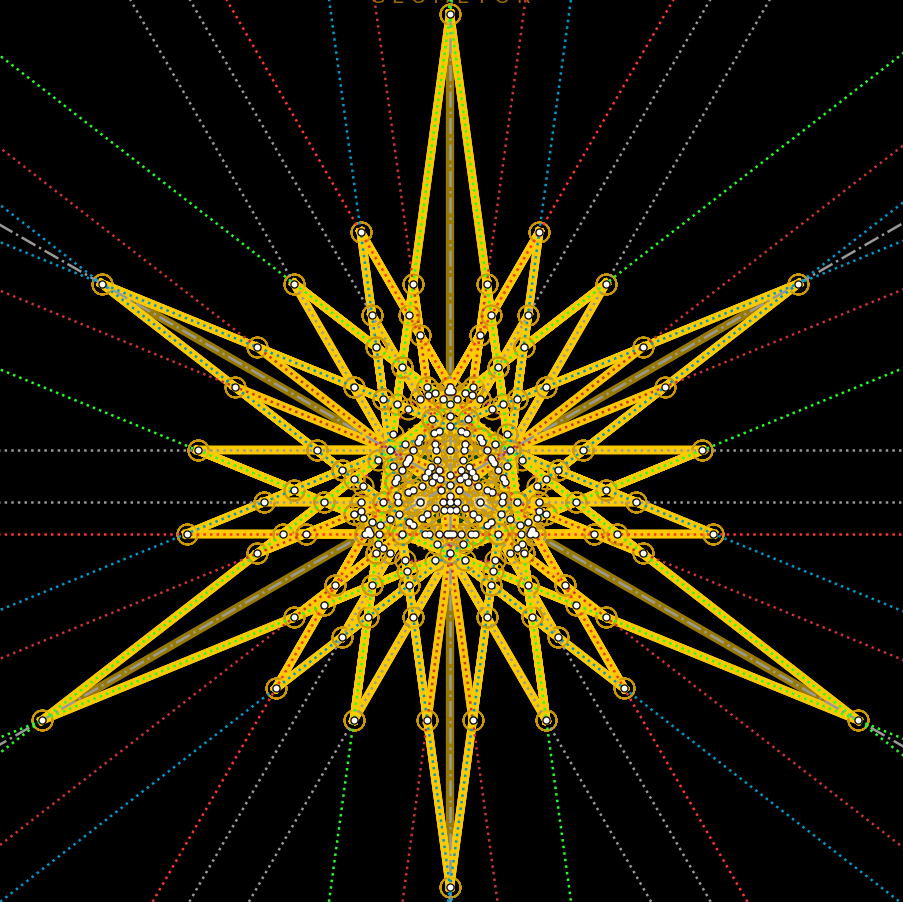
Liber V, Capita IV–IX: Consonances of Extremal Motions & Polyhedral Synthesis
Original GEOMETOR English translation from Johannes Kepler’s Harmonices Mundi Liber V, Capita IV–IX (Linz: Tampach/Plancus, 1619, pp. 190–255; Frisch V, pp. 285–329).
Why then did the five regular solids of Mysterium Cosmographicum leave small discrepancies when compared with Copernicus's and Brahe's eccentricities? Because—Kepler demonstrates in Chapters IV–IX—the Supreme Geometer wedded two distinct archetypes in a single cosmos:
Spatial Polyhedral Scaffolding: The five Euclidean regular solids (together with the Golden Rhombic Triacontahedron) prescribe the rough spacing of the six planetary shells around Terra (Circulus mensor).
Dynamic Musical Tuning of Eccentricities (harmonia motuum extremorum): Because a planet sweeps equal focal sector areas in equal times—compare the short, wide perihelion sector SECPER around Pper with the long, narrow aphelion sector SECAPH around Aaph—its apparent daily heliocentric angular speed $\omega$ varies inversely as the square of its solar distance:
$$\frac{\omega_{\text{per}}}{\omega_{\text{aph}}} = \left(\frac{r_{\text{aph}}}{r_{\text{per}}}\right)^2 = \left(\frac{1 + e}{1 - e}\right)^2.$$
Tuning these extremal daily angular motions to the just-intonation musical consonances derived from constructible polygons in Books I and III fixes the precise orbital eccentricities $e$ of all six planets:
Saturn ($1'46'' : 2'15''$ per day $\approx 4 : 5$) — Major Third (ditonus);
Jupiter ($4'30'' : 5'30''$ per day $= 5 : 6$) — Minor Third (sesquiquinta);
Mars ($26'14'' : 38'1''$ per day $\approx 2 : 3$) — Perfect Fifth (diapente);
Earth ($57'3'' : 61'18''$ per day $\approx 15 : 16$) — Diatonic Semitone (mi–fa, prompting Kepler’s wry lament: “Earth sings MI–FA–MI, so that even from the syllable you may guess that in this home of ours MIsery and FAmine hold sway”);
Venus ($94'50'' : 97'37''$ per day $\approx 24 : 25$) — Chromatic Diesis (nearly circular orbit inside the icosahedron);
Mercury ($164'0'' : 384'0''$ per day $= 5 : 12$) — Octave plus Minor Third (diapason cum semiditono, matching Mercury’s dramatic eccentricity inside the octahedron).