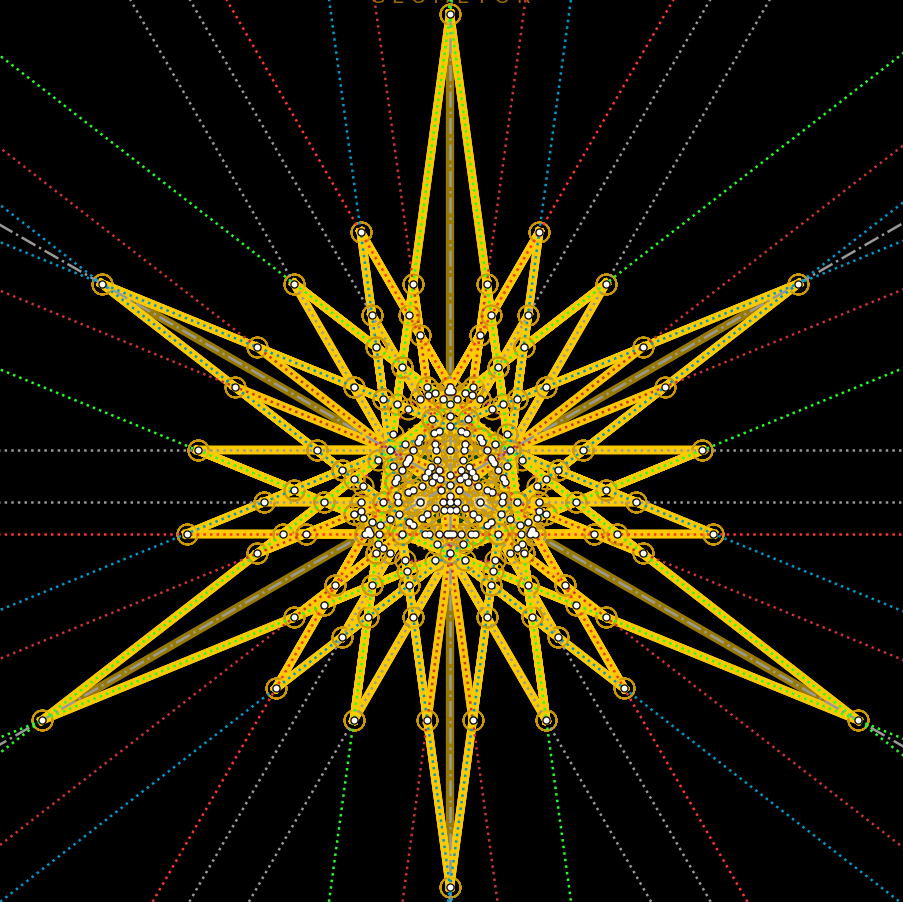
Prooemium: Historical & Mathematical Commentary
Why Harmonic Consonances Stop at the Number Five (Senarius)
Renaissance music theorists led by Gioseffo Zarlino (Le Istitutioni Harmoniche, 1558) had observed empirically that pure just-intonation musical consonances employ only ratios built from the integers $\{1, 2, 3, 4, 5, 6\}$ (octave $1:2$, fifth $2:3$, fourth $3:4$, major third $4:5$, minor third $5:6$, major sixth $3:5$, minor sixth $5:8$), whereas seven ($6:7, 7:8$) sounds harsh and dissonant—yet Zarlino offered only numerological excuses (senarius).
In Harmonices Mundi Books I and III, Kepler replaced numerology with constructive Euclidean geometry: the soul judges harmonic proportions by comparing circular arcs against the whole circle through innate geometric archetypes (scibilitas). Because polygons of $3, 4, 5, 6, 8, 10, 12, 15, 16\dots$ sides are constructible by straightedge and compass (Scibilia), their arc divisions generate musical consonances; because the regular heptagon ($n = 7$), enneagon ($n = 9$? wait: $1/3$ is constructible while $1/9$ requires angle trisection, though $9$ enters secondary ratios only via $3 \times 3$), hendecagon ($n = 11$), and tridecagon ($n = 13$) are non-constructible (Inscibilia), the prime $7$ is barred from primary harmonic division!