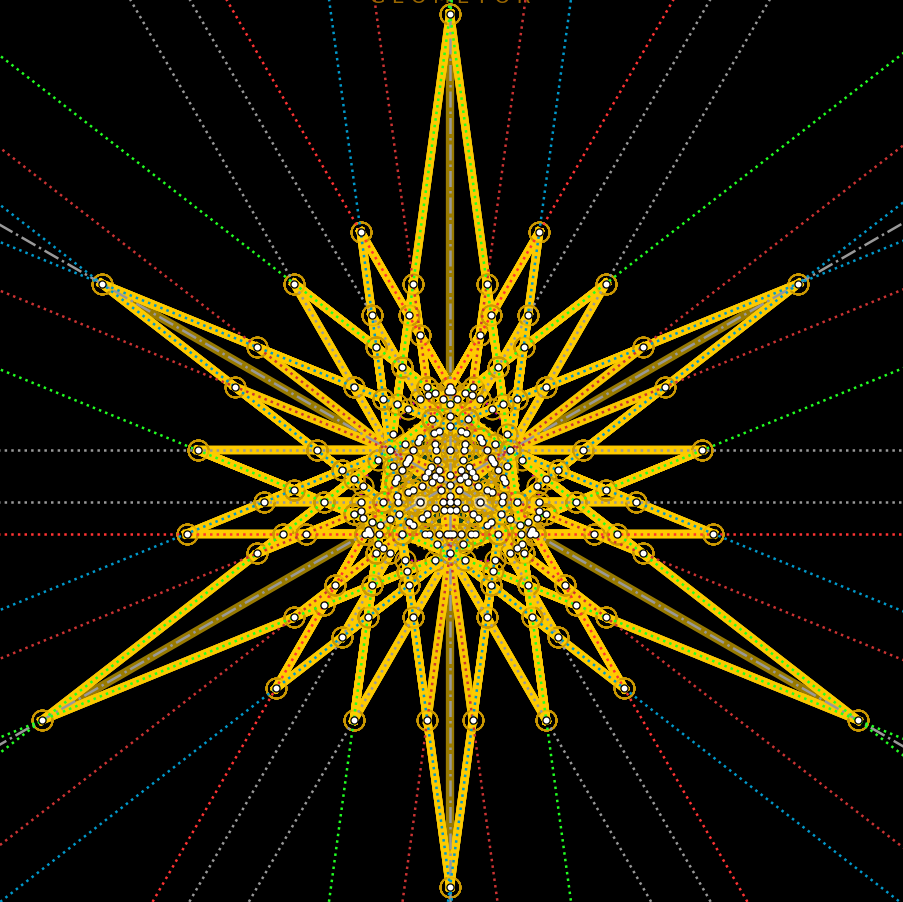
NOTES — DISTINCTIO VIII: SUBTILITATES GEOMETRICAE & FLOS (1225)
Philological Commentary, Classical Lineage, and Exact Symbolic Verification
English Edition · Latin (1220 / Boncompagni 1862) · Summary
Section 1: The Influence of Abū Kāmil’s On the Pentagon and Decagon
Leonardo’s algebraic treatment of the pentagon is directly modeled on the 9th-century Egyptian master Abū Kāmil Shujāʿ ibn Aslam (Kitāb fī al-jabr wa-al-muqābala and On the Pentagon and Decagon). By setting $x$ for the side, $x^2$ for census, and $x^4$ for census census, Leonardo introduces the earliest complete Latin demonstration of a biquadratic algebraic equation applied to classical Euclidean geometry.
Exact symbolic verification in geometor.fibonacci:
from geometor.fibonacci import construct_pentagon_decagon_in_circle, solve_pentagon_ptolemy_quartic, PHI
        import sympy as sp

        pent = construct_pentagon_decagon_in_circle()
        alg_side, alg_diag = solve_pentagon_ptolemy_quartic(10)
        assert sp.simplify(alg_side - pent.pentagon_side) == 0
        assert sp.simplify(alg_diag / alg_side - PHI) == 0
Section 2: The 1225 Imperial Mathematical Contest in Pisa
In 1225, Emperor Frederick II visited Pisa with his court philosopher Master John of Palermo. John proposed two famous challenge problems:
The Congruum Problem: Solved by Fibonacci using the congruum identity $C = 4mn(m^2 - n^2)$ with generator pair $(m, n) = (5, 4)$, yielding $C = 720$ and the rational solution $x = \frac{41}{12}$.
The Cubic Equation: $x^3 + 2x^2 + 10x = 20$. Leonardo’s geometric proof that this equation has no solution among the rational numbers or the quadratic irrationals of Euclid’s Book X represents the high-water mark of medieval European algebra, three centuries before Cardano and Tartaglia.
Symbolic verification in geometor.fibonacci:
from geometor.fibonacci import flos_congruum_squares, flos_sexagesimal_cubic
        import sympy as sp

        cong_a, cong_x, cong_b = flos_congruum_squares()
        assert cong_x**2 - 5 == cong_a**2
        assert cong_x**2 + 5 == cong_b**2

        cubic = flos_sexagesimal_cubic()
        assert cubic.rational_root == sp.Rational(1_596_577_777, 1_166_400_000)
        assert float(cubic.abs_root_error.evalf()) < 4e-11