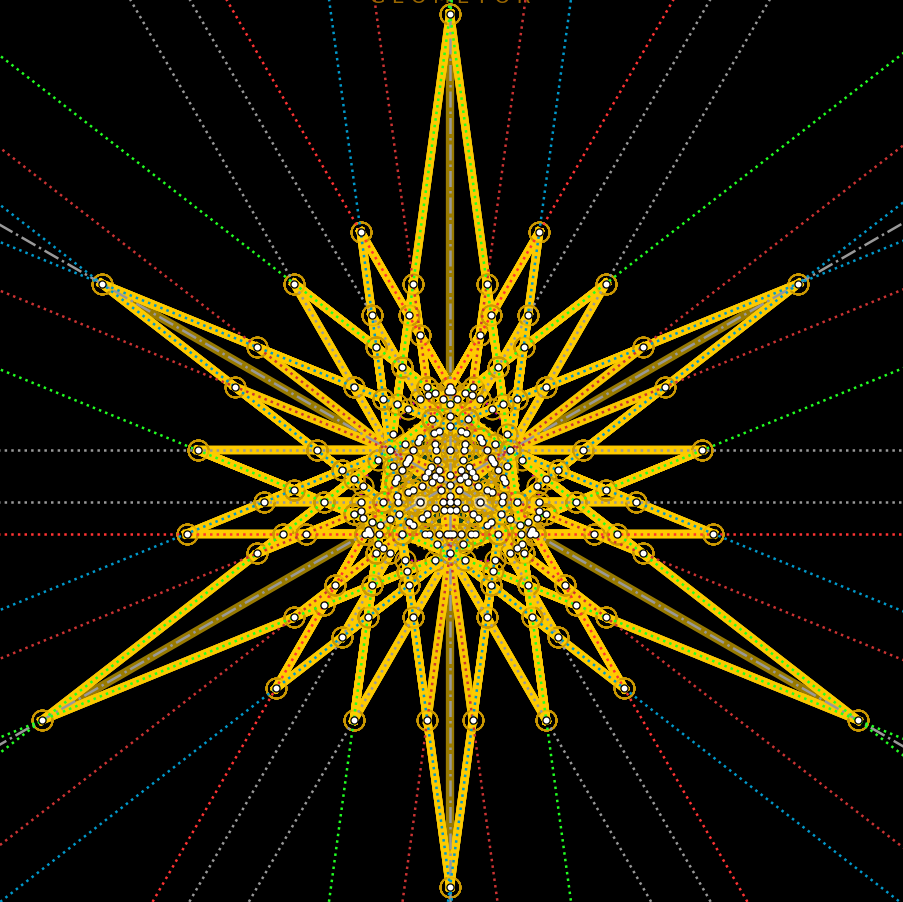
DISTINCTIO VIII — SUBTILITATES GEOMETRICAE & FLOS (1225)
Geometrical Subtleties of the Pentagon and Decagon, Al-Jabr Quartic, and the Flos Imperial Cubic
Source Text: fibonacci:pg-8, fibonacci:flos (Boncompagni Vol. II, pp. 207–234 · fol. 134r–148v & Flos) · Latin (1220 / Boncompagni 1862) · Summary · GEOMETOR Notes
Distinctio VIII — Subtilitates Geometricae: Pentagon, Decagon & Al-Jabr
Latin Locus: Distinctio VIII — De Subtilitatibus Geometricis (pp. 207–226) · Commentary: Notes on Abū Kāmil’s Quartic & Euclid XIII.10
Euclidean Construction in Circle Diameter $10$ ([XIII. 9–10]): In circle (IA) of diameter $CA = 10$ through C, center I, and A, erect perpendicular radius ID $= 5$ to apex D, and bisect $IC$ at H ($IH = 2\frac{1}{2}$). Then hypotenuse HD has square $25 + 6\frac{1}{4} = 31\frac{1}{4}$. Turning circle (HD) onto the diameter at K along IK divides radius $IA = 5$ (the inscribed hexagon side) in extreme and mean ratio, yielding the decagon side IK equal to chord DQ1 (an apotome):
$$s_{10} = IK = \sqrt{31\frac{1}{4}} - 2\frac{1}{2} = \frac{5(\sqrt{5} - 1)}{2}.$$
By Euclid’s theorem that the square on the pentagon side equals the sum of the squares on the hexagon and decagon sides [XIII. 10], hypotenuse DK is the exact side of the regular pentagon DP1P2P3P4 (with vertices P1, P2, P3, P4):
$$s_5^2 = ID^2 + IK^2 = 25 + \left(37\frac{1}{2} - \sqrt{781\frac{1}{4}}\right) = 62\frac{1}{2} - \sqrt{781\frac{1}{4}}, \qquad s_5 = \frac{5\sqrt{10 - 2\sqrt{5}}}{2}.$$
Algebraic Derivation via *Res*, *Census* & *Census Census* (ptolemy:almagest): Following al-Khwārizmī and Abū Kāmil, let the unknown pentagon side be one thing (res $= x$), so its square is one census ($x^2$) and its fourth power is census census ($x^4$). Combining Ptolemy’s cyclic-quadrilateral theorem [VI. D] with diameter $d = 10$ produces the biquadratic equation:
$$x^4 + 3{,}125 = 125\,x^2.$$
Completing the square in census ($x^2 = 62\frac{1}{2} - \sqrt{3{,}906\frac{1}{4} - 3{,}125} = 62\frac{1}{2} - \sqrt{781\frac{1}{4}}$) recovers the identical Euclid X minor irrational!
f. boncompagni_1862_vol2_practica_geometriae:0234 · p. 227–234
Flos (1225) — The Imperial Cubic & Book X Irrationals
Latin Locus: Flos super Solutionibus Quarundam Questionum (pp. 227–234) · Commentary: Notes on the Flos Cubic & Congruum
Five years after Practica Geometriae, at the Pisan court of Emperor Frederick II, Master John of Palermo proposed two celebrated challenges preserved in Leonardo’s Flos (fibonacci:flos, dedicated to Cardinal Raniero Capocci):
The Congruum of Five (Liber Quadratorum & Flos): Find a rational square $x^2$ which, increased or diminished by $5$, remains a rational square ($x^2 \pm 5 = \square$). Scaling by $12^2 = 144$ (since $5 \times 144 = 720$ is a congruum arising from $m = 5, n = 4$: $4mn(m^2 - n^2) = 720$), Leonardo exhibits $31^2 + 720 = 41^2$ and $41^2 + 720 = 49^2$, whence $x = 3\frac{5}{12} = \frac{41}{12}$:
$$\left(\frac{41}{12}\right)^2 - 5 = \left(\frac{31}{12}\right)^2, \qquad \left(\frac{41}{12}\right)^2 + 5 = \left(\frac{49}{12}\right)^2.$$
The Irreducible Cubic Equation: Find a line $x$ such that a cube plus two squares and ten roots equals twenty:
$$x^3 + 2x^2 + 10x = 20.$$
Testing every species of rational fraction and every quadratic irrational classified in Euclid’s Book X (binomiale, recisum, medial, minor, major), Leonardo proves rigorously that $x$ cannot be expressed by any square-root tower of Book X, and then exhibits its astonishing six-place sexagesimal root:
$$x \approx 1^{\circ}\ 22'\ 7''\ 42'''\ 33''''\ 4'''''\ 40'''''' = \frac{1{,}596{,}577{,}777}{1{,}166{,}400{,}000} \approx 1.36880810785322\dots$$
whose error from the true real root $1.36880810782137\dots$ is less than $3.2 \times 10^{-11}$!