VII.39
To find the number which is the least that will have given parts.
Let A, B, C be the given parts; thus it is required to find the number which is the least that will have the parts A, B, C.
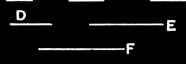
Let D, E, F be numbers called by the same name as the parts A, B, C, and let G, the least number measured by D, E, F, be taken. [VII.36]
Therefore G has parts called by the same name as D, E, F. [VII.37]
But A, B, C are parts called by the same name as D, E, F; therefore G has the parts A, B, C.
I say next that it is also the least number that has.
For, if not, there will be some number less than G which will have the parts A, B, C.
Let it be H.
Since H has the parts A, B, C, therefore H will be measured by numbers called by the same name as the parts A, B, C. [VII.38]
But D, E, F are numbers called by the same name as the parts A, B, C; therefore H is measured by D, E, F.
And it is less than G : which is impossible.
Therefore there will be no number less than G that will have the parts A, B, C. Q. E. D.