IV.4
In a given triangle to inscribe a circle.
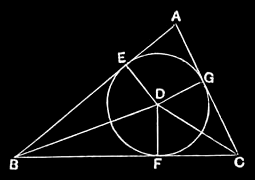
Let ABC be the given triangle; thus it is required to inscribe a circle in the triangle ABC.
Let the angles ABC, ACB
be bisected by the straight lines BD, CD [I.9], and let these meet one another at the point D; from D let DE, DF, DG be drawn perpendicular to the straight lines AB, BC, CA.
Now, since the angle ABD is equal to the angle CBD, and the right angle BED is also equal to the right angle BFD, EBD, FBD are two triangles having two angles equal to two angles and one side equal to one side, namely that subtending one of the equal angles, which is BD common to the triangles;
therefore they will also have the remaining sides equal to the remaining sides; [I.26]
therefore DE is equal to DF.
For the same reason
DG is also equal to DF.
Therefore the three straight lines DE, DF, DG are equal to one another;
- therefore the circle described with centre
Dand distance one of the straight linesDE,DF,DGwill pass also through the remaining points, and will touch the straight linesAB,BC,CA, because the angles at the pointsE,F,G are right.
For, if it cuts them, the straight line drawn at right angles to the diameter of the circle from its extremity will be found to fall within the circle : which was proved absurd; [III.16]
therefore the circle described with centre D and distance one of the straight lines DE, DF, DG will not cut the straight lines AB, BC, CA;
therefore it will touch them, and will be the circle inscribed in the triangle ABC. [IV.def.5]
Let it be inscribed, as FGE.
Therefore in the given triangle ABC the circle EFG has been inscribed. Q. E. F.
and distance one of the (straight lines D)E, (D)F, (D)G. The words and letters here shown in brackets are put in to fill out the rather careless language of the Greek. Here and in several other places in Book IV. Euclid says literally and with distance one of the (points) E, F, G
(καὶ διαστήματι ὲνὶ τῶν E, Z, H) and the like. In one case (IV.13) he actually has with distance one of the points G, H, K, L, M
(διαστήματι ὲνὶ τῶν Η, Θ, Κ, Λ, Μ σημείων). Heiberg notes Graecam locutionem satis miram et negligentem,
but, in view of its frequent occurrence in good MSS., does not venture to correct it.