I.43
In any parallelogram the complements of the parallelograms about the diameter are equal to one another.
- Let
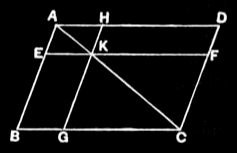
ABCDbe a parallelogram, andACits diameter; and aboutACletEH,FGbe parallelograms, andBK,KD the so-called complements;
I say that the complement BK is equal to the complement KD.
For, since ABCD is a parallelogram, and AC its diameter, the triangle ABC is equal to the triangle ACD. [I.34]
Again, since EH is a parallelogram, and AK is its diameter, the triangle AEK is equal to the triangle AHK.
For the same reason the triangle
KFCis also equal toKGC.
- Now, since the triangle
AEKis equal to the triangleAHK, andKFCtoKGC, the triangle
AEKtogether withKGCis equal to the triangleAHKtogether withKFC. [I.cn.2]
And the whole triangle ABC is also equal to the whole ADC; therefore the complement BK which remains is equal to the complement KD which remains. [I.cn.3]
Therefore etc.
Q. E. D.
Note
1
complements, παραπληρώματα, the figures put in to fill up (interstices).
Note
4. and about AC….
Euclid’s phraseology here and in the next proposition implies that the complements as well as the other parallelograms are about
the diagonal. The words are here περὶ δὲ τὴν ΑΓ παραλληλόγραμμα μὲν ἔστω τὰ ΕΘ, ΖΗ, τὰ δὲ λεγόμενα παραπληρώματα τὰ ΒΚ, ΚΔ. The expression the so-called complements
indicates that this technical use of παραπληρώματα was not new, though it might not be universally known.