I.34
In parallelogrammic areas the opposite sides and angles are equal to one another, and the diameter bisects the areas.
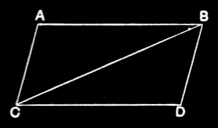
Let ACDB be a parallelogrammic area, and BC its diameter; I say that the opposite sides and angles of the parallelogram ACDB are equal to one another, and the diameter BC bisects it.
For, since AB is parallel to CD, and the straight line BC has fallen upon them, the alternate angles ABC, BCD are equal to one another. [I.29]
Again, since AC is parallel to BD, and BC``has fallen upon them, the alternate angles ``ACB, CBD are equal to one another. [I.29]
Therefore ABC, DCB are two triangles having the two angles ABC, BCA equal to the two angles DCB, CBD respectively, and one side equal to one side, namely that adjoining the equal angles and common to both of them, BC; therefore they will also have the remaining sides equal to the remaining sides respectively, and the remaining angle to the remaining angle; [I.26] therefore the side AB is equal to CD, and AC to BD, and further the angle BAC is equal to the angle CDB.
- And, since the angle
ABCis equal to the angleBCD, and the angleCBDto the angleACB, the whole angleABDis equal to the whole angleACD. [I.cn.2] And the angle
BACwas also proved equal to the angleCDB.
Therefore in parallelogrammic areas the opposite sides and angles are equal to one another.
I say, next, that the diameter also bisects the areas.
For, since AB is equal to CD, and BC is common, the two sides AB, BC are equal to the two sides DC, CB respectively; and the angle ABC is equal to the angle BCD; therefore the base AC is also equal to DB, and the triangle ABC is equal to the triangle DCB. [I.4]
Therefore the diameter BC bisects the parallelogram ACDB.
Q. E. D.
Note
1
It is to be observed that, when parallelograms have to be mentioned for the first time, Euclid calls them parallelogrammic areas
or, more exactly, parallelogram
areas (παραλληλόγραμμα χωρία). The meaning is simply areas bounded by parallel straight lines with the further limitation placed upon the term by Euclid that only
four-sidedfigures are so called, although of course there are certain regular polygons which have opposite sides parallel, and which therefore might be said to be areas bounded by parallel straight lines. We gather from Proclus (p. 393) that the word parallelogramwas first introduced by Euclid, that its use was suggested by I.33, and that the formation of the word παραλληλόγραμμος (parallel-lined) was analogous to that of εὐθύγραμμος (straight-lined or rectilineal).
Note
17, 18, 40. DCB
and 36. DC, CB. The Greek has in these places BCD
and
CD,BCrespectively. Cf. note on I.33, lines 15, 18.