I.35
Parallelograms which are on the same base and in the same parallels are equal to one another.
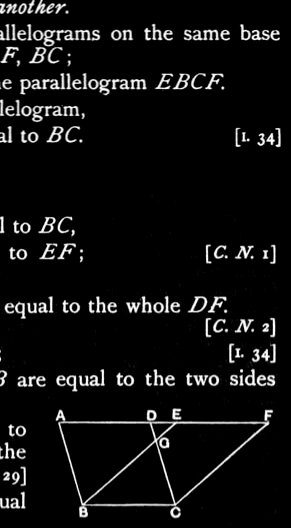
Let ABCD, EBCF be parallelograms on the same base BC and in the same parallels AF, BC; I say that ABCD is equal to the parallelogram EBCF.
For, since ABCD is a parallelogram, AD is equal to BC. [I.34]
For the same reason also EF is equal to BC, so that AD is also equal to EF; [I.cn.1] and DE is common; therefore the whole AE is equal to the whole DF. [I.cn.2]
- But
ABis also equal toDC; [I.34] therefore the two sidesEA,ABare equal to the two sidesFD,DCrespectively, and the angle
FDCis equal to the angleEAB, the exterior to the interior; [I.29] therefore the baseEBis equal to the baseFC, and the triangleEABwill be equal to the triangleFDC. [I.4]
Let DGE be subtracted from each; therefore the trapezium ABGD which remains is equal to the trapezium EGCF which remains. [I.cn.3]
Let the triangle GBC be added to each; therefore the whole parallelogram ABCD is equal to the whole parallelogram EBCF. [I.cn.2]
Therefore etc.
Q. E. D.
Note
21. FDC.
The text has DFC.
Note
22. Let DGE be subtracted.
Euclid speaks of the triangle DGE without any explanation that, in the case which he takes (where AD, EF have no point in common), BE, CD must meet at a point G between the two parallels. He allows this to appear from the figure simply.