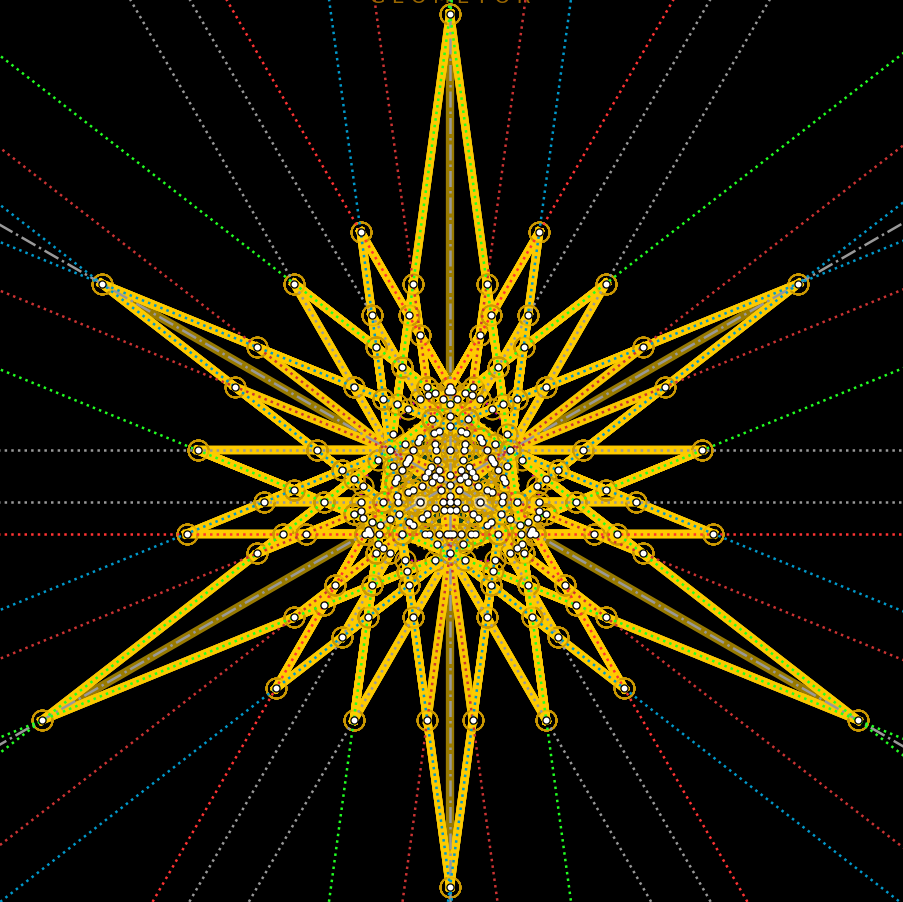
X3640
1st KIRIKAMI POINT
X3640 (1st KIRIKAMI POINT) constructed on acute reference triangle \((a, b, c) = (5, 6, 7)\) with unit baseline AB = \(1\).
Constructed Elements
Central Lines: {1, 6}, {8, 175}
Related Centers: X1 (INCENTER), X6 (SYMMEDIAN POINT), X8 (NAGEL POINT), X175 (ISOPERIMETRIC POINT)
Linear Combinations1 combination
Incident Central Lines70 lines
{1, 6}, {3, 11498}, {8, 175}, {10, 5590}, {30, 16131}, {40, 11825}, {55, 8199}, {65, 10976}, {142, 30342}, {144, 30334}, {145, 30333}, {200, 13388}, {355, 6214}, {481, 2550}, {515, 5870}, {517, 1160}, {519, 5860}, {537, 24832}, {730, 6272}, {944, 10784}, {946, 6201}, {952, 5874}, {976, 36567}, {982, 8945}, {1374, 5880}, {1385, 26348}, {1482, 11917}, {1703, 8416}, {1829, 11389}, {1837, 10926}, {2800, 12754}, {2802, 13270}, {2809, 6213}, {3057, 10928}, {3083, 3873}, {3084, 3681}, {3244, 26340}, {3576, 45553}, {3579, 35247}, {4847, 13390}, {5252, 10924}, {5393, 25568}, {5405, 24477}, {5587, 10515}, {5594, 9798}, {5657, 10518}, {5689, 10513}, {5698, 31567}, {5881, 6278}, {6001, 6257}, {6203, 30320}, {8218, 12440}, {8219, 12441}, {8975, 8983}, {9941, 9995}, {10793, 12194}, {11902, 12438}, {12697, 40268}, {13950, 13971}, {16232, 39959}, {18480, 18511}, {18525, 26346}, {26338, 45717}, {26344, 45711}, {26345, 45712}, {26347, 45718}, {35641, 35794}, {35642, 35793}, {36480, 36536}, {45551, 45716}
Functional Relations3 relations
X3640 = reflection of Xi in Xj for these {i,j}: {1, 45713}, {3641, 1}, {12698, 1160}, {45720, 3244}
X3640 = {Xi,Xj}-harmonic conjugate of Xk for these (i,j,k): {1, 6, 11371}, {1, 3751, 18991}, {1, 5223, 30557}, {1, 5588, 6}, {1, 5589, 7969}, {1, 18992, 11370}, {1, 19003, 1386}, {1, 19004, 45398}, {1, 45426, 18992}, {6, 5604, 1}, {6, 10930, 10041}, {6, 10932, 10049}, {8, 1270, 5688}, {3242, 7968, 1}, {4663, 45398, 19004}, {5588, 5604, 11371}, {5605, 44636, 1}, {6762, 7174, 3641}, {7969, 45476, 1}, {8199, 8206, 55}, {10920, 10922, 6214}, {11498, 22757, 3}, {12594, 19049, 10040}, {12595, 19047, 10048}, {26349, 26350, 6}, {45422, 45729, 3301}, {45424, 45728, 3299}
Notes
Seiichi Kirikami (November 1, 2010), defined a point P having actual trilinear distances (p,q,r) by the equations a + p = b + q = c + r and a point P' with distances (p’,q’,r’) satisfying p - a = q - b = r - c. Here, P = X3640 and P' = X3641. Kirikami also discovered a bicentric pair of points satisfying p + b = q + c = r + a and another bicentric pair satisfying p - b = q - c = r - a. The six point are given by homogeneous trilinears \(t(a,b,c) : t(b,c,a) : t(c,a,b)\) as follows:
X3640: t(a,b,c) = \(b^{2}\) + \(c^{2}\) - ab - ac + 2*area(ABC)
X3641: t(a,b,c) = \(b^{2}\) + \(c^{2}\) - ab - ac - 2*area(ABC)
K1: t(a,b,c) = ac - \(b^{2}\) + 2*area(ABC)
K2: t(a,b,c) = ab - \(c^{2}\) + 2*area(ABC)
K3: t(a,b,c) = ac - \(b^{2}\) + 2*area(ABC)
K4: t(a,b,c) = ab -\(cb^{2}\) + 2*area(ABC)
Peter Moses (November 1, 2010) found that the six points lie on an ellipse, E, here called the Kirikami-Moses ellipse. The center of E is the incenter of ABC, and an equation for E is as follows:
e(a,b,c,x,y,z) + e(b,c,a,y,z,x) + e(c,a,b,z,x,y) = 0, where
e(a,b,c,x,y,z) = h(a,b,c)\(x^{2}\) - j(a,b,c)yz, where
\(h(a,b,c) = (5a^{4} + b^{4} + c^{4} - 4a^{3}b - 4a^{3}c - 4a^{2}bc + 2b^{2}c^{2} + 2c^{2}a^{2} + 2a^{2}b^{2})\)
and
Moses found six more points on E:
M1 = (b - c) (a + b + c) + 2*\(\sqrt{3}\)*area(ABC) : :
M2 = (b - c) (a + b + c) - 2*\(\sqrt{3}\)*area(ABC) : :
M3 = 2ab + ac - \(b^{2}\) - \(2c^{2}\) + 2*\(\sqrt{3}\)*area(ABC) : :
M4 = 2ac + ab - \(c^{2}\) - \(2b^{2}\) + 2*\(\sqrt{3}\)*area(ABC) : :
M5 = 2ab + ac - \(b^{2}\) - \(2c^{2}\) - 2*\(\sqrt{3}\)*area(ABC) : :
M6 = 2ac + ab - \(c^{2}\) - \(2b^{2}\) - 2*\(\sqrt{3}\)*area(ABC) : : ‘
These six points comprise three bicentric pairs: {M1, M2}, {M3, M4}, {M5, M6}.
Further properties found by Moses:
The incenter is the midpoint of the segments X3640X3641, K1K2, and K3K4.
The lines X3640K4, K1K3, and X3641K2 are parallel; indeed, the reflection of the first in the second is the third.
The lines X3640K3, K2K3, and X3641K1 are parallel, and the reflection of the first in the second is the third.
The lines tangent to E at X3640 and X3641 are perpendicular to the line X1X3, as are the lines K1K2 and K3K4.
The following four lines are parallel: the tangents to E at K2 and K4, and X3640K1 and X3641K3.
The following four lines are parallel: the tangents to E at K1 and K3, and X3640K2 and X3641K4.