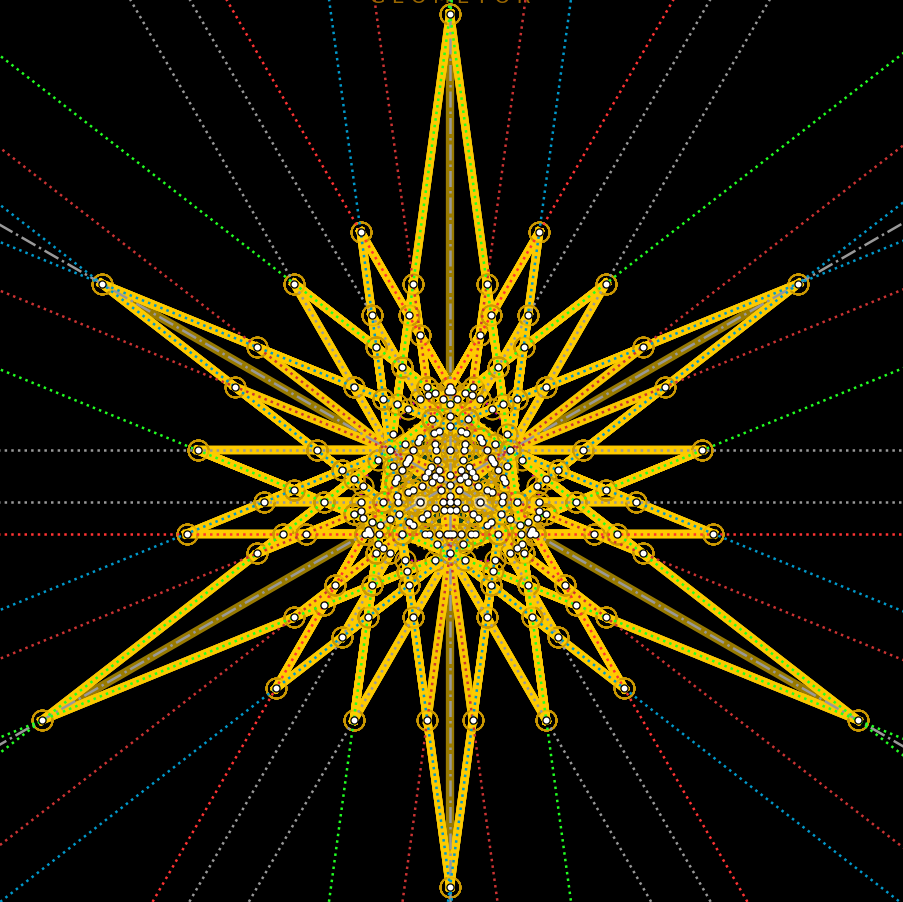
Centers associated with the three Morley cubics K029–K031 (X3602–X3615), medial-triangle t-dilation homothetic centers H(X; M, t) and their isogonal conjugates H⁻¹(X; M, t) (X3616–X3637), Soddy-Gergonne, Kirikami, Alkaid, and Almach points (X3638–X3646), and Kirikami-Schiffler points KS(T) (X3647–X3662).
X3602–X3662 (Morley Cubics, Medial Homothetic Centers H(X; M, t) & Kirikami-Schiffler Points) — 16 representative centers (from 61 in collection) constructed on acute reference triangle \((a, b, c) = (5, 6, 7)\) with unit baseline AB = \(1\).
Group Preamble — Points Associated with Morley Cubics (Points associated with Morley cubics K29, K30, K31)
Points X3602-X3609 are associated with the three Morley Cubics indexed as K29, K30, K31 at Bernard Gibert’s Cubics in the Triangle Plane. The points are related to those in the section just before X3272, under the heading “Points Associated with Equilateral Triangles.” See also
Jean-Pierre Ehrmann and Bernard Gibert, “A Morley Configuration,” :cite:`Forum Geometricorum <forum-geometricorum>` 1 (2001) 51-58. (Click here to download a PDF of this article.)
Group Preamble — Homothetic Centers: X3616-X3637
Suppose that X is a triangle center, that M is the medial triangle, and that t is a real number. The t-dilation of M from X, denoted by H(X; M, t), is a triangle center. If X =\(x : y : z\) (trilinears), then
Group Preamble — Kirikami-Schiffler Points: X3647-X3652
Suppose that X is a point and A'B'C' is a central triangle. Let LA be the line through A' parallel to the Euler line of triangle BCX, let LB be the line through B' parallel to the Euler line of CXA, and let LC be the line through C' parallel to the Euler line of AXB.
It is well known that if X=X1, the incenter, then the three aforementioned Euler lines concur in the Schiffler point, X21. If their parallels, the lines LA, LB, LC concur, the point of concurrence is the Kirikami-Schiffler point of the triangle A'B'C', denoted by KS(A'B'C'). Seiichi Kirikami (February 1, 2011) found that those lines concur if A'B'C' is the reference triangle ABC and also concur if A'B'C' is the medial triangle. Peter Moses found additional cases and properties. A summary follows:
Suppose that A'B'C' is the cevian triangle of a point P. Then LA, LB, LC concur if and only if P lies on the cubic K455.
Suppose that A'B'C' is the anticevian triangle of a point P. Then LA, LB, LC concur if and only if P lies on the cubic given by the barycentric equation
a(2a + b + c)yz(y - z) + b(2b + c + a)zx(z - x) + c(2c + a + b)xy(x - y) = 0.
Suppose that A'B'C' is the pedal triangle of a point P on the line X1X3. Then LA, LB, LC concur.
Suppose that A'B'C' is the antipedal triangle of a point P on the line X1X4. Then LA, LB, LC concur.
X3609 is the perspector of the triangle of the cusps of the Steiner deltoid and the equilateral triangle J defined just before X3272. (Bernard Gibert, November 3, 2010)
Moses found that the locus of X such that the cevian triangle of X is perspective to the Ayme triangle is a cubic which passes through the points Xi for i = 1, 2, 19, 75, 279, 304, 346, 2184. A barycentric equation for this Ayme-Moses cubic follows:
(Cyclic sum of ayz[\(by(a^{2}\) + \(b^{2}\) - \(c^{2})\) - \(cz(a^{2}\) - \(b^{2}\) + \(c^{2}\)] ) = 0.
In a Hyacinthos message dated January 7, 2011, Jean-Louis Ayme noted that the orthic triangle of ABC is perspective to the medial triangle of the extangents triangle of ABC. Peter Moses found coordinates for the perspector, X3611.
Let Ja, Jb, Jc be the excenters and I the incenter. Let A' be the centroid of JbJcI, and define B' and C' cyclically. A'B'C' is also the cross-triangle of the excentral and 2nd circumperp triangles. A'B'C' is homothetic to the reflection triangle of X1 at X3612. (Randy Hutson, July 31 2018)
Let EuaEubEuc be the Feuerbach triangle, L the line through A and X5, and A″ = L∩EubEuc; define B″ and C″ cyclically. Then the lines EuaA″, EubB″, EucC″ concur in X3614. X3614 = {X5,X12}-harmonic conjugate of X11. Further, X3614 is the trilinear pole (with respect to the Feuerbach triangle) of the perspectrix of ABC and the Feuerbach triangle. (Randy Hutson, August 30, 2011.)
Let OA be the circle tangent to side BC at its midpoint and to the circumcircle on the side of BC opposite A. Define OB and OC cyclically. Let LA be the external tangent to circles OB and OC that is the nearer of the two to OA. Define LB and LC cyclically. Let A' = LB∩LC, and define B' and C' cyclically. Then A'B'C' is homothetic to ABC, and the center of homothety is X3616. See the reference at X1001.
Write I = X1, U = X7, r = inradius, R = circumradius, and d = 4*\(\sqrt{3}\)*area(ABC). Then distance ratios are given by |IP|/|PU| = 2r(r + 4R)/d and |IQ|/|QU| = -2r(r + 4R)/d
Denote the incenter and excenters by I, IA, IB, IC. Let JA be the incenter of triangle BCI, and define JB and JC cyclically. The lines IAJA, IBJB, ICJC concur in X3645.
Denote the incenter and excenters by I, IA, IB, IC. Let KA be the centroid of triangle BCI, and define KB and KC cyclically. The lines IAKA, IBKB, ICKC concur in X3646.
Two proofs of Dao’s theorem about cyclic hexagons were published in 2014: Nikolaos Dergiades’s Dao’s Theorem on Six Circumcenters Associated with a Cyclic Hexagon and Telv Cohl’s A Purely Synthetic Proof of Dao’s Theorem on Six Circumcenters Associated with a Cyclic Hexagon. In the degenerate case that the hexagon is the intouch triangleA'B'C', the triangle of the circumcenters of AB'C', A'BC', A'B'C is perspective to A'B'C' with perspector X3649. (Dao Thanh Oai, Francisco Javier Garcia Capitan, ADGEOM #1718, September 16, 2014)
Quim Castellsaguer defines the Carnot triangle as the triangle formed by the circumcenters of the triangles BCH, CAH, ABH, where H denotes the orthocenter. The Carnot triangle is also known as the Johnson triangle.