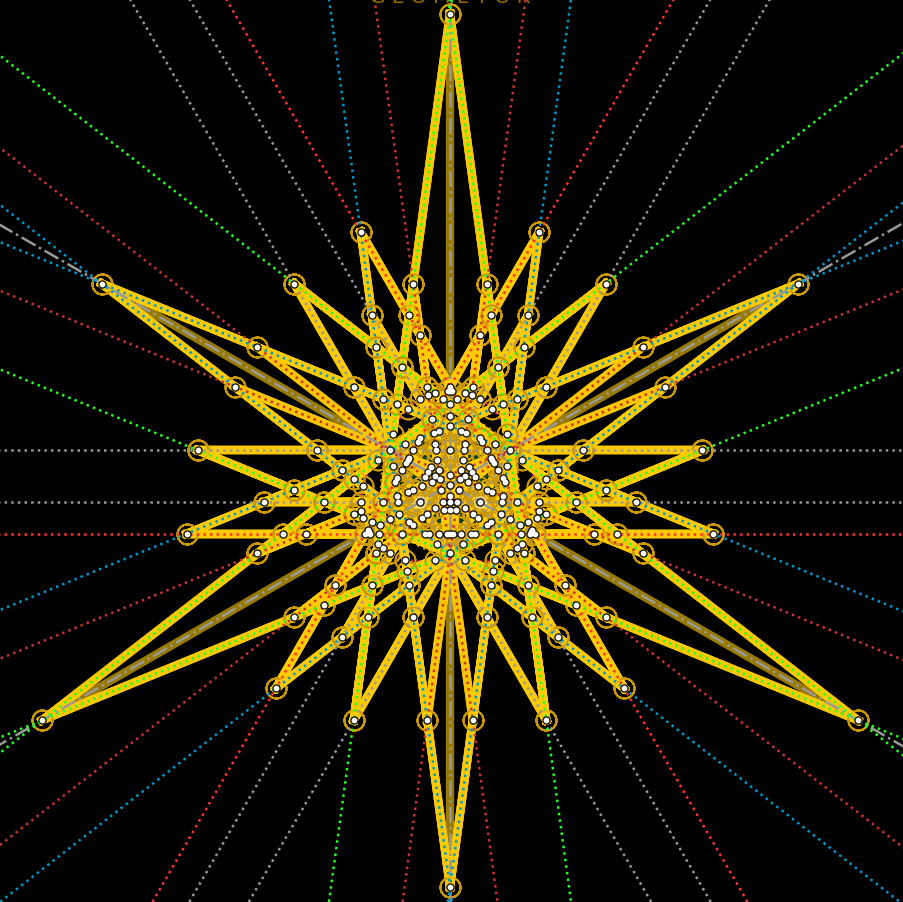
G.549 sides opposite planes — Code
If the sides of the opposite planes of a cube be bisected, and planes be carried through the points of section, the common section of the planes and the diameter of the cube bisect one another.
#!/usr/bin/env python3
        """
        Programmatic construction for Book XI, Proposition 38 (XI.38)
        using geometor.model.
        """
        from geometor.model import Model


        def build_model() -> Model:
            m = Model("XI.38")

            # Top face CDFE (CF) of cube AF
            D = m.set_point(38, 24, classes=["given"], ID="D")
            F = m.set_point(242, 24, classes=["given"], ID="F")
            E = m.set_point(282, 108, classes=["given"], ID="E")
            C = m.set_point(78, 108, classes=["given"], ID="C")

            # Bottom face ABHG (AH) of cube AF
            B = m.set_point(38, 248, classes=["given"], ID="B")
            H = m.set_point(242, 248, classes=["given"], ID="H")
            G = m.set_point(282, 332, classes=["given"], ID="G")
            A = m.set_point(78, 332, classes=["given"], ID="A")

            # Midpoints of the sides of opposite planes CF, AH
            K = m.set_point(140, 24, classes=["constructed"], ID="K")
            L = m.set_point(180, 108, classes=["constructed"], ID="L")
            M = m.set_point(140, 248, classes=["constructed"], ID="M")
            N = m.set_point(180, 332, classes=["constructed"], ID="N")
            O = m.set_point(58, 66, classes=["constructed"], ID="O")
            P = m.set_point(262, 66, classes=["constructed"], ID="P")
            Q = m.set_point(58, 290, classes=["constructed"], ID="Q")
            R = m.set_point(262, 290, classes=["constructed"], ID="R")

            # Intersections of bisecting planes and cube diameter DG
            U = m.set_point(160, 66, classes=["constructed"], ID="U")
            S = m.set_point(160, 290, classes=["constructed"], ID="S")
            T = m.set_point(160, 178, classes=["constructed"], ID="T")

            # Polygons (cube, planes, triangles)
            m.set_polygon([D, F, E, G, A, B])  # Cube < A F >
            m.set_polygon([C, D, F, E])        # Plane < C F >
            m.set_polygon([A, B, H, G])        # Plane < A H >
            m.set_polygon([K, L, N, M])        # Plane < K N >
            m.set_polygon([O, P, R, Q])        # Plane < O R >
            m.set_polygon([D, O, U])
            m.set_polygon([P, U, E])
            m.set_polygon([D, T, U])
            m.set_polygon([G, T, S])

            # Segments
            for p1, p2 in [
                (U, S), (U, T), (T, S),
                (D, G), (D, T), (T, G),
                (D, E), (D, U), (U, E),
                (B, G), (B, S), (S, G),
                (D, C), (D, O), (O, C),
                (F, E), (F, P), (P, E),
                (O, P), (O, U), (U, P),
                (C, A), (D, B), (E, G), (F, H),
                (D, F), (D, K), (K, F),
                (C, E), (C, L), (L, E),
                (K, L), (A, B), (M, N), (Q, R),
            ]:
                m.set_segment(p1, p2)

            return m


        if __name__ == "__main__":
            model = build_model()
            print(f"Constructed {model.name} with {len(model)} elements.")