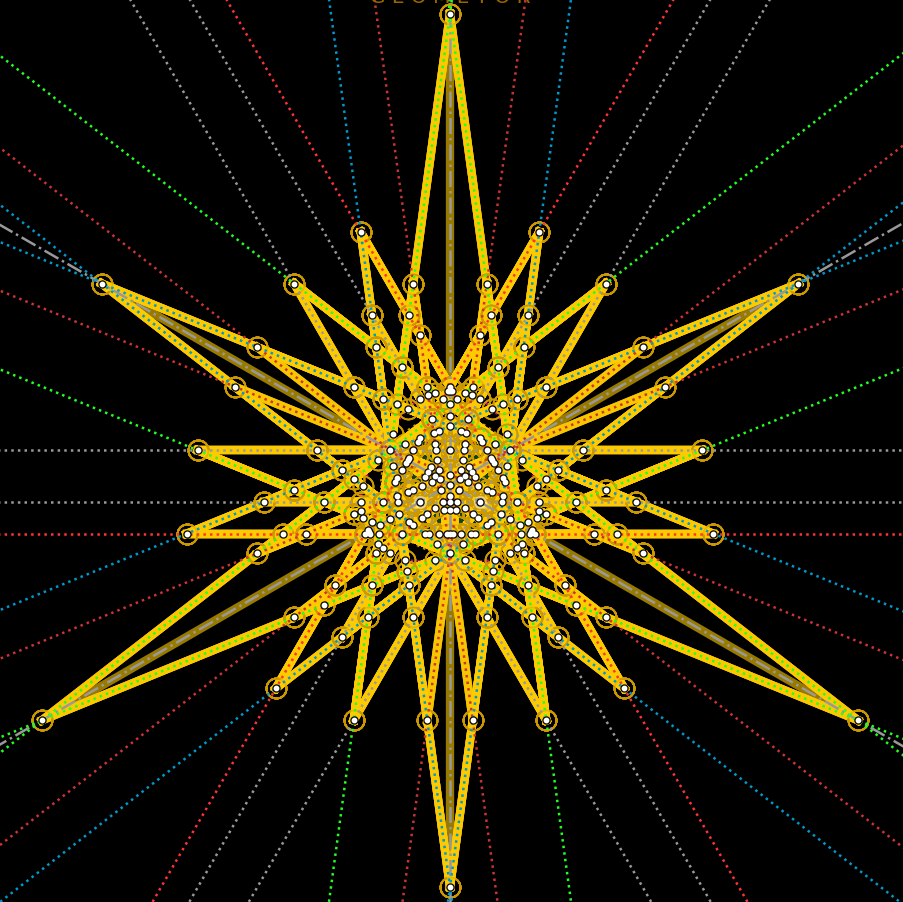
Euclidean Area Transformations & Circle Quadrature (Figs. 28–36)
The closing movement of Book II treats comparison and transformation of plane areas (vergleichung der ebnen):
Squaring Triangles, Rectangles & Regular Polygons (Figs. 28, 32–33 — Demonstrative): Bisecting any triangle converts it into an equal-area rectangle; placing the rectangle’s long and short sides end-to-end as diameter
e.f.g.of a semicircle and erecting perpendicularf.i.constructs the exact geometric mean $f i = \sqrt{e f \cdot f g}$ (Euclid II.14 & VI.13), yielding a square equal in area to the triangle or to any $n$-gon decomposed into radial triangles (Fig. 33).Homothetic Scaling & Area Multiplication (Figs. 29–31, 35): Extending the diagonal (Ortstrich) of a rectangle preserves aspect ratio under arbitrary rescaling (Euclid VI.24, Fig. 29); combining semicircle mean proportionals with the diagonal multiplies the area of any rectangle or square twofold, threefold, or sevenfold while preserving shape (Figs. 30–31), and generalizes the Pythagorean theorem from squares to equilateral triangles or any similar figures erected on a right triangle’s sides (Euclid VI.31, Fig. 35).
Workshop Quadrature of the Circle (Fig. 34, p. 075): On squaring the circle (Quadratura circuli), Dürer states with exemplary scientific candor: “One ought also to know quadratura circuli—that is, equating a circle and a square so that one contains as much area as the other—yet this has not yet been demonstrated by scholars (*noch nit von den gelerten demonstrirt). Mechanice, however—that is, approximately, so that in practical work it misses not at all or only by very little—this equality may be made thus: draw a square, divide its diagonal (ortstrich) into ten equal parts, and draw a circle whose diameter takes eight of those ten parts”* (centered at Oq alongside the heptagon in the figure below).