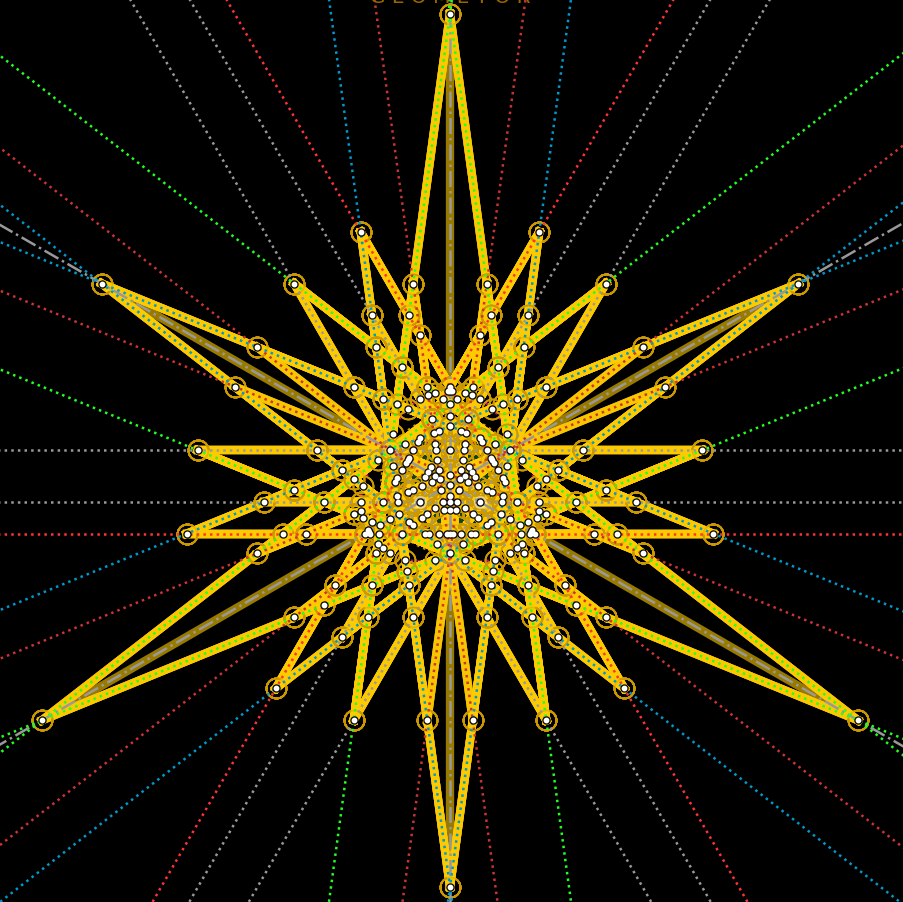
Notes — Circle Quadrature & $\pi_{\text{Dürer}} = \frac{25}{8}$ (Fig. 34)
3. Dürer’s Circle Quadrature & $\pi_{\text{Dürer}} = \frac{25}{8}$ (Fig. 34)
For a square of side $a$ and area $a^2$, the diagonal (ortstrich) has length $a\sqrt{2}$. Taking $d = \frac{8}{10}\,a\sqrt{2} = \frac{4\sqrt{2}}{5}a$ gives radius $r = frac{2sqrt{2}}{5}a = sqrt{frac{8}{25}},a$. Equating $\pi_{\text{Dürer}}\,r^2 = a^2$ yields
$$\pi_{\text{Dürer}} = \frac{25}{8} = 3.125,$$
the classical Roman-Vitruvian value ($3\frac{1}{8}$, relative error $-0.528\%$), which Dürer rightly refuses to pass off as demonstrative—anticipating Lindemann’s 1882 proof of the transcendence of $\pi$ (klein:1895).