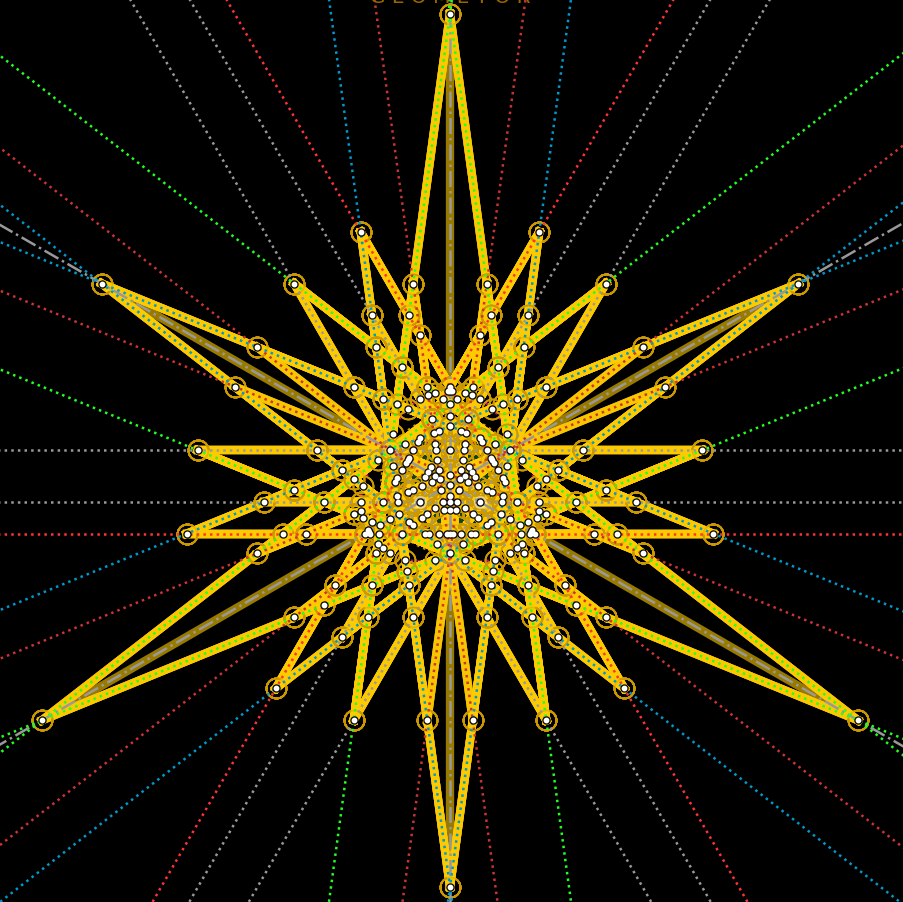
Instruction in Measurement

Underweysung der Messung, mit dem Zirckel und Richtscheyt (Nuremberg, 1525)

Albrecht Dürer (1471–1528)
Nuremberg Painter, Printmaker & Mathematician

First Edition: Nuremberg (1525, printed by Hieronymus Andreae)
Latin Edition: Paris (1532, trans. Joachim Camerarius, Christian Wechel)
Second Edition: Nuremberg (1538, posthumous enlarged edition)

“To my especially dear Lord and friend, Lord Willibald Pirckheimer, I, Albrecht Dürer, offer my willing service. … For from measurement one may undertake to make all manner of forms and things.”

—Albrecht Dürer, Dedication to Willibald Pirckheimer, Nuremberg, 1525

The Four Books

O: (0, 0) P_24: (12, 0) A: (-12, 0) B: (6 \sqrt{3}, 6) C: (- 6 \sqrt{3}, -6) D: (6, 6 \sqrt{3}) E: (-6, - 6 \sqrt{3}) F: (0, 12) G: (0, -12) H: (-6, 6 \sqrt{3}) I: (6, - 6 \sqrt{3}) J: (- 6 \sqrt{3}, 6) K: (6 \sqrt{3}, -6) S1: (\frac{\sqrt{3}}{4}, \frac{1}{4}) S2: (\frac{1}{2}, \frac{\sqrt{3}}{2}) S3: (0, \frac{3}{2}) S4: (-1, \sqrt{3}) S5: (- \frac{5 \sqrt{3}}{4}, \frac{5}{4}) P_6: (-3, 0) S7: (- \frac{7 \sqrt{3}}{4}, - \frac{7}{4}) S8: (-2, - 2 \sqrt{3}) S9: (0, - \frac{9}{2}) S10: (\frac{5}{2}, - \frac{5 \sqrt{3}}{2}) S11: (\frac{11 \sqrt{3}}{4}, - \frac{11}{4}) P_12: (6, 0) S13: (\frac{13 \sqrt{3}}{4}, \frac{13}{4}) S14: (\frac{7}{2}, \frac{7 \sqrt{3}}{2}) S15: (0, \frac{15}{2}) S16: (-4, 4 \sqrt{3}) S17: (- \frac{17 \sqrt{3}}{4}, \frac{17}{4}) P_18: (-9, 0) S19: (- \frac{19 \sqrt{3}}{4}, - \frac{19}{4}) S20: (-5, - 5 \sqrt{3}) S21: (0, - \frac{21}{2}) S22: (\frac{11}{2}, - \frac{11 \sqrt{3}}{2}) S23: (\frac{23 \sqrt{3}}{4}, - \frac{23}{4}) O P24 P6 P12 P18 Book I, Figs. 7 & 17 — 12-Sector Archimedean Schneckenlini

Book I: Lines, Spirals & Conic Sections

Dedication to Willibald Pirckheimer, foundational geometric definitions, Archimedean spirals, volutes, and the first printed two-view descriptive geometry of conic sections.

Albrecht Dürer
a: (0, 0) b: (1, 0) d: (\frac{1}{2}, - \frac{\sqrt{3}}{2}) c: (\frac{1}{2}, \frac{\sqrt{3}}{2}) e: (- \frac{1}{2}, - \frac{\sqrt{3}}{2}) f: (\frac{3}{2}, - \frac{\sqrt{3}}{2}) g: (\frac{1}{2}, 1 - \frac{\sqrt{3}}{2}) h: (\frac{1}{4} + \frac{\sqrt{3}}{4} + \frac{\sqrt{2} \sqrt{-2 + 3 \sqrt{3}}}{4}, - \frac{\sqrt{3}}{4} + \frac{\sqrt{2} \sqrt{-2 + 3 \sqrt{3}}}{4} + \frac{3}{4}) i: (- \frac{\sqrt{2} \sqrt{-2 + 3 \sqrt{3}}}{4} - \frac{\sqrt{3}}{4} + \frac{3}{4}, - \frac{\sqrt{3}}{4} + \frac{\sqrt{2} \sqrt{-2 + 3 \sqrt{3}}}{4} + \frac{3}{4}) k: (\frac{- \left(- \frac{\sqrt{2} \sqrt{-2 + 3 \sqrt{3}}}{4} - \frac{\sqrt{3}}{4} + \frac{3}{4}\right)^{2} + \left(- \frac{3}{4} + \frac{\sqrt{3}}{4} + \frac{\sqrt{2} \sqrt{-2 + 3 \sqrt{3}}}{4}\right)^{2} + \left(- \frac{\sqrt{2} \sqrt{-2 + 3 \sqrt{3}}}{2} - \frac{\sqrt{3}}{2} + \frac{1}{2}\right)^{2}}{2 \left(- \frac{\sqrt{2} \sqrt{-2 + 3 \sqrt{3}}}{2} - \frac{\sqrt{3}}{2} + \frac{1}{2}\right)} + \frac{1}{4} + \frac{\sqrt{3}}{4} + \frac{\sqrt{2} \sqrt{-2 + 3 \sqrt{3}}}{4}, - \frac{\sqrt{3}}{4} - \frac{\sqrt{- \left(- \left(- \frac{\sqrt{2} \sqrt{-2 + 3 \sqrt{3}}}{4} - \frac{\sqrt{3}}{4} + \frac{3}{4}\right)^{2} + \left(- \frac{3}{4} + \frac{\sqrt{3}}{4} + \frac{\sqrt{2} \sqrt{-2 + 3 \sqrt{3}}}{4}\right)^{2} + \left(- \frac{\sqrt{2} \sqrt{-2 + 3 \sqrt{3}}}{2} - \frac{\sqrt{3}}{2} + \frac{1}{2}\right)^{2}\right)^{2} + 4 \left(\left(- \frac{3}{4} + \frac{\sqrt{3}}{4} + \frac{\sqrt{2} \sqrt{-2 + 3 \sqrt{3}}}{4}\right)^{2} + \left(- \frac{\sqrt{3}}{4} + \frac{\sqrt{2} \sqrt{-2 + 3 \sqrt{3}}}{4} + \frac{3}{4}\right)^{2}\right) \left(- \frac{\sqrt{2} \sqrt{-2 + 3 \sqrt{3}}}{2} - \frac{\sqrt{3}}{2} + \frac{1}{2}\right)^{2}}}{2 \left(- \frac{\sqrt{2} \sqrt{-2 + 3 \sqrt{3}}}{2} - \frac{\sqrt{3}}{2} + \frac{1}{2}\right)} + \frac{\sqrt{2} \sqrt{-2 + 3 \sqrt{3}}}{4} + \frac{3}{4}) phi: (\frac{1}{2} + \frac{\sqrt{5}}{2}, 0) H_phi: (\frac{\sqrt{5}}{4} + \frac{3}{4}, \frac{\sqrt{2} \sqrt{5 - \sqrt{5}}}{8} + \frac{\sqrt{10} \sqrt{5 - \sqrt{5}}}{8}) I_phi: (\frac{1}{4} - \frac{\sqrt{5}}{4}, \frac{\sqrt{2} \sqrt{5 - \sqrt{5}}}{8} + \frac{\sqrt{10} \sqrt{5 - \sqrt{5}}}{8}) K_phi: (\frac{1}{2}, \frac{\sqrt{2 \sqrt{5} + 5}}{2}) a b d c e f g h i k phi Hphi Iphi Kphi Solid Gold: Dürer Rusty Compass (108.37°) | Dashed Blue: Euclid Q(phi) (108°)

Book II: Regular Polygons & Planar Tilings

Epistemology of demonstrative vs. mechanice regular polygons, fixed-aperture rusty-compass pentagon, pentagonal parquetries (fünf rosen), and circle quadrature.

Albrecht Dürer
a: (0, 10) b: (10, 10) c: (0, 0) d: (10, 0) e: (5, 10) f: (5, 0) g: (0, 5) h: (10, 5) i: (1, 0) k: (9, 0) V: (\frac{14}{3}, \frac{200}{21}) S_L: (\frac{3}{2} - \frac{\sqrt{449}}{14}, \frac{10}{7}) S_R: (\frac{\sqrt{449}}{14} + \frac{17}{2}, \frac{10}{7}) a b c d e f g h i k V SL SR Book III, p. 115 — Roman Antiqua A (10x10 Square, 1 : 1/3 Contrast)

Book III: Columns, Sundials & Roman/Gothic Typography

Vitruvian columns, 60-station enveloped-sphere helices, Nuremberg gnomonics for 49° latitude, optical tower scaling, Roman Antiqua A–Z, and modular Gothic Textura.

Albrecht Dürer
A: (0, \frac{1}{2}) B: (1, \frac{1}{2}) C: (\frac{1}{2}, \frac{1}{2} + \frac{\sqrt{3}}{2}) D: (\frac{1}{2}, \frac{1}{2} - \frac{\sqrt{3}}{2}) E: (\frac{3}{2}, \frac{1}{2} + \frac{\sqrt{3}}{2}) F: (- \frac{1}{2}, \frac{1}{2} + \frac{\sqrt{3}}{2}) G: (\frac{7}{2}, \frac{1}{2}) H: (4, \frac{1}{2} + \frac{\sqrt{3}}{2}) I: (3, \frac{1}{2} + \frac{\sqrt{3}}{2}) J: (\frac{9}{2}, \frac{1}{2}) K: (5, \frac{1}{2} + \frac{\sqrt{3}}{2}) L: (\frac{11}{2}, \frac{1}{2}) M: (4, \frac{1}{2} - \frac{\sqrt{3}}{2}) N: (5, \frac{1}{2} - \frac{\sqrt{3}}{2}) O: (3, \frac{1}{2} - \frac{\sqrt{3}}{2}) P: (\frac{5}{2}, \frac{1}{2}) Q: (8, - \frac{1}{2}) R: (9, - \frac{1}{2}) S: (9, \frac{1}{2}) T: (8, \frac{1}{2}) U: (8, - \frac{3}{2}) V: (9, - \frac{3}{2}) W: (10, - \frac{1}{2}) X: (10, \frac{1}{2}) Y: (9, \frac{3}{2}) Z: (8, \frac{3}{2}) AA: (7, \frac{1}{2}) BB: (7, - \frac{1}{2}) CC: (9, \frac{5}{2}) DD: (8, \frac{5}{2}) Tetrahedron (Fig. 29) Octahedron (Fig. 30) Cube (Fig. 32)

Book IV: Platonic & Archimedean Polyhedral Nets & Perspective

First printed planar fold-out nets for Platonic and Archimedean polyhedra, Delian cube duplication, two-view cube sciagraphy, and glass-frame central projection.

Albrecht Dürer

Bibliography

Dürer, Albrecht (1525). Underweysung der Messung, mit dem Zirckel un[d] Richtscheyt, in Linien Ebnen unnd gantzen Corporen, durch Albrecht Dürer zu sammen getzoge[n], und zu nutz alle[n] kunstliebhabenden mit zu gehörigen figuren, in truck gebracht, im jar. M.D.XXV. Nuremberg: [Hieronymus Andreae]. Copy-text witness: SLUB Dresden, PPN 27778509X (S.B. 618), collated with the twice-proofread diplomatic edition on German Wikisource.

Cross-Corpus Concordance (Underweysung ↔ GEOMETOR)

The table below links the thirteen canonical mathematical loci across Books I–IV of Albrecht Dürer’s Underweysung der Messung (1525) to their algebraic fields in geometor.durer and sister editions across the GEOMETOR Digital Scriptorium.

Scholarly Apparatus