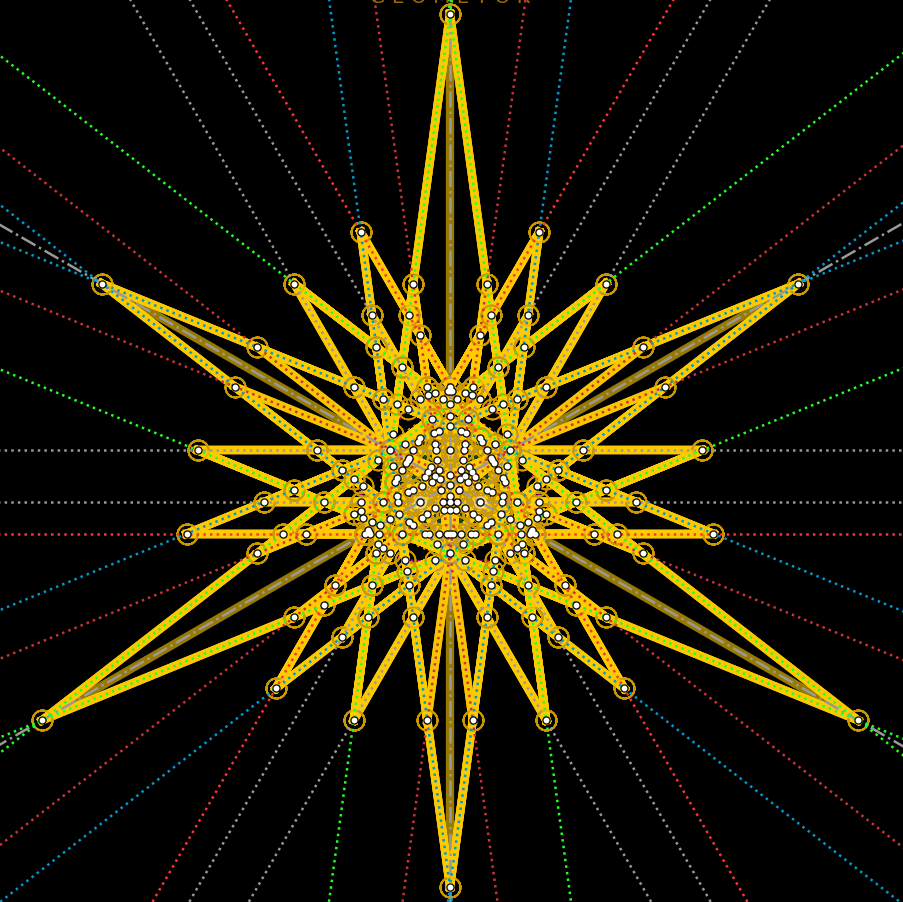
Aurea Propositio in Mathematicis — Three-Ray Sum Invariance and the Golden Proposition — Critical Commentary & Notes
Exact Symbolic Reconstruction, Latin Philology & Canon Reception · APM (1459)
I. Exact Algebraic Audit of Aurea Propositio in Mathematicis (1459)
Both De Mathematica Perfectione and Aurea Propositio converge on the Cusa–Snellius–Huygens Law (cusa:perf:1458, cusa:aurea:1459, snellius:huygens:1654). Let rays at angles \(\pm\theta\) (\(0 < \theta \le \frac{\pi}{4}\)) and central ray \(0\) issue from A at \((0, 0)\) across unit circle \(R = 1\), meeting a vertical rectifying line \(x = x_K\) at I, K, L, so \(|AK| = x_K\) and \(|AI| = |AL| = \frac{x_K}{\cos\theta}\). Enforcing Cusa’s Three-Ray Sum Invariance:
At \(\theta = \frac{\pi}{6}\) (modeled over \(\mathbb{Q}(\sqrt{3})\) in
cusa_aurea_propositio_1459.svg), \(x_K = \frac{3\sqrt{3}/2}{2 + \sqrt{3}/2} =
\frac{12\sqrt{3} - 9}{13}\), the outer rays have length \(|AI| = |AL| =
\frac{24 - 6\sqrt{3}}{13}\), the combined endpoint ascent \(2(|AI| - 1) =
\frac{22 - 12\sqrt{3}}{13}\) equals the midpoint descent \(1 - x_K\), and the rectified
length is:
so for the half-arc \(\theta - \frac{3\sin\theta}{2 + \cos\theta} = \frac{\theta^5}{180} + \frac{\theta^7}{1512} + O(\theta^9)\)! Because \(\cos\theta\) and \(\sin\theta\) cancel through third order in the [1/1] Padé-type rational weight \(\frac{3}{2 + \cos\theta}\), Cusa achieved fifth-order accuracy—yielding at \(\theta = \frac{\pi}{6}\) an implied \(\pi\) estimate of \(\frac{18}{2 + \sqrt{3}/2} = \frac{36(4 - \sqrt{3})}{26} \approx 3.140237\), within \(0.043\%\) of \(\pi\)!
IV. Executable Symbolic Verification
In accordance with GEOMETOR’s strict content/code separation for historical editions, executable geometor.model SymPy constructions, Rational Trigonometry proofs, and series-error audits for Aurea Propositio in Mathematicis — Three-Ray Sum Invariance and the Golden Proposition live in src/geometor/cusa/ and the companion walkthrough Demos.