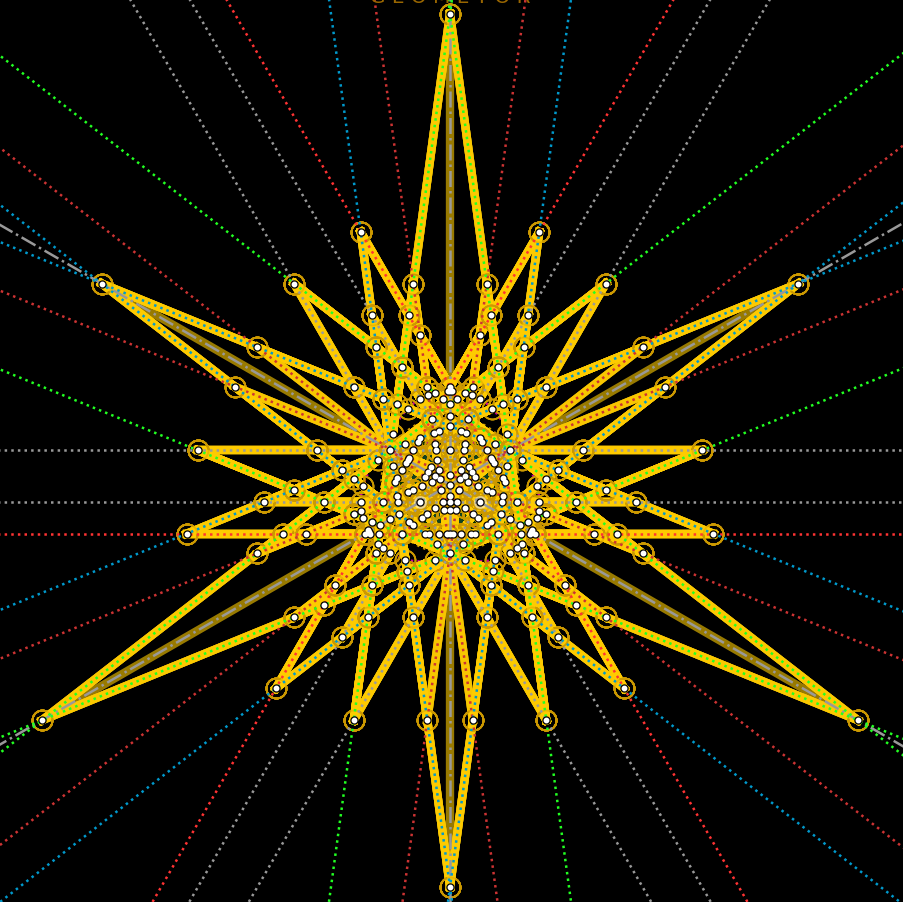
Book VI, Section VII Summary: Poles, Polars & Reciprocation
Mathematical Synthesis of Casey’s Book VI, Section VII (pp. 141–147)
1. Key Theorems of Polar Duality & Reciprocation
Section VII establishes the projective duality of poles and polars with respect to a circle:
Anharmonic Equivalence (Prop. 1): The cross-ratio of four collinear points equals the cross-ratio of their four polars: $(A, B; C, D) = (a, b; c, d)$.
Self-Conjugate Triangles (Prop. 1.1): If two triangles are self-conjugate with respect to a circle, any two sides are divided equianharmonically by the four remaining sides, and any two vertices are subtended equianharmonically by the four remaining vertices.
Perspective of Polar Triangles (Prop. 1.2): If two triangles are such that the sides of one are the polars of the vertices of the other, they are in perspective (homologous).
Locus of Pole (Prop. 2): If two variable points on fixed lines subtend a constant angle at the centre $O$ of circle $X$, the locus of the pole of their join is a circle.
Homographic Systems (Prop. 3): For two homographic systems of points on two lines, there exist two points at each of which corresponding points subtend equal angles.
Harmonic Envelope and Tangent Invariance (Prop. 3.2): Any four fixed tangents to a circle are cut by any fifth variable tangent in four points whose anharmonic ratio is constant.
Involution of Quadrilateral Rays (Prop. 3.3): Lines drawn from any variable point in the plane of a quadrilateral to the six points of intersection of its four sides form a pencil in involution (dual of Section VI Prop. 9.1).
Brianchon’s Theorem (Prop. 3.6): If a hexagon be described about a circle, the three lines joining opposite angular points are concurrent (reciprocal of Pascal’s Theorem).
Parallel Homologous Rays (Prop. 3.7): In two homographic pencils of rays, there exist two pairs of homologous rays that are parallel to each other.
2. Verified Exact Symbolic Ledgers (geometor.casey.poles_polars)
Theorem / Element |
Symbol |
Exact Symbolic Value |
|---|---|---|
Base Circle & Pole–Polar Pair (0071.g1) |
$x^2 + y^2 = 25, \; D \leftrightarrow [UV]$ |
$D = \left(\frac{15}{2}, \frac{5}{4}\right), \; 6x + y - 20 = 0$ |
Self-Conjugate Triangle & Reciprocal Pole |
$\triangle DUV, \; Q \in [UV]$ |
$U = (3, 2), \; V = \left(\frac{5}{3}, 10\right), \; Q = (4, -4)$ |
Tangent Cross-Ratio Invariance |
$(T_1, T_2; T_3, T_4)$ |
Preserved across all variable transverse tangents |
Brianchon Concurrence |
$AD \cap BE \cap CF$ |
Concurrent Brianchon point dual to Pascal line |