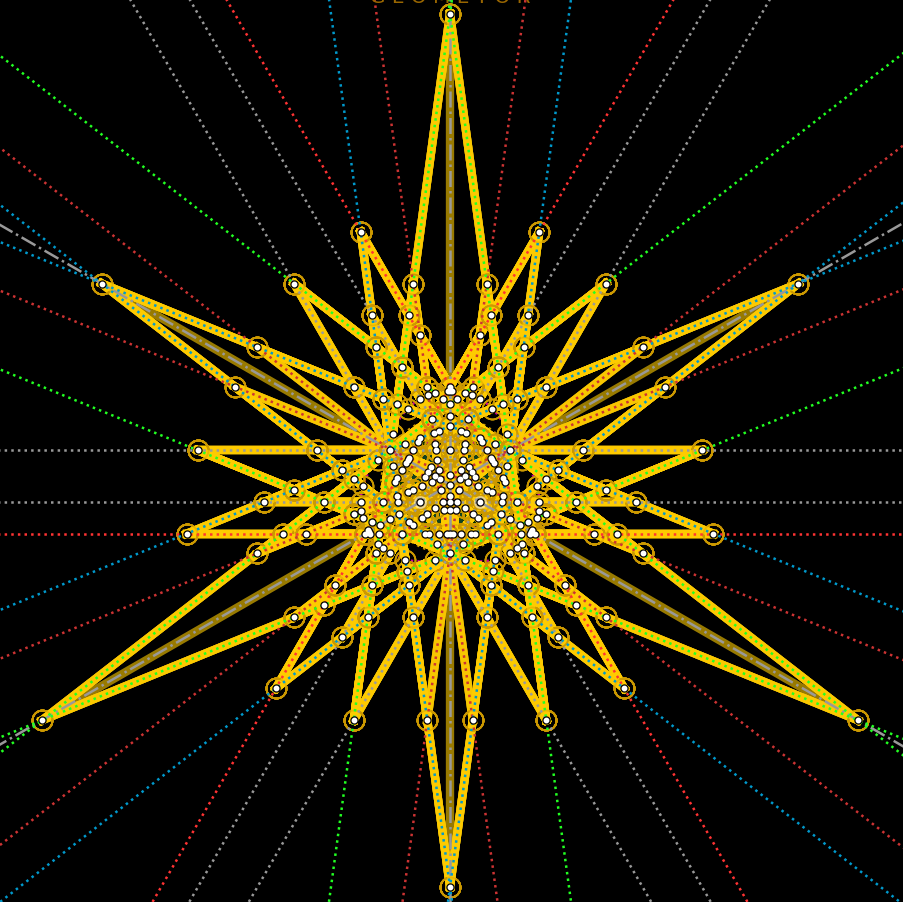
Book VI, Section VII Notes: Poles, Polars & Reciprocation
Historical Context & Projective Foundations
1. Historical Foundations: Poncelet, Chasles & Brianchon
Philippe de La Hire (1685): First systematic treatment of harmonic poles and polars for conic sections in Sectiones Conicae.
Jean-Victor Poncelet (1822): In Traité des propriétés projectives des figures, Poncelet developed the principle of duality and the method of reciprocal polars, transforming theorems concerning points and lines into reciprocal theorems concerning lines and points.
Charles-Julien Brianchon (1806): In Sur les surfaces de courbure et les lignes de courbure, Brianchon published his celebrated dual of Pascal’s Hexagrammum Mysticum (1639), showing that opposite diagonals of a circumscribed hexagon meet in a point. Casey provides the direct polar reciprocation proof via Pascal’s theorem on folios 0172–0173.
Michel Chasles (1837): In Aperçu historique sur l’origine et le développement des méthodes en géométrie, Chasles demonstrated the power of anharmonic ratios and homographic systems on conics, which Casey systematically adapts into Euclidean elementary propositions.
2. Cross-Canon Links (geometor.casey.poles_polars)
Projective Duality: Casey’s Section VII supplies the metric-to-projective bridge whereby inscribed Pascal configurations dualize via $(x_0 - h)(x - h) + (y_0 - k)(y - k) = r^2$ into circumscribed Brianchon hexagons.
Self-Conjugate Systems: The self-conjugate triangle with respect to a circle provides the fundamental projective frame for polar coordinates and orthogonal involution pencils.