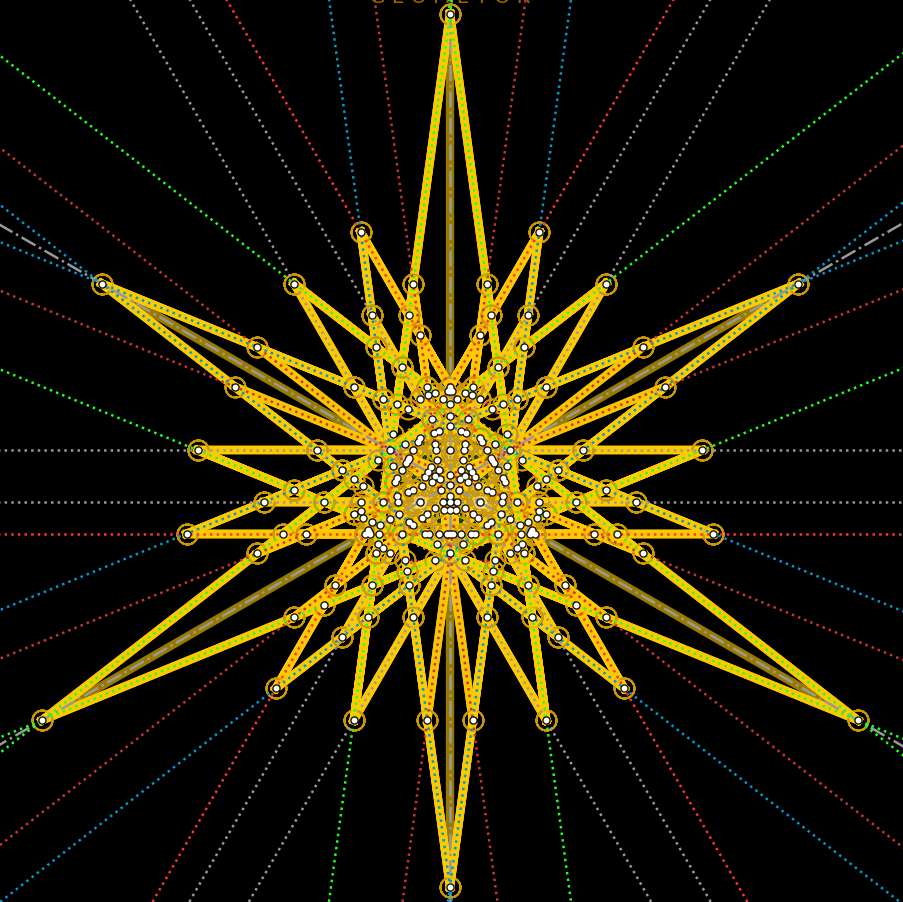
The Antinomy of the Point and Geometrical Order¶
Chapter IV: Philosophical Consequences — Antinomy of the Point (§§ 194–200, pp. 188–193)
§ 194. What are we to do with the contradictions in space?¶
f. §194 · p. p. 188194. I come now to the second question with which this chapter has to deal, the question, namely: What are we to do with the contradictions which obtruded themselves in Chapter III., whenever we came to a point which seemed fundamental? I shall treat this question briefly, as I have little to add to answers with which we are all familiar. I have only to prove, first, that the contradictions are inevitable, and therefore form no objection to my argument; secondly, that the first step in removing them is to restore the notion of matter, as that which, in the data of sense-perception, is localized and interrelated in space.
§ 195. Three contradictions will be discussed in what follows¶
f. §195 · p. p. 188195. The contradictions in space are an ancient theme—as ancient, in fact, as Zeno’s refutation of motion. They are, roughly, of two kinds, though the two kinds cannot be sharply divided. There are the contradictions inherent in the notion of the continuum, and the contradictions which spring from the fact that space, while it must, to be knowable, be pure relativity, must also, it would seem, since it is immediately experienced, be something more than mere relations. The first class of contradictions has been encountered more frequently in this essay, and is also, I think, the more definite, and the more important for our present purpose. I doubt, however, whether the two classes are really distinct; for any continuum, I believe, in which the elements are not data, but intellectual constructions resulting from analysis, can be shown to have the same relational and yet not wholly relational character as belongs to space.
The three following contradictions, which I shall discuss successively, seem to me the most prominent in a theory of Geometry.
(1) Though the parts of space are intuitively distinguished, no conception is adequate to differentiate them. Hence arises a vain search for elements, by which the differentiation could be accomplished, and for a whole, of which the parts of space are to be components. Thus we get the point, or zero extension, as the spatial element, and an infinite regress or a vicious circle in the search for a whole.
(2) All positions being relative, positions can only be defined by their relations, i.e. by the straight lines or planes through them; but straight lines and planes, being all qualitatively similar, can only be defined by the positions they relate. Hence, again, we get a vicious circle.
(3) Spatial figures must be regarded as relations. But a relation is necessarily indivisible, while spatial figures are necessarily divisible ad infinitum.
§ 196. (1) The antinomy of the Point proves the relativity of space,¶
f. §196 · p. p. 189196. (1) Points. The antinomy of the point—which arises wherever a continuum is given, and elements have to be sought in it—is fundamental to Geometry. It has been given, perhaps unintentionally, by Veronese as the first axiom, in the form: “There are different points. All points are identical” (op. cit. p. 226). We saw, in discussing projective Geometry, that straight lines and planes must be regarded, on the one hand as relations between points, and on the other hand as made up of points [1]. We saw again, in dealing with measurement, how space must be regarded as infinitely divisible, and yet as mere relativity. But what is divisible and consists of parts, as space does, must lead at last, by continued analysis, to a simple and unanalyzable part, as the unit of differentiation. For whatever can be divided, and has parts, possesses some thinghood, and must, therefore, contain two ultimate units, the whole namely, and the smallest element possessing thinghood. But in space this is notoriously not the case. After hypostatizing space, as Geometry is compelled to do, the mind imperatively demands elements, and insists on having them, whether possible or not. Of this demand, all the geometrical applications of the infinitesimal calculus are evidence [2]. But what sort of elements do we thus obtain? Analysis, being unable to find any earlier halting-place, finds its elements in points, that is, in zero quanta of space. Such a conception is a palpable contradiction, only rendered tolerable by its necessity and familiarity. A point must be spatial, otherwise it would not fulfil the function of a spatial element; but again it must contain no space, for any finite extension is capable of further analysis. Points can never be given in intuition, which has no concern with the infinitesimal: they are a purely conceptual construction, arising out of the need of terms between which spatial relations can hold. If space be more than relativity, spatial relations must involve spatial relata; but no relata appear, until we have analyzed our spatial data down to nothing. The contradictory notion of the point, as a thing in space without spatial magnitude, is the only outcome of our search for spatial relata. This reductio ad absurdum surely suffices, by itself, to prove the essential relativity of space.
§ 197. And shows that Geometry must have some reference to matter,¶
f. §197 · p. p. 190197. Thus Geometry is forced, since it wishes to regard space as independent, to hypostatize its abstractions, and therefore to invent a self-contradictory notion as the spatial element. A similar absurdity appears, even more obviously, in the notion of a whole of space. The antinomy may, therefore, be stated thus: Space, as we have seen throughout, must, if knowledge of it is to be possible, be mere relativity; but it must also, if independent knowledge of it, such as Geometry seeks, is to be possible, be something more than mere relativity, since it is divisible and has parts. But we saw, in Chap. III., Section A (§ 133) that knowledge of a form of externality must be logically independent of the particular matter filling the form. How then are we to extricate ourselves from this dilemma?
The only way, I think, is, not to make Geometry dependent on Physics, which we have seen to be erroneous [3], but to give every geometrical proposition a certain reference to matter in general. And at this point an important distinction must be made. We have hitherto spoken of space as relational, and of spatial figures as relations. But space, it would seem, is rather relativity than relations—itself not a relation, it gives the bare possibility of relations between diverse things [4]. As applied to a spatial figure, which can only arise by a differentiation of space, and hence by the introduction of some differentiating matter, the word relation is, perhaps, less misleading than any other; as applied to empty undifferentiated space, it seems by no means an accurate description.
But a bare possibility cannot exist, or be given in sense-perception! What becomes, then, of the arguments of the first part of this chapter? I reply, it is not empty space, but spatial figures, which sense-perception reveals, and spatial figures, as we have just seen, involve a differentiation of space, and therefore a reference to the matter which is in space. It is spatial figures, also, and not empty space, with which Geometry has to deal. The antinomy discussed above arises then—so it would seem—from the attempt to deal with empty space, rather than with spatial figures and the matter to which they necessarily refer.
§ 198. By which means it is made to refer to spatial order, not to empty space¶
f. §198 · p. p. 191198. Let us see whether, by this change, we can overcome the antinomy of the point. Spatial figures, we shall now say, are relations between the matter which differentiates empty space. Their divisibility, which seemed to contradict their relational character, may be explained in two ways: first, as holding of the figures considered as parts of empty space, which is itself not a relation; second, as denoting the possibility of continuous change in the relation expressed by the spatial figure. These two ways are, at bottom, the same; for empty space is a possibility of relations, and the figure, when viewed in connection with empty space, thus becomes a possible relation, with which other possible relations may be contrasted or compared. But the second way of regarding divisibility is the better way, since it introduces a reference to the matter which differentiates empty space, without which, spatial figures, and therefore Geometry, could not exist. It is empty space, then—so we must conclude—which gives rise to the antinomy in question; for empty space is a bare possibility of relations, undifferentiated and homogeneous, and thus wholly destitute of parts or of thinghood. To speak of parts of a possibility is nonsense; the parts and differentiations arise only through a reference to the matter which is differentiated in space.
§ 199. The causal properties of matter are irrelevant to Geometry, which must regard it as composed of unextended atoms, by which points are replaced¶
f. §199 · p. p. 191199. But what nature must we ascribe to this matter, which is to be involved in all geometrical propositions? In criticizing Helmholtz (Chap. II. § 73), it may be remembered, we decided that Geometry refers to a peculiar and abstract kind of matter, which is not regarded as possessing any causal qualities, as exerting or as subject to the action of forces. And this is the matter, I think, which we require for the needs of the moment. Not that we affirm, of course, that actual matter can be destitute of the properties with which Physics is cognizant, but that we abstract from these properties, as being irrelevant to Geometry. All that we require, for our immediate purpose, is a subject of that diversity which space renders possible, or terms for those relations by which empty space, if space is to be studied at all, must be differentiated. But how must a matter, which is to fulfil this function, be regarded?
Empty space, we have said, is a possibility of diversity in relation, but spatial figures, with which Geometry necessarily deals, are the actual relations rendered possible by empty space. Our matter, therefore, must supply the terms for these relations. It must be differentiated, since such differentiation, as we have seen, is the special work of space. We must find, therefore, in our matter, that unit of differentiation, or atom [5], which in space we could not find. This atom must be simple, i.e. it must contain no real diversity; it must be a This not resolvable into Thises. Being simple, it can contain no relations within itself, and consequently, since spatial figures are mere relations, it cannot appear as a spatial figure; for every spatial figure involves some diversity of matter. But our atom must have spatial relations with other atoms, since to supply terms for these relations is its only function. It is also capable of having these relations, since it is differentiated from other atoms. Hence we obtain an unextended term for spatial relations, precisely of the kind we require. So long as we sought this term without reference to anything more than space, the self-contradictory notion of the point was the only outcome of our search; but now that we allow a reference to the matter differentiated by space, we find at once the term which was needed, namely, a non-spatial simple element, with spatial relations to other elements. To Geometry such a term will appear, owing to its spatial relations, as a point; but the contradiction of the point, as we now see, is a result only of the undue abstraction with which Geometry deals.
§ 200. (2) The circle in defining straight lines and planes is overcome by the same reference to matter¶
f. §200 · p. p. 192200. (2) The circle in the definition of straight lines and planes. This difficulty need not long detain us, since we have already, with the material atom, broken through the relativity which caused our circle. Straight lines, in the purely geometrical procedure, are defined only by points, and points only by straight lines. But points, now, are replaced by material atoms: the duality of points and lines, therefore, has disappeared, and the straight line may be defined as the spatial relation between two unextended atoms. These atoms have spatial adjectives, derived from their relations to other atoms; but they have no intrinsic spatial adjectives, such as could belong to them if they had extension or figure. Thus straight lines and planes are the true spatial units, and points result only from the attempt to find, within space, those terms for spatial relations which exist only in a more than spatial matter. Straight lines, planes and volumes are the spatial relations between two, three or four unextended atoms, and points are a merely convenient geometrical fiction, by which possible atoms are replaced. For, since space, as we saw, is a possibility, Geometry deals not with actually realized spatial relations, but with the whole scheme of possible relations.
Footnotes