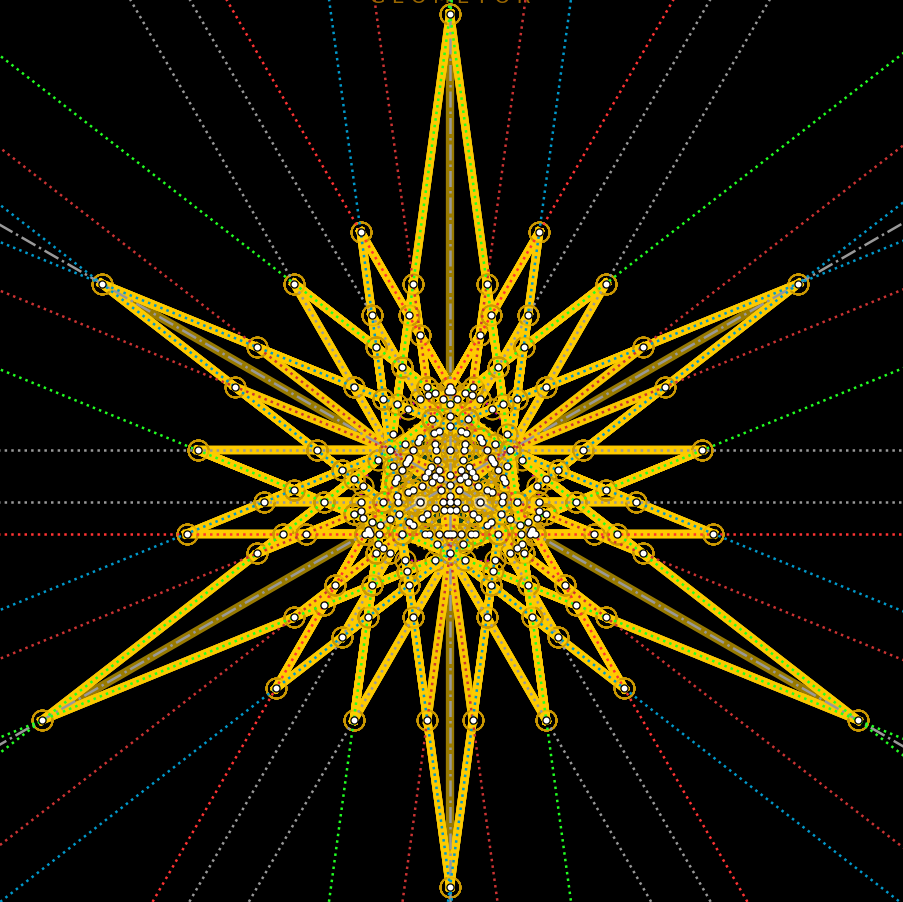
Liber V.B — Intelligible Matter, Constructive Actuality & Mathematical Beauty — Critical Commentary & Notes
Historical-Mathematical (Heath) & Scholastic-Noetic (Hoenen) Apparatus · Bekker 1034b–1037a, 1051a, 1076a–1078b
I. Mathematical-Historical Commentary (Secundum Heath & Euclidem)
Sir Thomas Heath (Thirteen Books, Vol. I, p. 317; Vol. II, p. 63; Mathematics in Aristotle, pp. 216–219) celebrates Metaphysics $\Theta$.9 (1051a21–33) as the most vivid window into Greek heuristic proof anywhere in surviving classical literature!
Look closely at Aristotle’s two theorems in 1051a24–29: First, for the 2R angle-sum of $\triangle ABC$, Aristotle extends the base $BC$ and draws the auxiliary line through a vertex parallel to the opposite side (ἀνῆκτο ἡ παρὰ τὴν πλευράν)—the exact Pythagorean/Euclidean construction preserved in Elements I.32! Second, to prove that every angle $\angle BAC$ inscribed in a semicircle on diameter $BC$ with center $O$ is a right angle (Elements III.31), Aristotle’s geometer draws the radius $OA$ from the midpoint (ἐκ μέσου) equal to the two half-diameters $OB = OC$ (actually Aristotle describes the symmetric case where $OA$ is erected perpendicular or simply equal to the half-diameters; cf. Anal. Post. II.11, 94a28–34), splitting $\triangle ABC$ into isosceles triangles so that seeing the 2R theorem makes the right angle instantaneously luminous!
Notice Aristotle’s Greek noun in 1051a21: τὰ διαγράμματα means not merely static drawings, but geometrical propositions/proofs-through-construction! Before the geometer’s mind divides the figure (διαιροῦντες), the auxiliary parallel and radius exist only potentially (δυνάμει) inside continuous space; the act of constructive thought (νοήσει ἐνέργεια, 1051a30–31) brings them into actuality!
II. Scholastic-Noetic Commentary (Secundum Hoenen, Thomam & Paciolum)
In De Noetica Geometriae (Caput V–VII & Appendix, n. 18, p. 262), Metaphysics Z.10 (1036a9–12) and $\Theta$.9 (1051a21–33) converge to complete Hoenen’s entire philosophical edifice. Why can geometry discover genuinely new, synthetic-yet-necessary truths through construction—truths neither tautologically contained in verbal definitions nor empirically guessed from physical rulers?
Because of the partnership of intelligible matter (ὕλη νοητή, 1036a9) and constructive noetic actuality (νοήσει ἐνέργεια, 1051a30)! Pure logical concepts without extension cannot be divided into two congruent semicircles or traversed by an auxiliary parallel; sensible bronze cannot guarantee strict zero-breadth parallelism. Only because the intellect abstracts continuous spatial extension (materia intelligibilis) preserved in the phantasma, and actively constructs divisions (διαιροῦντες γὰρ εὑρίσκουσιν) inside it, does the causal nexus flash forth directly to intellectual vision: `ἰδόντι ἂν ἦν εὐθὺς δῆλον` — ‘it would have been immediately clear to one who simply saw it!’ (1051a26).
Finally, Metaphysics M.3 (1078a31–b6) links Aristotle directly to the foundational ethos of GEOMETOR and Pacioli's Divine Proportion: mathematics is not value-neutral calculation, for in demonstrating order (`τάξις`), symmetry/proportion (`συμμετρία`), and definiteness (`τὸ ὡρισμένον`), constructive geometry reveals the intelligible architecture of beauty itself.
III. Locus-by-Locus Philological & Geometrical Notes
1036a9–12 — The Locus Classicus of Hylē Noētē (Intelligible Matter)
νοητὴ δὲ ἡ ἐν τοῖς αἰσθητοῖς ὑπάρχουσα μὴ ᾗ αἰσθητά, οἷον τὰ μαθηματικά: intelligible matter is not a ghost-substance floating outside the world, but the real continuous dimensionality present in sensible things considered not qua sensible.
1036b32–1037a5 — Critique of the Elder Platonists/Pythagoreans Reducing All Form to Number
Against Speusippus/Xenocrates who tried to eliminate continuous extension and reduce the line’s essence to the number ‘two’ (δυάς), Aristotle insists that geometric figures essentially include continuous intelligible substrate alongside formal ratio.
1051a21–33 — Diagrammatic Actuality as Engine of Discovery
Here 77b30 (Anal. Post. I.12), 431b2 (De Anima III.7), 1036a9 (Metaph. Z.10), and 1051a21 (Metaph. $\Theta$.9) lock together into a single seamless theory of constructive geometric cognition—precisely what GEOMETOR models computationally through exact symbolic construction DAGs.
1078a31–b6 — Taxis, Symmetria, To Hōrismenon
Against Aristippus the Cyrenaic (who disparaged mathematics for ignoring ‘good and bad’, cf. Metaph. B.2, 996a32), Aristotle distinguishes moral finality from formal-mathematical kalon: motionless geometric invariants exhibit supreme order, proportion, and determinate precision, and furthermore serve as causes (ὡς αἴτια) of harmony in nature.
IV. Sister-Corpus Citations Indexed in This Unit
Bekker Locus |
Treatise & Chapter |
Sister Repos |
Cited Locations (Volume, Page / Folio & Display) |
|---|---|---|---|
Metaphysica VII.10 |
|
euclid (volume_I, I, p. 181): |
|
Metaphysica VII.10 |
|
euclid (volume_I, I, p. 155): |
|
Metaphysica IX.8 |
|
euclid (volume_I, I, p. 320): |
|
Metaphysica IX.8 |
|
euclid (volume_II, III, p. 63): |
|
Metaphysica IX.8 |
|
hoenen (de_noetica_geometriae, Appendix, p. 273): |