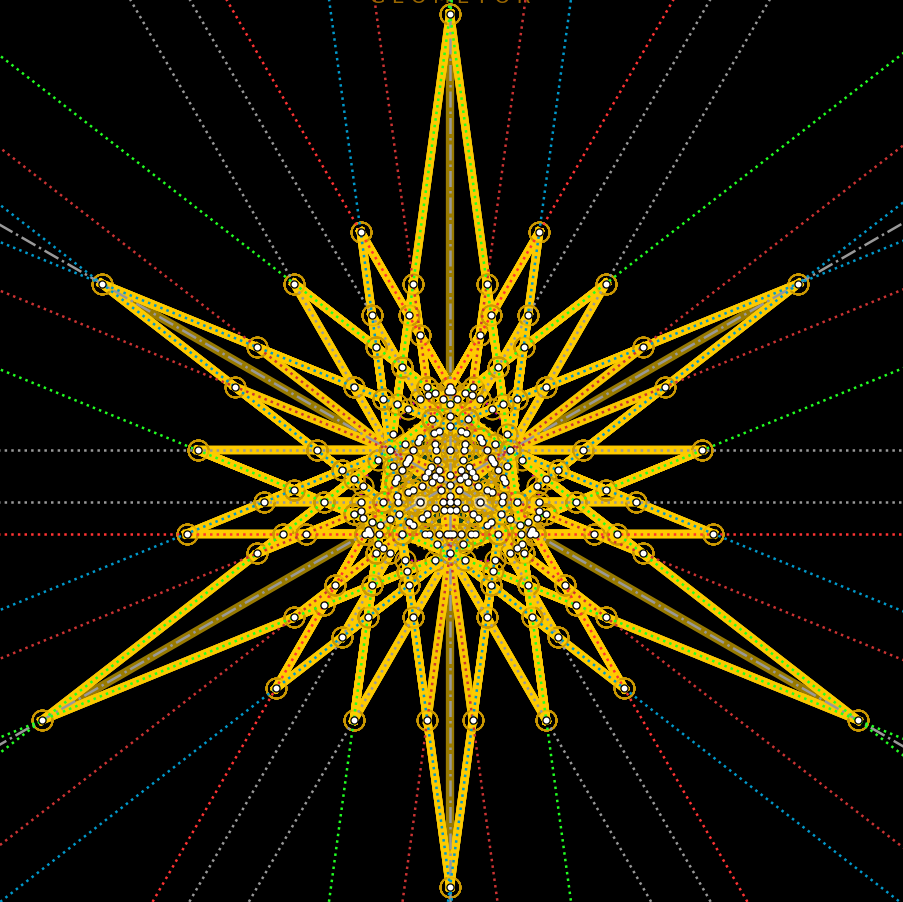
Liber V.B — Intelligible Matter, Constructive Actuality & Mathematical Beauty
Liber V — Metaphysica: Mathematical Sciences, Intelligible Matter, Actuality & Beauty · Bekker 1034b–1037a, 1051a, 1076a–1078b
«καὶ τὰ διαγράμματα εὑρίσκεται ἐνεργείᾳ· διαιροῦντες γὰρ εὑρίσκουσιν. εἰ δ’ ἦν διῃρημένα, φανερὰ ἂν ἦν· νῦν δ’ ἐνυπάρχει δυνάμει.»
“It is by an activity also that geometrical constructions are discovered; for we find them by dividing. If the figures had been already divided, the constructions would have been obvious; but as it is they are present only potentially.” — Metaphysica Θ.9, 1051a21–24
Metaphysics Z (VII).10 — Parts of Definition vs. Parts of Matter & Introduction of Intelligible Matter (Hyle Noete, 1036a9) (1034b20–1036a25)
Oxford Translation by W. D. Ross · Bekker 1034b20–1036a25
“Since a definition is a formula, and every formula has parts, and as the formula is to the thing, so is the part of the formula to the part of the thing, the question is already being asked whether the formula of the parts must be present in the formula of the whole or not. For in some cases the formulae of the parts are seen to be present, and in some not. The formula of the circle does not include that of the segments, but that of the syllable includes that of the letters; yet the circle is divided into segments as the syllable is into letters.-And further if the parts are prior to the whole, and the acute angle is a part of the right angle and the finger a part of the animal, the acute angle will be prior to the right angle and finger to the man. But the latter are thought to be prior; for in formula the parts are explained by reference to them, and in respect also of the power of existing apart from each other the wholes are prior to the parts.
“Perhaps we should rather say that ‘part’ is used in several senses. One of these is ‘that which measures another thing in respect of quantity’. But let this sense be set aside; let us inquire about the parts of which substance consists. If then matter is one thing, form another, the compound of these a third, and both the matter and the form and the compound are substance even the matter is in a sense called part of a thing, while in a sense it is not, but only the elements of which the formula of the form consists. E.g. of concavity flesh (for this is the matter in which it is produced) is not a part, but of snubness it is a part; and the bronze is a part of the concrete statue, but not of the statue when this is spoken of in the sense of the form. (For the form, or the thing as having form, should be said to be the thing, but the material element by itself must never be said to be so.) And so the formula of the circle does not include that of the segments, but the formula of the syllable includes that of the letters; for the letters are parts of the formula of the form, and not matter, but the segments are parts in the sense of matter on which the form supervenes; yet they are nearer the form than the bronze is when roundness is produced in bronze. But in a sense not even every kind of letter will be present in the formula of the syllable, e.g. particular waxen letters or the letters as movements in the air; for in these also we have already something that is part of the syllable only in the sense that it is its perceptible matter. For even if the line when divided passes away into its halves, or the man into bones and muscles and flesh, it does not follow that they are composed of these as parts of their essence, but rather as matter; and these are parts of the concrete thing, but not also of the form, i.e. of that to which the formula refers; wherefore also they are not present in the formulae. In one kind of formula, then, the formula of such parts will be present, but in another it must not be present, where the formula does not refer to the concrete object. For it is for this reason that some things have as their constituent principles parts into which they pass away, while some have not. Those things which are the form and the matter taken together, e.g. the snub, or the bronze circle, pass away into these materials, and the matter is a part of them; but those things which do not involve matter but are without matter, and whose formulae are formulae of the form only, do not pass away,-either not at all or at any rate not in this way. Therefore these materials are principles and parts of the concrete things, while of the form they are neither parts nor principles. And therefore the clay statue is resolved into clay and the ball into bronze and Callias into flesh and bones, and again the circle into its segments; for there is a sense of ‘circle’ in which involves matter. For ‘circle’ is used ambiguously, meaning both the circle, unqualified, and the individual circle, because there is no name peculiar to the individuals.
“The truth has indeed now been stated, but still let us state it yet more clearly, taking up the question again. The parts of the formula, into which the formula is divided, are prior to it, either all or some of them. The formula of the right angle, however, does not include the formula of the acute, but the formula of the acute includes that of the right angle; for he who defines the acute uses the right angle; for the acute is ‘less than a right angle’. The circle and the semicircle also are in a like relation; for the semicircle is defined by the circle; and so is the finger by the whole body, for a finger is ‘such and such a part of a man’. Therefore the parts which are of the nature of matter, and into which as its matter a thing is divided, are posterior; but those which are of the nature of parts of the formula, and of the substance according to its formula, are prior, either all or some of them. And since the soul of animals (for this is the substance of a living being) is their substance according to the formula, i.e. the form and the essence of a body of a certain kind (at least we shall define each part, if we define it well, not without reference to its function, and this cannot belong to it without perception), so that the parts of soul are prior, either all or some of them, to the concrete ‘animal’, and so too with each individual animal; and the body and parts are posterior to this, the essential substance, and it is not the substance but the concrete thing that is divided into these parts as its matter:-this being so, to the concrete thing these are in a sense prior, but in a sense they are not. For they cannot even exist if severed from the whole; for it is not a finger in any and every state that is the finger of a living thing, but a dead finger is a finger only in name. Some parts are neither prior nor posterior to the whole, i.e. those which are dominant and in which the formula, i.e. the essential substance, is immediately present, e.g. perhaps the heart or the brain; for it does not matter in the least which of the two has this quality. But man and horse and terms which are thus applied to individuals, but universally, are not substance but something composed of this particular formula and this particular matter treated as universal; and as regards the individual, Socrates already includes in him ultimate individual matter; and similarly in all other cases. ‘A part’ may be a part either of the form (i.e. of the essence), or of the compound of the form and the matter, or of the matter itself. But only the parts of the form are parts of the formula, and the formula is of the universal; for ‘being a circle’ is the same as the circle, and ‘being a soul’ the same as the soul. But when we come to the concrete thing, e.g. this circle, i.e. one of the individual circles, whether perceptible or intelligible (I mean by intelligible circles the mathematical, and by perceptible circles those of bronze and of wood),-of these there is no definition, but they are known by the aid of intuitive thinking or of perception; and when they pass out of this complete realization it is not clear whether they exist or not; but they are always stated and recognized by means of the universal formula. But matter is unknowable in itself. And some matter is perceptible and some intelligible, perceptible matter being for instance bronze and wood and all matter that is changeable, and intelligible matter being that which is present in perceptible things not qua perceptible, i.e. the objects of mathematics.
“We have stated, then, how matters stand with regard to whole and part, and their priority and posteriority. But when any one asks whether the right angle and the circle and the animal are prior, or the things into which they are divided and of which they consist, i.e. the parts, we must meet the inquiry by saying that the question cannot be answered simply. For if even bare soul is the animal or the living thing, or the soul of each individual is the individual itself, and ‘being a circle’ is the circle, and ‘being a right angle’ and the essence of the right angle is the right angle, then the whole in one sense must be called posterior to the art in one sense, i.e. to the parts included in the formula and to the parts of the individual right angle (for both the material right angle which is made of bronze, and that which is formed by individual lines, are posterior to their parts); while the immaterial right angle is posterior to the parts included in the formula, but prior to those included in the particular instance, and the question must not be answered simply. If, however, the soul is something different and is not identical with the animal, even so some parts must, as we have maintained, be called prior and others must not.
Metaphysics Z (VII).11 — Formal Essence vs. Sensible & Intelligible Matter of the Circle (1036a26–1037a20)
Oxford Translation by W. D. Ross · Bekker 1036a26–1037a20
“Another question is naturally raised, viz. what sort of parts belong to the form and what sort not to the form, but to the concrete thing. Yet if this is not plain it is not possible to define any thing; for definition is of the universal and of the form. If then it is not evident what sort of parts are of the nature of matter and what sort are not, neither will the formula of the thing be evident. In the case of things which are found to occur in specifically different materials, as a circle may exist in bronze or stone or wood, it seems plain that these, the bronze or the stone, are no part of the essence of the circle, since it is found apart from them. Of things which are not seen to exist apart, there is no reason why the same may not be true, just as if all circles that had ever been seen were of bronze; for none the less the bronze would be no part of the form; but it is hard to eliminate it in thought. E.g. the form of man is always found in flesh and bones and parts of this kind; are these then also parts of the form and the formula? No, they are matter; but because man is not found also in other matters we are unable to perform the abstraction.
“Since this is thought to be possible, but it is not clear when it is the case, some people already raise the question even in the case of the circle and the triangle, thinking that it is not right to define these by reference to lines and to the continuous, but that all these are to the circle or the triangle as flesh and bones are to man, and bronze or stone to the statue; and they reduce all things to numbers, and they say the formula of ‘line’ is that of ‘two’. And of those who assert the Ideas some make ‘two’ the line-itself, and others make it the Form of the line; for in some cases they say the Form and that of which it is the Form are the same, e.g. ‘two’ and the Form of two; but in the case of ‘line’ they say this is no longer so.
“It follows then that there is one Form for many things whose form is evidently different (a conclusion which confronted the Pythagoreans also); and it is possible to make one thing the Form-itself of all, and to hold that the others are not Forms; but thus all things will be one.
“We have pointed out, then, that the question of definitions contains some difficulty, and why this is so. And so to reduce all things thus to Forms and to eliminate the matter is useless labour; for some things surely are a particular form in a particular matter, or particular things in a particular state. And the comparison which Socrates the younger used to make in the case of ‘animal’ is not sound; for it leads away from the truth, and makes one suppose that man can possibly exist without his parts, as the circle can without the bronze. But the case is not similar; for an animal is something perceptible, and it is not possible to define it without reference to movement-nor, therefore, without reference to the parts’ being in a certain state. For it is not a hand in any and every state that is a part of man, but only when it can fulfil its work, and therefore only when it is alive; if it is not alive it is not a part.
“Regarding the objects of mathematics, why are the formulae of the parts not parts of the formulae of the wholes; e.g. why are not the semicircles included in the formula of the circle? It cannot be said, ‘because these parts are perceptible things’; for they are not. But perhaps this makes no difference; for even some things which are not perceptible must have matter; indeed there is some matter in everything which is not an essence and a bare form but a ‘this’. The semicircles, then, will not be parts of the universal circle, but will be parts of the individual circles, as has been said before; for while one kind of matter is perceptible, there is another which is intelligible.
“It is clear also that the soul is the primary substance and the body is matter, and man or animal is the compound of both taken universally; and ‘Socrates’ or ‘Coriscus’, if even the soul of Socrates may be called Socrates, has two meanings (for some mean by such a term the soul, and others mean the concrete thing), but if ‘Socrates’ or ‘Coriscus’ means simply this particular soul and this particular body, the individual is analogous to the universal in its composition.
“Whether there is, apart from the matter of such substances, another kind of matter, and one should look for some substance other than these, e.g. numbers or something of the sort, must be considered later. For it is for the sake of this that we are trying to determine the nature of perceptible substances as well, since in a sense the inquiry about perceptible substances is the work of physics, i.e. of second philosophy; for the physicist must come to know not only about the matter, but also about the substance expressed in the formula, and even more than about the other. And in the case of definitions, how the elements in the formula are parts of the definition, and why the definition is one formula (for clearly the thing is one, but in virtue of what is the thing one, although it has parts?),-this must be considered later.
“What the essence is and in what sense it is independent, has been stated universally in a way which is true of every case, and also why the formula of the essence of some things contains the parts of the thing defined, while that of others does not. And we have stated that in the formula of the substance the material parts will not be present (for they are not even parts of the substance in that sense, but of the concrete substance; but of this there is in a sense a formula, and in a sense there is not; for there is no formula of it with its matter, for this is indefinite, but there is a formula of it with reference to its primary substance-e.g. in the case of man the formula of the soul-, for the substance is the indwelling form, from which and the matter the so-called concrete substance is derived; e.g. concavity is a form of this sort, for from this and the nose arise ‘snub nose’ and ‘snubness’); but in the concrete substance, e.g. a snub nose or Callias, the matter also will be present. And we have stated that the essence and the thing itself are in some cases the same; ie. in the case of primary substances, e.g. curvature and the essence of curvature if this is primary. (By a ‘primary’ substance I mean one which does not imply the presence of something in something else, i.e. in something that underlies it which acts as matter.) But things which are of the nature of matter, or of wholes that include matter, are not the same as their essences, nor are accidental unities like that of ‘Socrates’ and ‘musical’; for these are the same only by accident.
Metaphysics Θ (IX).9 — Constructive Actuality (Energeia) in Geometrical Discovery: Triangle 2R & Semicircle Angle (1051a21–33) (1051a4–1051a33)
Oxford Translation by W. D. Ross · Bekker 1051a4–1051a33
“That the actuality is also better and more valuable than the good potency is evident from the following argument. Everything of which we say that it can do something, is alike capable of contraries, e.g. that of which we say that it can be well is the same as that which can be ill, and has both potencies at once; for the same potency is a potency of health and illness, of rest and motion, of building and throwing down, of being built and being thrown down. The capacity for contraries, then, is present at the same time; but contraries cannot be present at the same time, and the actualities also cannot be present at the same time, e.g. health and illness. Therefore, while the good must be one of them, the capacity is both alike, or neither; the actuality, then, is better. Also in the case of bad things the end or actuality must be worse than the potency; for that which ‘can’ is both contraries alike. Clearly, then, the bad does not exist apart from bad things; for the bad is in its nature posterior to the potency. And therefore we may also say that in the things which are from the beginning, i.e. in eternal things, there is nothing bad, nothing defective, nothing perverted (for perversion is something bad).
“It is an activity also that geometrical constructions are discovered; for we find them by dividing. If the figures had been already divided, the constructions would have been obvious; but as it is they are present only potentially. Why are the angles of the triangle equal to two right angles? Because the angles about one point are equal to two right angles. If, then, the line parallel to the side had been already drawn upwards, the reason would have been evident to any one as soon as he saw the figure. Why is the angle in a semicircle in all cases a right angle? If three lines are equal the two which form the base, and the perpendicular from the centre-the conclusion is evident at a glance to one who knows the former proposition. Obviously, therefore, the potentially existing constructions are discovered by being brought to actuality; the reason is that the geometer’s thinking is an actuality; so that the potency proceeds from an actuality; and therefore it is by making constructions that people come to know them (though the single actuality is later in generation than the corresponding potency). (See diagram.)
Metaphysics M (XIII).1 — Programmatic Inquiry into the Mode of Existence of Mathematical Objects (1076a8–1076a37)
Oxford Translation by W. D. Ross · Bekker 1076a8–1076a37
“
“WE have stated what is the substance of sensible things, dealing in the treatise on physics with matter, and later with the substance which has actual existence. Now since our inquiry is whether there is or is not besides the sensible substances any which is immovable and eternal, and, if there is, what it is, we must first consider what is said by others, so that, if there is anything which they say wrongly, we may not be liable to the same objections, while, if there is any opinion common to them and us, we shall have no private grievance against ourselves on that account; for one must be content to state some points better than one’s predecessors, and others no worse.
“Two opinions are held on this subject; it is said that the objects of mathematics-i.e. numbers and lines and the like-are substances, and again that the Ideas are substances. And (1) since some recognize these as two different classes-the Ideas and the mathematical numbers, and (2) some recognize both as having one nature, while (3) some others say that the mathematical substances are the only substances, we must consider first the objects of mathematics, not qualifying them by any other characteristic-not asking, for instance, whether they are in fact Ideas or not, or whether they are the principles and substances of existing things or not, but only whether as objects of mathematics they exist or not, and if they exist, how they exist. Then after this we must separately consider the Ideas themselves in a general way, and only as far as the accepted mode of treatment demands; for most of the points have been repeatedly made even by the discussions outside our school, and, further, the greater part of our account must finish by throwing light on that inquiry, viz. when we examine whether the substances and the principles of existing things are numbers and Ideas; for after the discussion of the Ideas this remans as a third inquiry.
“If the objects of mathematics exist, they must exist either in sensible objects, as some say, or separate from sensible objects (and this also is said by some); or if they exist in neither of these ways, either they do not exist, or they exist only in some special sense. So that the subject of our discussion will be not whether they exist but how they exist.
Metaphysics M (XIII).2 — Refutation of Immanent & Separate Mathematical Solids: Priority in Formula vs. Substance (1076a38–1077b16)
Oxford Translation by W. D. Ross · Bekker 1076a38–1077b16
“That it is impossible for mathematical objects to exist in sensible things, and at the same time that the doctrine in question is an artificial one, has been said already in our discussion of difficulties we have pointed out that it is impossible for two solids to be in the same place, and also that according to the same argument the other powers and characteristics also should exist in sensible things and none of them separately. This we have said already. But, further, it is obvious that on this theory it is impossible for any body whatever to be divided; for it would have to be divided at a plane, and the plane at a line, and the line at a point, so that if the point cannot be divided, neither can the line, and if the line cannot, neither can the plane nor the solid. What difference, then, does it make whether sensible things are such indivisible entities, or, without being so themselves, have indivisible entities in them? The result will be the same; if the sensible entities are divided the others will be divided too, or else not even the sensible entities can be divided.
“But, again, it is not possible that such entities should exist separately. For if besides the sensible solids there are to be other solids which are separate from them and prior to the sensible solids, it is plain that besides the planes also there must be other and separate planes and points and lines; for consistency requires this. But if these exist, again besides the planes and lines and points of the mathematical solid there must be others which are separate. (For incomposites are prior to compounds; and if there are, prior to the sensible bodies, bodies which are not sensible, by the same argument the planes which exist by themselves must be prior to those which are in the motionless solids. Therefore these will be planes and lines other than those that exist along with the mathematical solids to which these thinkers assign separate existence; for the latter exist along with the mathematical solids, while the others are prior to the mathematical solids.) Again, therefore, there will be, belonging to these planes, lines, and prior to them there will have to be, by the same argument, other lines and points; and prior to these points in the prior lines there will have to be other points, though there will be no others prior to these. Now (1) the accumulation becomes absurd; for we find ourselves with one set of solids apart from the sensible solids; three sets of planes apart from the sensible planes-those which exist apart from the sensible planes, and those in the mathematical solids, and those which exist apart from those in the mathematical solids; four sets of lines, and five sets of points. With which of these, then, will the mathematical sciences deal? Certainly not with the planes and lines and points in the motionless solid; for science always deals with what is prior. And (the same account will apply also to numbers; for there will be a different set of units apart from each set of points, and also apart from each set of realities, from the objects of sense and again from those of thought; so that there will be various classes of mathematical numbers.
“Again, how is it possible to solve the questions which we have already enumerated in our discussion of difficulties? For the objects of astronomy will exist apart from sensible things just as the objects of geometry will; but how is it possible that a heaven and its parts-or anything else which has movement-should exist apart? Similarly also the objects of optics and of harmonics will exist apart; for there will be both voice and sight besides the sensible or individual voices and sights. Therefore it is plain that the other senses as well, and the other objects of sense, will exist apart; for why should one set of them do so and another not? And if this is so, there will also be animals existing apart, since there will be senses.
“Again, there are certain mathematical theorems that are universal, extending beyond these substances. Here then we shall have another intermediate substance separate both from the Ideas and from the intermediates,-a substance which is neither number nor points nor spatial magnitude nor time. And if this is impossible, plainly it is also impossible that the former entities should exist separate from sensible things.
“And, in general, conclusion contrary alike to the truth and to the usual views follow, if one is to suppose the objects of mathematics to exist thus as separate entities. For because they exist thus they must be prior to sensible spatial magnitudes, but in truth they must be posterior; for the incomplete spatial magnitude is in the order of generation prior, but in the order of substance posterior, as the lifeless is to the living.
“Again, by virtue of what, and when, will mathematical magnitudes be one? For things in our perceptible world are one in virtue of soul, or of a part of soul, or of something else that is reasonable enough; when these are not present, the thing is a plurality, and splits up into parts. But in the case of the subjects of mathematics, which are divisible and are quantities, what is the cause of their being one and holding together?
“Again, the modes of generation of the objects of mathematics show that we are right. For the dimension first generated is length, then comes breadth, lastly depth, and the process is complete. If, then, that which is posterior in the order of generation is prior in the order of substantiality, the solid will be prior to the plane and the line. And in this way also it is both more complete and more whole, because it can become animate. How, on the other hand, could a line or a plane be animate? The supposition passes the power of our senses.
“Again, the solid is a sort of substance; for it already has in a sense completeness. But how can lines be substances? Neither as a form or shape, as the soul perhaps is, nor as matter, like the solid; for we have no experience of anything that can be put together out of lines or planes or points, while if these had been a sort of material substance, we should have observed things which could be put together out of them.
“Grant, then, that they are prior in definition. Still not all things that are prior in definition are also prior in substantiality. For those things are prior in substantiality which when separated from other things surpass them in the power of independent existence, but things are prior in definition to those whose definitions are compounded out of their definitions; and these two properties are not coextensive. For if attributes do not exist apart from the substances (e.g. a ‘mobile’ or a pale’), pale is prior to the pale man in definition, but not in substantiality. For it cannot exist separately, but is always along with the concrete thing; and by the concrete thing I mean the pale man. Therefore it is plain that neither is the result of abstraction prior nor that which is produced by adding determinants posterior; for it is by adding a determinant to pale that we speak of the pale man.
“It has, then, been sufficiently pointed out that the objects of mathematics are not substances in a higher degree than bodies are, and that they are not prior to sensibles in being, but only in definition, and that they cannot exist somewhere apart. But since it was not possible for them to exist in sensibles either, it is plain that they either do not exist at all or exist in a special sense and therefore do not ‘exist’ without qualification. For ‘exist’ has many senses.
Metaphysics M (XIII).3 — Qua-Theory of Mathematical Objects & Mathematical Beauty: Order, Symmetry & Definiteness (1078a31–b6) (1077b17–1078b6)
Oxford Translation by W. D. Ross · Bekker 1077b17–1078b6
“For just as the universal propositions of mathematics deal not with objects which exist separately, apart from extended magnitudes and from numbers, but with magnitudes and numbers, not however qua such as to have magnitude or to be divisible, clearly it is possible that there should also be both propositions and demonstrations about sensible magnitudes, not however qua sensible but qua possessed of certain definite qualities. For as there are many propositions about things merely considered as in motion, apart from what each such thing is and from their accidents, and as it is not therefore necessary that there should be either a mobile separate from sensibles, or a distinct mobile entity in the sensibles, so too in the case of mobiles there will be propositions and sciences, which treat them however not qua mobile but only qua bodies, or again only qua planes, or only qua lines, or qua divisibles, or qua indivisibles having position, or only qua indivisibles. Thus since it is true to say without qualification that not only things which are separable but also things which are inseparable exist (for instance, that mobiles exist), it is true also to say without qualification that the objects of mathematics exist, and with the character ascribed to them by mathematicians. And as it is true to say of the other sciences too, without qualification, that they deal with such and such a subject-not with what is accidental to it (e.g. not with the pale, if the healthy thing is pale, and the science has the healthy as its subject), but with that which is the subject of each science-with the healthy if it treats its object qua healthy, with man if qua man:-so too is it with geometry; if its subjects happen to be sensible, though it does not treat them qua sensible, the mathematical sciences will not for that reason be sciences of sensibles-nor, on the other hand, of other things separate from sensibles. Many properties attach to things in virtue of their own nature as possessed of each such character; e.g. there are attributes peculiar to the animal qua female or qua male (yet there is no ‘female’ nor ‘male’ separate from animals); so that there are also attributes which belong to things merely as lengths or as planes. And in proportion as we are dealing with things which are prior in definition and simpler, our knowledge has more accuracy, i.e. simplicity. Therefore a science which abstracts from spatial magnitude is more precise than one which takes it into account; and a science is most precise if it abstracts from movement, but if it takes account of movement, it is most precise if it deals with the primary movement, for this is the simplest; and of this again uniform movement is the simplest form.
“The same account may be given of harmonics and optics; for neither considers its objects qua sight or qua voice, but qua lines and numbers; but the latter are attributes proper to the former. And mechanics too proceeds in the same way. Therefore if we suppose attributes separated from their fellow attributes and make any inquiry concerning them as such, we shall not for this reason be in error, any more than when one draws a line on the ground and calls it a foot long when it is not; for the error is not included in the premisses.
“Each question will be best investigated in this way-by setting up by an act of separation what is not separate, as the arithmetician and the geometer do. For a man qua man is one indivisible thing; and the arithmetician supposed one indivisible thing, and then considered whether any attribute belongs to a man qua indivisible. But the geometer treats him neither qua man nor qua indivisible, but as a solid. For evidently the properties which would have belonged to him even if perchance he had not been indivisible, can belong to him even apart from these attributes. Thus, then, geometers speak correctly; they talk about existing things, and their subjects do exist; for being has two forms-it exists not only in complete reality but also materially.
“Now since the good and the beautiful are different (for the former always implies conduct as its subject, while the beautiful is found also in motionless things), those who assert that the mathematical sciences say nothing of the beautiful or the good are in error. For these sciences say and prove a great deal about them; if they do not expressly mention them, but prove attributes which are their results or their definitions, it is not true to say that they tell us nothing about them. The chief forms of beauty are order and symmetry and definiteness, which the mathematical sciences demonstrate in a special degree. And since these (e.g. order and definiteness) are obviously causes of many things, evidently these sciences must treat this sort of causative principle also (i.e. the beautiful) as in some sense a cause. But we shall speak more plainly elsewhere about these matters.