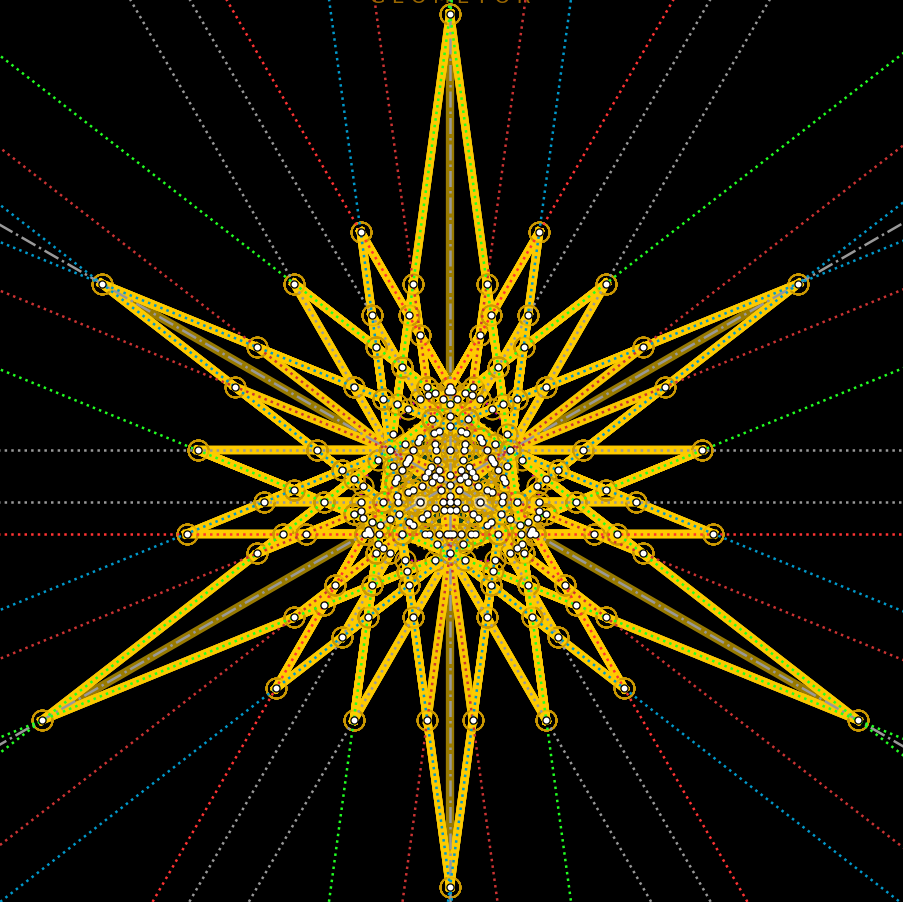
Book V: Normals, Minimum & Maximum Lines, Subnormals & the Evolute
Propositions 84–113 [Classical V. 1–77] — Apollonius of Perga (ed. T. L. Heath, 1896)
Preserved solely through Thābit ibn Qurra's ninth-century Arabic translation (Halley 1710, Nix 1889), Book V is universally acclaimed by historians of mathematics as the supreme masterpiece of ancient synthetic geometry—anticipating differential curvature, centers of osculation, and the evolute of a conic nearly two millennia before Huygens, Leibniz, and Newton.
Sections
1. Normals as Maxima and Minima & the Subnormal Laws [Props. 84–94 / V. 1–34]
Extending Euclid's theorems on the shortest and longest segments from an eccentric point to a circle ([III.7], [III.8]), Apollonius investigates the minimum and maximum straight lines GP drawn to a conic from a point G on its principal axis:
2. Determination of the Evolute Diorismos [Props. 99–100 / V. 51–52]
Proposition 99 [V. 51, 52] — Exact Evolute Threshold. If AM measured along the axis from vertex A be greater than (and in the ellipse less than AC), and if MO be drawn perpendicular to the axis, then a critical length can be assigned by pure cubic/mean-proportional division along the axis such that:
(a) if , no normal can be drawn through O cutting the axis in that quadrant (only 2 normals exist globally on an ellipse);
(b) if , one unique coalesced normal can be so drawn through O (hence O lies directly on the evolute!);
(c) if , two distinct normals can be so drawn in that quadrant (yielding 4 real normals globally on an ellipse, or 3 on the evolute!).
3. Constructing Normals via Apollonius’s Rectangular Hyperbola [Props. 105–106 / V. 58–63]
Because finding the feet Pi of the four normals from Ox0y0 is a solid (degree-4 / cubic-resolvent) problem, Apollonius constructs the normal feet synthetically (V.62–63 [Prop. 106]) by intersecting the given conic with an auxiliary rectangular hyperbola (the Hyperbola of Apollonius) whose asymptotes are parallel to the conic’s axes!