2. Non-Coincidence of Arcs & the Four-Point Intersection Bound [Props. 77–83 / IV. 24–57]
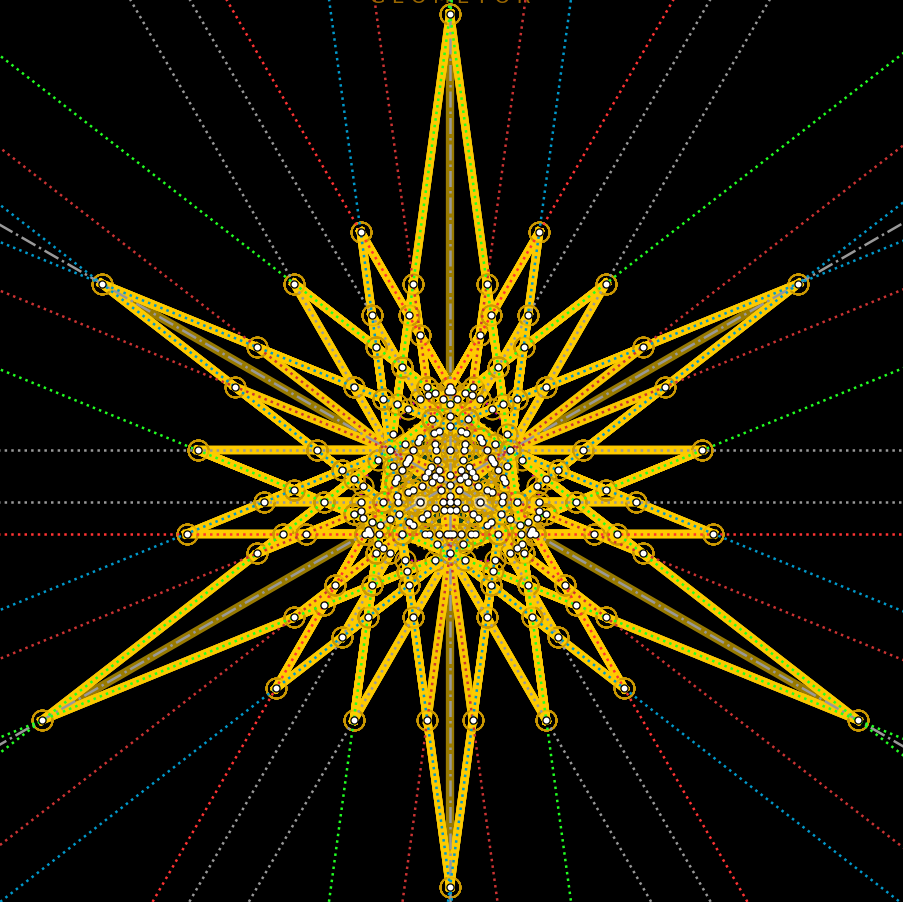
Plate 8 — At Most Four Intersections & the Four-Point Conic Pencil (Book IV.24–57 [Props. 77–83]). Two distinct conics (here an ellipse, a circle, and a two-branch hyperbola) can intersect in at most four pointsABCD; their diagonal triangle EFG is self-polar with respect to every conic in the pencil.
Proposition 77 [IV. 24] — Identity Principle for Conic Arcs. No two conics can intersect in such a way that part of one of them is common to both, while the rest is not. (Proved via chord-bisection diameters: two curves sharing an arc qQPQ must share the same diameter PV and half-chords everywhere.)
Proposition 78 [IV. 25, 38, 43] — Maximum of Four Intersection Points. Two conics (including a circle or a double-branch hyperbola) cannot intersect in more than four points.
Proof Method via Harmonic Polarity: Suppose two conics met in five points ABCDE taken in order along a convex arc. Join AB and CD meeting at T. On both conics simultaneously, the harmonic conjugate of T with respect to AB is a single point M1, and with respect to CD is a single point M2. Hence both conics share the exact same polar line M1M2 of pole T, forcing any fifth common point E to yield contradictory harmonic conjugates on a secant through T!
Propositions 79–83 [IV. 26–57] — Tangency Multiplicity Counting.
- Single Tangency (`Prop. 79 [IV. 26, 41–42, 46]`): Two conics touching at one point cannot intersect in more than two other points ().
- Double Tangency / Bitangency (`Prop. 80 [IV. 27–30, 49–54]`): Two conics touching one another at two distinct points cannot intersect at any other point ().
- Opposite-Branch Separations (`Props. 81–83 [IV. 35–37, 55–57]`): Complete enumeration of how single-branch conics and opposite hyperbolic branches distribute up to four intersections across napes.