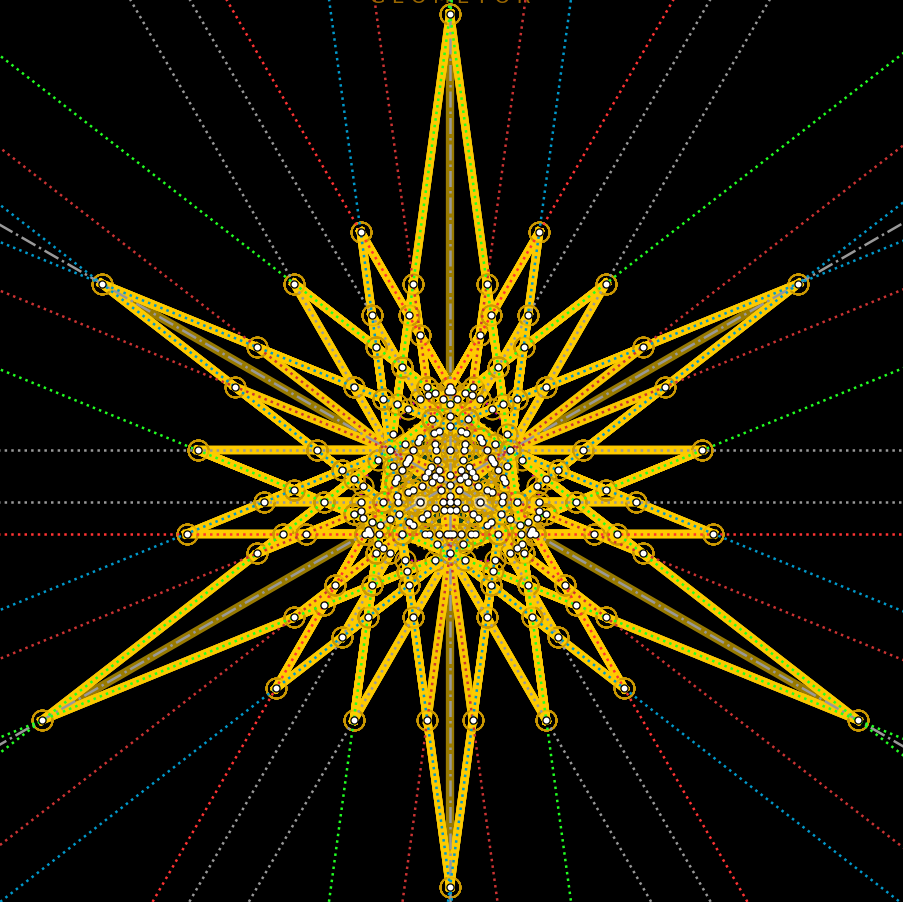
Book IV: Number of Intersections & Tangencies of Conics
Propositions 77–83 [Classical IV. 1–57] — Apollonius of Perga (ed. T. L. Heath, 1896)
In the Preface to Book IV (addressed to Attalus after the death of Eudemus), Apollonius states the exact purpose of the fourth Book: in how many points at most can sections of cones meet one another, or meet the circumference of a circle, whether by simple intersection or by tangency—and in particular how a double-branch hyperbola meets another conic, resolving the polemic between Conon of Samos and Nicoteles of Cyrene.
Sections
1. Converse Harmonic Polarity [IV. 1–23]
Propositions IV.1–23 supply the exact converse of Book III’s harmonic polar theorems (III.30–40): if from an external point T secants meet a conic in RR and harmonic conjugates M of T with respect to RR are marked on each secant, those harmonic conjugates lie along the straight polar chord of contact joining the points of tangency from T—giving a pure straightedge-only construction of tangents!