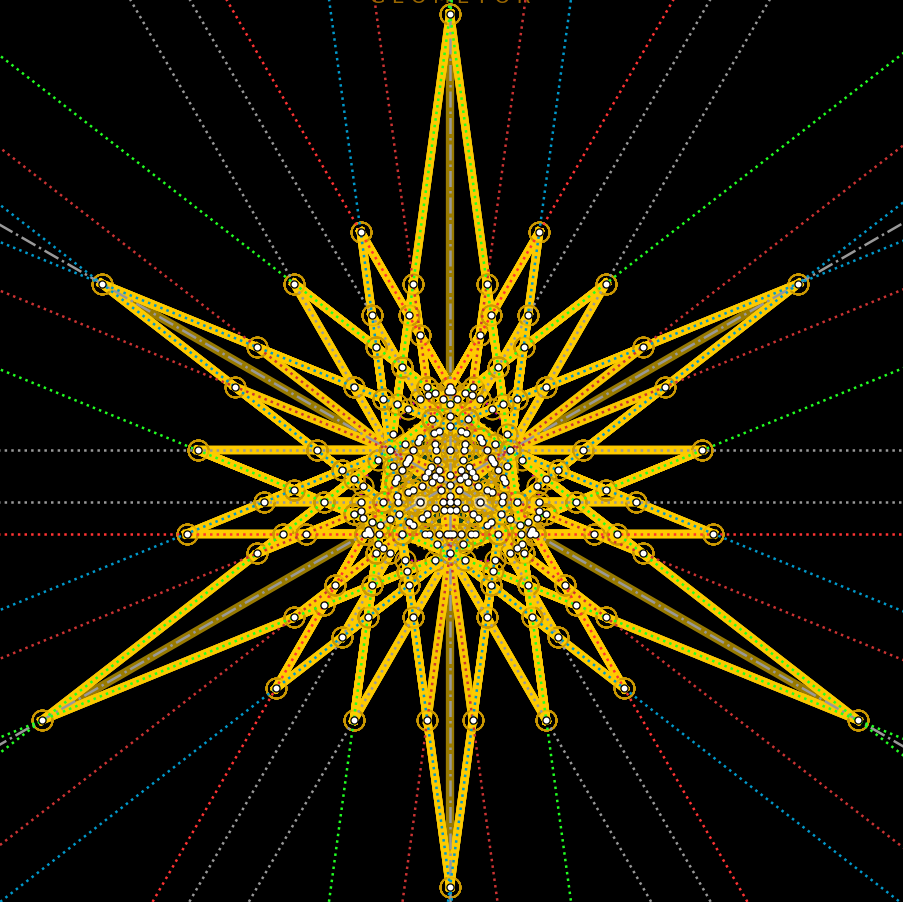
Apollonius of Perga
Original Name / Form: Ἀπολλώνιος ὁ Περγαῖος
Role: ‘The Great Geometer’ (ὁ μέγας γεωμέτρης); author of the Conics
Heath (1896) Loci: pp. lxviii–clxx, 1–254
Contribution: Born at Perga in Pamphylia and educated at Alexandria under the pupils of Euclid; unified the theory of conics by cutting all three curves and the opposite branches from a single arbitrary oblique double cone, coining the enduring names parabola, ellipse, and hyperbola via application of areas.
Born at Perga in Pamphylia around 240 BCE during the reign of Ptolemy III Euergetes and flourishing under Ptolemy IV Philopator (Heath 1896, p. lxviii), Apollonius of Perga studied as a young man at Alexandria under the successors of Euclid. As Geminus (quoted by Eutocius) records, his contemporaries held him in such awe for his mastery of conic sections that they named him simply ὁ μέγας γεωμέτρης — “The Great Geometer.”
From Apollonius’s own epistolary Prefaces (Preface), we trace an unusually vivid intellectual network across the Hellenistic eastern Mediterranean: at Alexandria, prompted by Naucrates, he drafted the initial eight books of the Conics; at Ephesus, he conversed with the Epicurean mathematician Philonides; at Pergamum, home of the Attalid royal library, he dedicated Books I–III to Eudemus of Pergamum and Books IV–VIII to Attalus.
In addition to the Conics and the six analytic treatises preserved in syllabus by Pappus, ancient sources credit Apollonius with proving the geometric equivalence of eccentric and epicyclic planetary models (Ptolemy, Almagest XII.1), comparing the regular dodecahedron and icosahedron inscribed in the same sphere (Elements Book XIV), and calculating closer approximations to in his Quick-Delivery (Ὠκυτόκιον).
GEOMETOR Website: Apollonius of Perga
GitHub Repository: https://github.com/geometor/apollonius