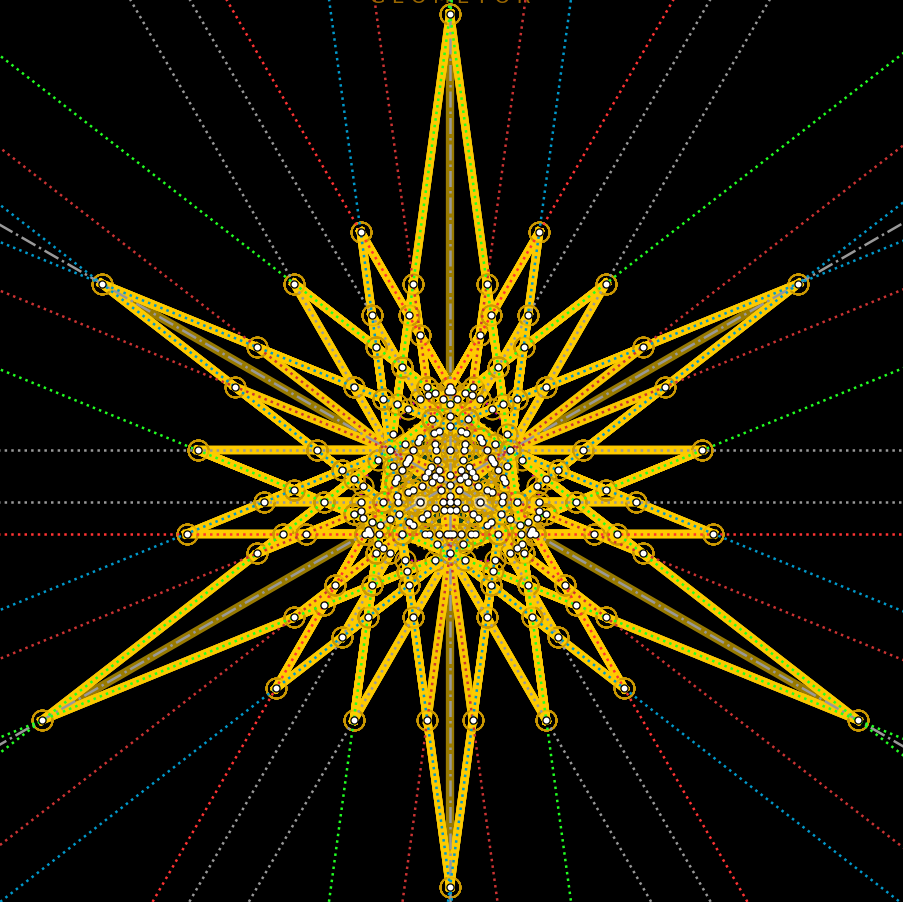
Book III: Chord Rectangles, Poles & Polars, Foci & the 4-Line Locus
Propositions 54–76 [Classical III. 1–56] — Apollonius of Perga (ed. T. L. Heath, 1896)
In the General Preface (Preface), Apollonius singles out Book III with special pride: it contains “many remarkable theorems useful for the syntheses of solid loci and for diorismoi, the majority and prettiest of which are new”, culminating in the long-sought synthesis of the Three-Line and Four-Line Locus.
Five Thematic Pillars of Book III
Tangent & Diameter Area Equalities (`III.1–15 [Props. 54–56]`): Equal triangles cut off by two tangents and the diameters through their contact points.
Power of a Point & Intersecting Chords (`III.16–29 [Props. 57–61]`): for chords in fixed directions—often called Newton’s Theorem despite originating verbatim in Apollonius Book III!
Harmonic Poles & Polars (`III.30–40 [Props. 62–66]`): Every secant through pole T is divided harmonically by the conic and polar Qq: .
Intercepts on Two Tangents by a Third (`III.41–44 [Props. 67–68]`): Projective homography intercepted on two fixed tangents by a variable third tangent ( on central conics; proportional division on the parabola—the exact Bezier/Steiner string construction!).
Central Foci & the 3-/4-Line Locus (`III.45–56 [Props. 69–76]`): - Focal application ; equal reflection angles (III.48); pedal circle (III.49); (III.51–52). - Constant intercept products (III.53–56) synthesizing the Three-Line and Four-Line Locus.
Sections
1. Equality of Tangent Triangles & Intersecting Chord Rectangles [Props. 54–61 / III. 1–29]
Equal Tangent-Diameter Triangles [Prop. 54 / III. 1, 4, 11]: If tangents at P and Q meet at O, and diameters through P, Q meet the opposite tangents in E, T, the triangles OPT and OQE have equal area—the foundational lemma behind every chord-product theorem.
2. Harmonic Properties of Poles & Polars [Props. 62–66 / III. 30–40]
Proposition 64 [III. 37–40] — Universal Harmonic Polar Theorem. If TQ, Tq be two tangents to any conic section (parabola, ellipse, single-branch or opposite-branch hyperbola) and any straight line drawn through T meet the conic in R, R and the chord of contact Qq in M (or conversely if M lie inside the conic on Qq and a secant through M meet the curve in RR and the parallel through T in N), the transversal is divided harmonically:
3. Focal Properties of Central Conics [Props. 69–73 / III. 45–52]
Apollonius introduces the two foci S, S on the principal axis AA without using a word for “burning point” (coined by Kepler in 1604), naming them strictly from his area-application geometry τὰ ἐκ τῆς παραβολῆς γινόμενα σημεῖα ("the points arising out of the application"): apply along the axis AA a rectangle (falling short by a square on the ellipse so , exceeding by a square on the hyperbola so ).
4. The Locus with Respect to Three and Four Lines [Props. 74–76 / III. 53–56]
Plate 7 — The Three-Line and Four-Line Locus (Book III.53–56 [Props. 74–76]). For a point P on a conic inscribed with quadrilateral ABCD, the product of oblique distances to opposite side-pairs maintains a constant ratio (degenerating when two sides coalesce into a tangent and chord of contact to the Three-Line Locus ).