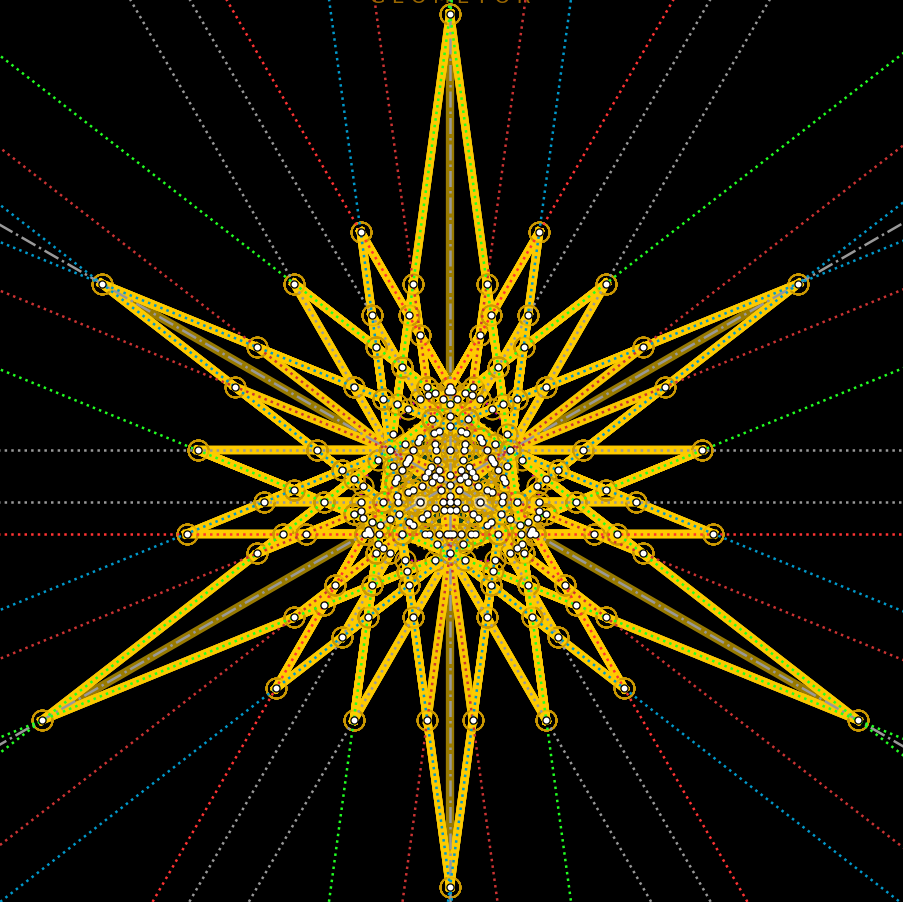
Notes — Book V: Evolutes Without Calculus & Solid-Problem Reduction
1. How Apollonius Derives the Evolute Without Derivatives
In Heath Intro pp. lxxv–lxxvi and pp. 168–179, Heath cautions against anachronistically imagining differential calculus in Book V while marveling at how Apollonius achieves the exact same algebraic envelope by pure Euclidean ratio inequalities ([V.8]):
In Prop. 99 [V. 51] for the parabola, Apollonius divides at N1 in the ratio , i.e., .
Using Euclid’s arithmetic-geometric inequality on three segments (), he shows that the two positive roots of the normal abscissa equation coalesce precisely at N1, which immediately yields —Neil’s semicubical parabola!
For the ellipse and hyperbola (V.52), extracting two mean proportionals (Menaechmus's cube root!) gives !
2. Architectural Relevance to geometor.model
Notice how Apollonius solves a quartic normal problem geometrically in V.62–63: instead of expanding a messy degree-4 trigonometric polynomial in , he intersects the given conic with the Hyperbola of Apollonius . In geometor.model, representing conics by exact symmetric matrices allows normal-foot construction from any rational point O to be expressed directly as the intersection of two exact quadrics !