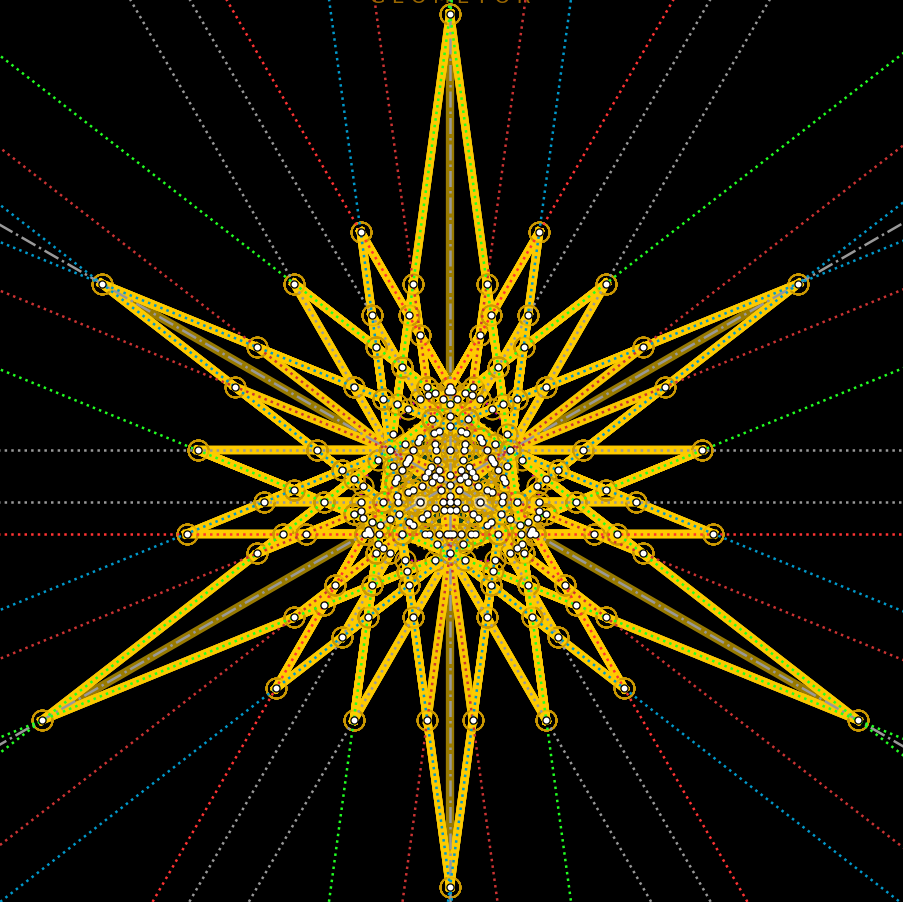
Notes — Book IV: Bézout’s Theorem, Five-Point Uniqueness & Pencils
1. Ancient Precursor to Bézout’s Theorem & Five-Point Conics
Book IV (IV.24–57) is the direct synthetic ancestor of Bézout’s Theorem for degree-2 plane curves (), generalizing Euclid's [III.10] (“A circle does not cut a circle at more points than two”—which holds only because every circle already passes through the two complex circular points at infinity , leaving finite intersections!).
Moreover, IV.25 (Prop. 78) immediately implies uniqueness of the conic through five general points (Heath Intro Ch. VI, pp. cli–clvi): no two distinct conics can pass through the same five points in general position, complementing Pascal's Hexagrammum Mysticum (1640) and Pappus's five-point ellipse construction in Synagoge VIII.
2. Desargues’s Involution & the Self-Polar Diagonal Triangle
Look closely at Apollonius’s proof technique in IV.25–57: given four intersection points ABCD, the intersection TABcapCD has the exact same polar line with respect to every conic passing through ABCD! In modern projective geometry (geometor/pappus), the three diagonal points EABcapCD, FACcapBD, GADcapBC of the complete quadrangle ABCD form a common self-polar triangle for the entire pencil , reducing the quartic intersection of two conics algebraically to solving a single resolvent cubic !