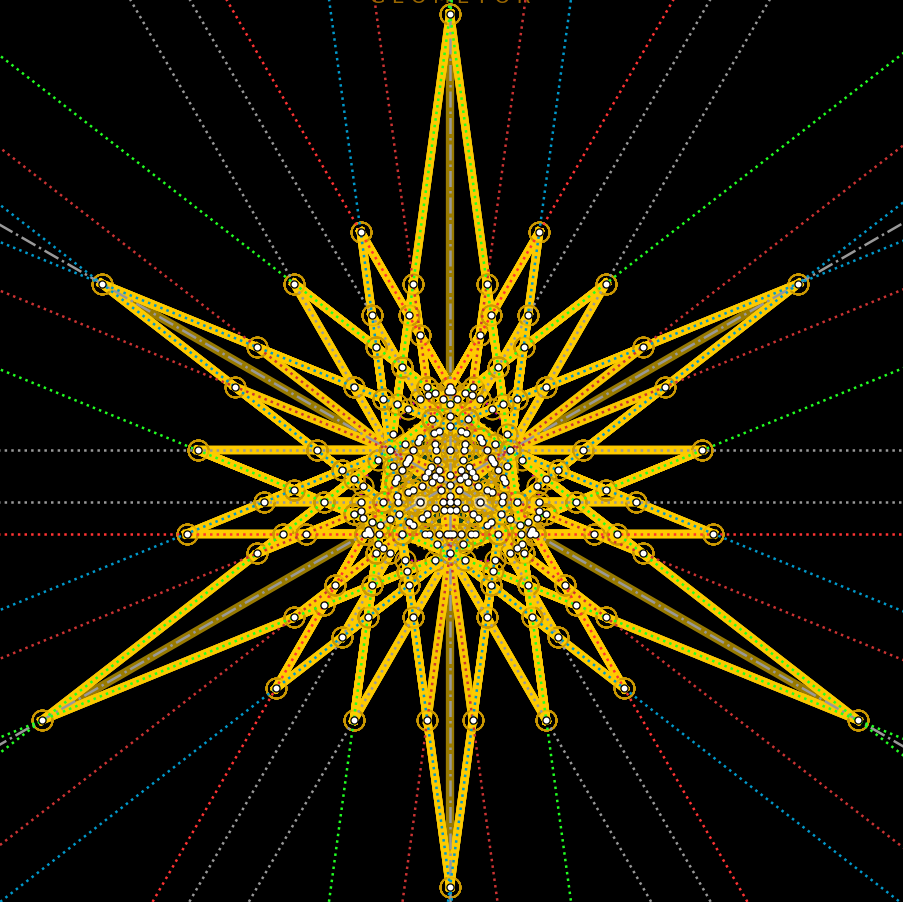
Notes — Book III: Why Apollonius Omitted the Parabola Focus, Lean Polarity & Descartes
1. Why Book III Omits the Focus of the Parabola
Every attentive reader of Book III.45–52 asks why Apollonius proves the optical reflection property and focal properties for the ellipse and hyperbola, yet never mentions the focus of the parabola (treated contemporaneously by Diocles in On Burning Mirrors and via focus-directrix in Pappus, Synagoge VII.238):
Apollonius defines the foci SS strictly as "the points arising out of the application" along the finite two-vertex transverse axis AA ().
Because the parabola has no center C and no second vertex A at finite distance, a two-vertex area application along AA cannot even be stated without passing to the projective limit (, placing S at distance from the vertex, as Kepler first articulated in 1604)!
2. Bridge to geometor/pappus & Lean mathlib4 (PolePolar.lean)
Propositions 62–66 (III.30–40) are the historical birthplace of projective polarity:
In homogeneous coordinates with symmetric conic matrix , the polar of T is the linear form , and harmonic cross-ratio holds over any field of characteristic —formalized algebraically in Lean 4’s Mathlib QuadraticForm.PolePolar and modeled constructively in
geometor/pappus.Crucially,
sympy.geometrystill lacks general conic polar_line and pole_point methods—one of the primary capabilities catalogued in our Concordance Gap Audit.
3. From Book III.53–56 to Pappus VII & Descartes’s La Géométrie (1637)
In Book III (III.41–43 too!), Note Prop. 67 [III. 41] already gives the quadratic Bézier / Steiner tangent envelope of a parabola ()! And III.53–56 (Props. 74–76), preserved alongside Pappus's commentary in Synagoge VII (Hultsch 1877), inspired René Descartes (1637) to translate oblique distances into bivariate polynomial equations , founding modern algebraic geometry.