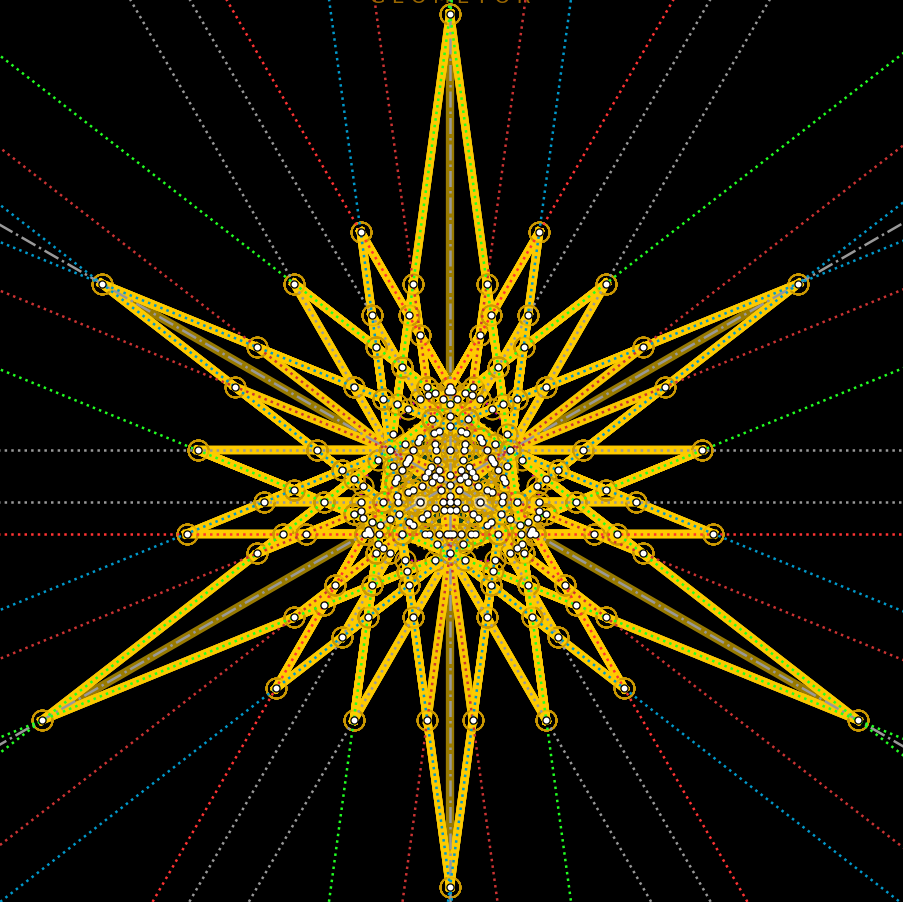
Geometry of Position¶
Geometrie der Lage (Nuremberg, 1847) — Karl Georg Christian von Staudt
“I have therefore attempted in the present treatise to make the Geometry of Position an autonomous science that stands in no need of measurement.”
—Karl Georg Christian von Staudt, Geometrie der Lage (1847), Vorwort
Preface (Nuremberg, August 1847)
In modern times Geometrie der Lage (Geometry of Position) has rightly been distinguished from the Geometry of Magnitude (Geometrie des Maßes); nevertheless, propositions in which no magnitude whatever is mentioned have commonly still been proved by means of considerations of ratio and distance. I have therefore attempted in the present treatise to make the Geometry of Position an autonomous science that stands in no need of measurement.
§ 1. Space, Surfaces, Lines, and Points (arts. 1–15)
Art. 1. Geometry treats of space and of spatial configurations: bodies, surfaces, lines, and points. Every body is bounded by surfaces; two adjacent portions of a surface meet along a line; two adjacent portions of a line meet in a point. Conversely, a moving point generates a line, a moving line (not sliding strictly along itself) generates a surface, and a moving surface generates a spatial region.
§ 2. Parallelism and Infinitely Distant Elements (arts. 16–22)
Art. 16. All straight lines in space that are parallel to a given straight line $g$ share a common direction (Richtung). Two parallel lines lie in a common plane and meet nowhere in finite space; three lines parallel to one and the same line are mutually parallel and form an axial sheaf of parallels (Parallelstrahlenbündel).
§ 3. The Law of Reciprocity (arts. 23–35)
Art. 25 (§ 3). Once ideal elements are adjoined, all fundamental incidence propositions of three-dimensional space exhibit an exact Law of Reciprocity (Gesetz der Reciprocität): every theorem remains valid when the words point and plane are interchanged throughout while straight line remains unchanged (join of two points $\leftrightarrow$ intersection of two planes; collinear points $\leftrightarrow$ coaxial planes). Within a single fixed plane, point and straight line exchange roles directly.
§ 4. Cyclical Order and Mutual Separation (arts. 36–44)
Art. 36 (§ 4). Every closed projective straight line is a single returning cycle (geschlossene Linie): a single point $A$ does not divide the projective line into two severed halves, because one may pass from one side of $A$ to the other through $P_\infty$. Two distinct points $A$ and $B$ divide the entire projective line into two complementary segments; two pairs $(A, B)$ and $(C, D)$ are mutually separating when each segment bounded by $A, B$ contains one point of $(C, D)$.
§ 5. Uniform Fundamental Forms and Perspectivity (arts. 45–53)
Art. 45 (§ 5). Geometry builds all higher projective configurations out of three Uniform Fundamental Forms (einförmige Grundgebilde) of the first grade:
§ 6. Complete Plane Quadrangles and Harmonic Forms (arts. 66–74)
Art. 66. Four points $E, F, G, H$ lying in one plane, no three of which are collinear, determine six connecting lines called sides (Seiten), which group into three pairs of opposite sides:
§ 7. Perspective Projection of Harmonic Tetrads (arts. 75–84)
Art. 76 (§ 7). Every perspective projection between a range of points and a flat pencil of rays, or between two ranges, carries every harmonic tetrad into a harmonic tetrad; for the four projecting planes or rays from an external center carry a complete quadrangle directly into a corresponding harmonic configuration.
§ 8. Pure Synthetic Projectivity & The Fundamental Theorem (arts. 85–98)
Art. 93 (§ 8 — Pure Synthetic Definition of Projectivity). Two uniform fundamental forms are called projectively related (projektivisch) when their elements are placed in one-to-one correspondence so that to every four harmonic elements of the one correspond four harmonic elements of the other.
§ 9. Involutions in Uniform Fundamental Forms (arts. 103–115)
Art. 103. When a non-identical projectivity of a uniform fundamental form onto itself interchanges even a single pair of distinct elements ($A \mapsto A'$ and $A' \mapsto A$), it interchanges every element with its image ($X \leftrightarrow X'$) and is called an involution (Involution).
§ 18. Planar Polar Systems (arts. 235–241)
Art. 235 (§ 18 — Planar Polarity). A reciprocal correspondence (Reciprocität or correlation) in a plane assigns to every point $P$ a unique straight line $p = \pi(P)$ and to every straight line $g$ a unique point $G = \pi(g)$ such that collinear points correspond to concurrent lines and harmonic tetrads of points correspond to harmonic pencils of four rays. When this correspondence is involutory—so that whenever $Q$ lies on the line $\pi(P)$, $P$ likewise lies on the line $\pi(Q)$—it is called a planar polar system (ebenes Polarsystem), $P$ is the pole (Pol) of $p$, and $p$ is the polar (Polare) of $P$.
§ 19. Curves of the Second Order & Polar Generation (arts. 242–257)
Art. 242 (§ 19 — Von Staudt’s Intrinsic Definition of Conics). In a planar polar system $\pi$, either no point lies upon its own polar (elliptic polar system), or infinitely many points lie upon their own polars (hyperbolic polar system). In the latter case: