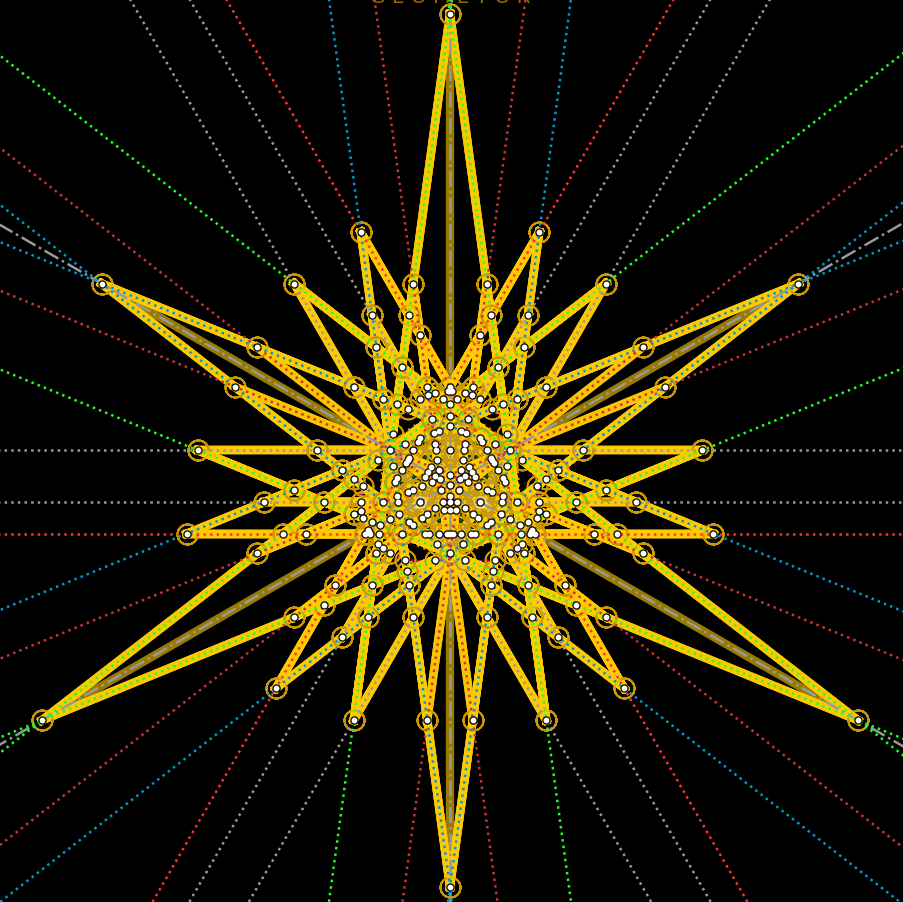
Section 2 · Summary
Geometric Principles of Section 2
Horizon Representation on the Astrolabe: - The local horizon for observer latitude $\varphi$ is an inclined great circle on the celestial sphere whose pole is the Zenith. - Like the oblique ecliptic, the projected horizon cuts the equatorial plane in an eccentric circle whose center lies along the local meridian line.
Preservation of Diametrical Bisection: - Every great circle on the sphere bisects every other great circle into two equal semicircles ($180^\circ$). - On the stereographic plane, the horizon bisects the equator at the East and West points of the horizon ($a$ and $g$). - Points $z$ and $h$ along any meridian diameter satisfy the inversion relation $ze \cdot eh = ed^2 = R_{\text{eq}}^2$. - By right-angle geometry at pole $t$, lines $tk$ and $tl$ project antipodal points on the sphere to points $z$ and $h$ in the plane, proving that the projected horizon bisects the zodiac into six rising signs and six setting signs.