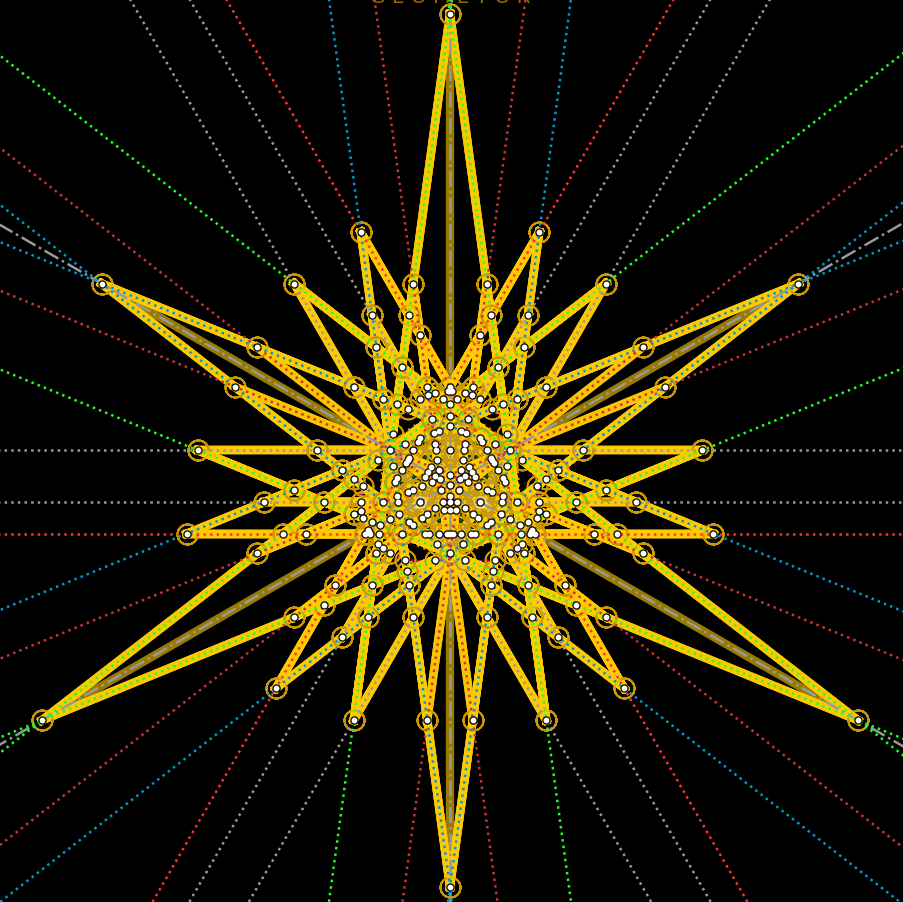
Section 1 · Summary
Geometric Principles of Section 1
The South-Pole Stereographic Projection: - Center of projection: The South Celestial Pole $S = (0, 0, -R)$ on the sphere $S^2$. - Projection plane: The equatorial plane $Z = 0$, centered at the North Celestial Pole $e = (0, 0, 0)$. - Ray mapping: A point $P = (X, Y, Z)$ on the celestial sphere is mapped along line $SP$ to equatorial intersection $(x, y)$:
$$(x, y) = \left(\frac{R\,X}{R + Z},\; \frac{R\,Y}{R + Z}\right).$$
Concentric Parallels: - Celestial equator: Projects to fixed circle $abgd$ with radius $R_{\text{eq}} = 60^p$. - Northern parallels ($Z > 0$, e.g. Tropic of Cancer): Project inside the equator with radius $r_{\text{Can}} < R_{\text{eq}}$. - Southern parallels ($Z < 0$, e.g. Tropic of Capricorn): Project outside the equator with radius $r_{\text{Cap}} > R_{\text{eq}}$.
Theorem on Ecliptic Bisection: - The oblique ecliptic circle meets the solstitial colure at summer solstice $t$ and winter solstice $m$. - The diameter $tm$ has center $r = \frac{1}{2}(t + m)$. - When viewed from South Pole $d$, the intercepted arc between the solstices on the sphere is a semicircle ($180^\circ$). - By Eucl. III.31, the inscribed angle $\angle mdt$ is a right angle ($90^\circ$). - Therefore, the circle described on diameter $tm$ must pass through vertex $d$—and by symmetry through $b$—bisecting the equatorial circle in the plane!